
Your buyers ask ChatGPT which tools to try before they ever open Google.
When the answers come back, your competitors get named, and you don’t.
Someone on your team suggests hiring a GEO content writer. The problem is that the role is still loosely defined, which makes it hard to know what the person should do or how to evaluate them.
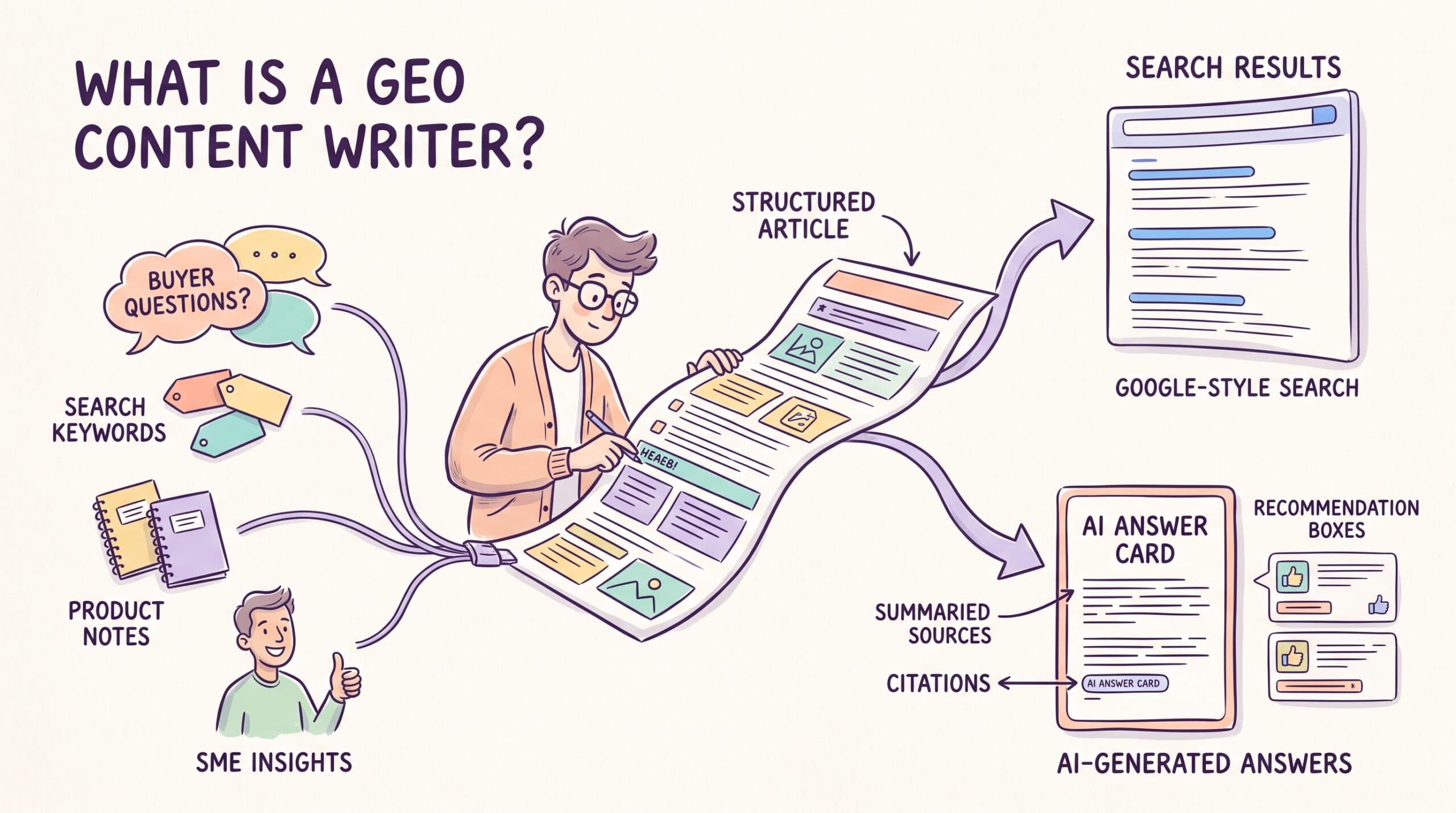
A GEO content writer creates content designed to perform in traditional search while improving a brand’s chances of being mentioned, cited, or recommended in AI-generated answers.
Despite the new title, the foundations have not disappeared. Google says its generative search features still rely on its existing Search index, ranking systems, and quality signals. From Google’s perspective, work described as GEO or AEO remains part of SEO.
I’ve written SEO content for B2B SaaS companies for over five years, and I now consciously build AI visibility into every article I produce.
This guide explains what a GEO content writer does, how the work differs from traditional SEO writing, the exact process I use, and how to decide between a freelancer, an agency, and an in-house hire. If you’re already comparing people, here’s who can write SaaS content that ranks on ChatGPT and Google.
What does GEO stand for?
GEO stands for generative engine optimization.
The term became widely known after a 2023 research paper introduced GEO as a framework to improve the appearance of content in AI search responses. The researchers studied how changes to a page could affect its visibility when a generative engine combined information from several sources.
Traditional search engines usually give you a ranked list of pages.

Generative engines can retrieve information from various sources, combine it, and produce a direct response. Your company may appear as a citation, a recommendation, an example, or part of a comparison.

It may also be left out completely.
GEO covers the work involved in improving your presence within those answers.
That work can include:
- Understanding what your buyers ask AI tools
- Creating original content around those questions
- Making your product and category easier to understand
- Publishing evidence that supports your claims
- Earning relevant third-party coverage and mentions
- Monitoring which brands and sources appear in important answers
- Updating content as the answer landscape changes
A content writer handles the parts of that work connected to research, briefing, writing, editing, on-page optimization, and content refreshes.
What is a GEO content writer?
A GEO content writer creates content that helps a company become more visible wherever its buyers search for information. That includes traditional search engines such as Google and AI-driven experiences such as ChatGPT, Perplexity, Gemini, Google AI Overviews, and AI Mode.
Side note: “GEO” also gets used for geographic or local content, which is part of why the search results for this term are such a mess. In this article, GEO means content written for generative AI answers.
The role is best understood as an SEO content writer with extra layers, not a new profession.
When Messi moved deeper into midfield later in his career, he kept everything that made him a forward and added new responsibilities on top.
GEO writers work the same way. The research, interviewing, and editorial skills stay. What gets added is prompt research, heavier sourcing standards, clearer entity and product information, and a habit of checking what AI engines say about the topic before and after publishing.
You can see this in how companies hire for the role. Job listings for “SEO and GEO writers” at SaaS companies and growth agencies ask for the same core skills that SEO writing has always required, plus experience optimizing content for AI search.
Alongside keywords and ranking pages, the writer may review:
- Questions people ask AI tools
- Follow-up questions generated during a conversation
- Brands commonly recommended for a use case
- Websites cited as supporting sources
- Language used to describe the product category
- Gaps or inaccuracies in existing answers
- Sources shaping how AI systems understand a market
The finished article should work for the person reading it. Making a page useful only to a crawler, retrieval system, or language model misses the point.
What does a GEO content writer do?
A GEO content writer helps a company turn the questions buyers ask into content that can perform across Google and AI-generated answers.
That starts with understanding demand. The writer looks at traditional keywords, but also studies comparison prompts, conversational questions, and the follow-up queries buyers may ask while researching a product.
They review which brands appear, how those brands are described, and which sources influence the answers.
Research alone is not enough. The writer also needs information worth adding to the conversation.
That may come from product documentation, subject-matter expert interviews, customer conversations, or internal data. These inputs help the article move beyond information already repeated across competing pages.
The writing itself should give readers clear explanations and useful examples. Where the company’s product is relevant, the writer can include screenshots, workflows, customer evidence, and honest limitations.
Claims should be accurate, properly sourced, and understandable when a section is read outside the context of the full article.
A GEO content writer may also prepare the page for publication by improving the title, headings, internal links, metadata, image descriptions, and CTA.
After publication, the work shifts towards performance. Rankings and conversions still matter, but the team may also track AI mentions, citations, competitor visibility, and changes in how important prompts are answered.
The role covers more than writing a draft and adding keywords. A GEO content writer connects search research, original information, product knowledge, content production, and post-publication analysis.
What is the difference between a GEO writer and an SEO writer?
The two roles overlap heavily.
An SEO content writer researches and creates content intended to rank in search engines and support business goals.
A GEO content writer keeps those responsibilities while paying closer attention to how AI systems retrieve, combine, and present information.
| Area | SEO content writer | GEO content writer |
| Research | Keywords, SERPs, and competitors | Keywords, prompts, AI answers, cited sources, and competitors |
| Visibility goal | Rankings and organic traffic | Rankings, AI mentions, citations, and qualified visibility |
| Content inputs | Search data and ranking pages | Search data, product access, SMEs, customer evidence, and answer-engine research |
| Optimisation | On-page SEO and search intent | On-page SEO, answer clarity, source quality, and entity understanding |
| Measurement | Rankings, traffic, and conversions | Rankings, traffic, conversions, mentions, and citation patterns |
| Refresh process | Update declining or outdated pages | Update search performance, product information, and AI answer coverage |
The overlap is the point.
Google’s guidance on its generative AI search features states that AI Overviews and AI Mode draw on its existing search index, ranking systems, and retrieval methods.
A writer who skips SEO fundamentals to chase AI citations is building on nothing.
The data backs this up too. Semrush’s 2026 AI Visibility Index surveyed organizations on how they structure this work.
Among teams that run SEO and AI visibility as a single integrated workflow, 81% reported increased traffic or leads from AI platforms.
Among teams that manage them as separate projects, only 36% said the same. One writer handling both jobs within a single process is the smallest possible version of that integration.
How to write GEO-friendly content: my 7-step process
GEO-friendly content gets written through a process, not a checklist of formatting tricks.
The seven steps below are what I follow for every article I produce for B2B SaaS clients.
1. Map the questions buyers ask
I start with traditional keyword research, then layer prompt research on top.
The difference shows up fast.
Someone shopping for payroll software types “best payroll software” into Google.
Their ChatGPT conversation looks different: which payroll tools suit a 50-person remote company, what sets Deel apart from Remote, and whether there’s a cheaper alternative to their current provider.
Those prompts reveal the criteria, concerns, and comparisons that a keyword tool never surfaces.
AI engines also run query fan-outs, generating several related searches behind the scenes to answer one broad question.
So I map the surrounding prompts along with the head term, and I pull questions from sales calls and support tickets while I’m at it.
For the commercial end of this research, I’ve written a full guide on finding bottom-of-funnel keywords.
2. Review the existing answer landscape
Before outlining, I check what Google ranks and what AI engines say for each target query.
I run the prompts in ChatGPT, Perplexity, and Google AI Mode and note which companies get named, which pages get cited, how products get described, and which sources keep recurring.
Two things I watch for: answers that repeat an inaccurate or outdated claim, and answers that all sound the same. Both are openings. Reddit threads, review platforms, and YouTube often show up where you’d expect blog posts.
The aim here is to find a useful angle that the existing results have missed.
3. Find the information gap
Every query has existing answers. The job is to find what those answers miss. It could be pricing details, real product limitations, expert commentary, an honest comparison, or a clearer definition.
4. Gather product and subject-matter expertise
This step separates citable content from summaries of other summaries.
I may interview subject-matter experts, use the product, review documentation, study customer conversations, and pull examples from internal data.
An expert can explain why customers struggle with a particular workflow. Product access enables the inclusion of real screenshots and accurate steps. Sales and support conversations often reveal questions that never show up in a keyword tool.
AI systems already know everything publicly available about a topic, so the only content worth citing is what adds something they haven’t seen.
5. Create the brief
The content brief gives the article direction.
It should clarify who the reader is, what they are trying to do, and why the topic matters to the business.
The brief also maps the questions the article needs to answer, the sources it should use, the internal pages it should link to, and the places where the product belongs.
Commercial intent matters here.
A broad educational guide should not force a demo CTA after every section. A comparison article aimed at buyers choosing between vendors needs much more product detail and a clearer route to the next step.
The brief connects the reader’s needs with the job the page is expected to do.
6. Write and optimize the article
Once the research and structure are in place, I turn them into a clear, useful article.
GEO writing should still feel like good writing.
The original Generative Engine Optimization research from Princeton and IIT Delhi found that techniques like adding statistics and citing sources boosted visibility in generative engine responses by up to 40% in their tests, with results that varied by domain.
Here’s how those findings translate into writing decisions:
- Open every section with the answer. I give each H2 a direct 30-to 80-word response before expanding with examples and data. AI systems lift self-contained passages, and readers get the point without scanning.
- Write sections that survive out of context. Each H2 block should make sense if it’s the only thing someone reads, whether that someone is a reader landing mid-page or an AI system quoting one passage. This doesn’t mean writing disconnected answer blocks. The article still has to flow from one idea to the next, or it reads like a glossary built for machines.
- Use specific numbers instead of vague claims. “Cuts average response time from 4 minutes to 45 seconds” is better than saying “Improves efficiency.”
- Name your sources. “Semrush’s 2026 study found” beats “experts believe” for readers and for AI systems checking whether a claim can be verified.
- Make the product earn its place. A vague paragraph about how the platform streamlines workflows adds nothing. Showing how a specific feature solves the problem for the reader makes the content more useful and gives AI systems clearer information about what the company does.
- Use formatting as an editorial decision, not a ritual. Tables, definitions, and FAQs help when the topic calls for them. Adding a table to every article because AI tools supposedly prefer tables is a poor substitute for judgment.
- Skip the hacks. Google’s guidance is direct on this: there’s no special markup, no llms.txt file, no required page length, and no “chunking” format that earns inclusion in AI features. Anyone selling you a secret GEO formatting system is selling you a formatting system.
7. Prepare the page for publication
I also handle the on-page elements surrounding the draft.
This can include the title, meta description, headings, internal links, image notes, alt text, source checks, and CTA.
Sometimes I flag opportunities for structured data or recommend additional pages the article should connect to.
8. Measure and refresh after publication
After publishing, I track rankings and conversions as usual, then spot-check the target prompts in ChatGPT, Perplexity, and Google AI Mode monthly.
For example, this is a check for the best freelance writers for B2B SaaS companies. My GEO work has earned me a place on the list.

Dedicated AI visibility tools can automate prompt tracking once there’s enough content to justify one.
Using RankShift, for instance, I can see which prompts I’m most visible in.

The findings drive the refresh work: a section that needs more depth, a claim that has aged out, or a competitor getting recommended for a use case the article doesn’t cover yet. When the answers change, or when the product does, the page gets updated rather than left to sit.
What GEO content writing is not
The term is new enough that almost any content tactic can be packaged as GEO.
A few claims deserve more scrutiny.
It is not a guaranteed way to earn citations
No writer can promise that ChatGPT, Perplexity, Gemini, or Google will cite a specific page.
The systems change, the answers can vary between users, and companies do not have access to the internal mechanisms controlling every response.
Writers can improve the quality, clarity, relevance, and accessibility of your content. They can also help you understand where your brand is absent and create stronger assets around those gaps.
A guaranteed citation should make you cautious.
Google gives similar advice when hiring an SEO. It recommends requesting prior work, discussing how results will be measured, and avoiding providers that guarantee first-place rankings.
It is not a license to ignore SEO
Your page still needs to be discovered, crawled, indexed, and understood.
Backlinks, internal links, and search intent all still matter. Technical problems can still prevent a good article from performing well.
Google’s generative search experiences retrieve information from its Search index, making existing SEO foundations relevant to AI Overviews and AI Mode.
You should be suspicious of anyone selling GEO as a complete replacement for SEO.
It is not mass-producing every prompt variation
AI tools may generate hundreds of possible questions around a topic.
Creating a separate page for every minor variation can leave you with a large collection of thin, repetitive articles.
One comprehensive guide may answer several related questions. Another prompt may deserve a dedicated comparison, use-case page, or product tutorial.
The decision should be based on how much the reader’s needs change, not on the number of prompts a tool exports.
When should you hire a GEO content writer?
Hire one when buyers are asking AI tools questions your content doesn’t answer, and your team lacks the time or process to fix that. A few situations make the decision easier:
- Your SEO content drives traffic but rarely appears in AI answers, while competitors are recommended when buyers ask about your category.
- Your writers primarily draw on competitor articles and AI research, so product knowledge never makes it into the content.
- You’ve bought an AI visibility tool, but nobody turns its data into articles.
- You have a backlog of comparison, alternatives, and use-case topics that keep getting pushed to the next quarter.
- Existing articles rank but read like they were written for 2022 search behavior.
A note on expectations. Semrush’s traffic channel study found that AI referral traffic grew 66% in 2025, faster than any other channel, while still accounting for under 0.15% of total web visits.
The volume is small. The visitors tend to arrive pre-qualified, though, because the AI has already compared their options for them.
GEO content is a bet on where buying research is heading, funded by SEO content that pays for itself today. If a writer pitches it as a replacement for your organic channel, that’s your first red flag.
How to evaluate a GEO content writer (and the red flags)
Evaluate a GEO writer the way you’d evaluate any freelance writer, then add the AI-search layer. A strong candidate can:
- Explain how GEO overlaps with SEO without pretending they’re separate disciplines
- Show published SEO or product-led content with results attached
- Describe their prompt research process beyond “I asked ChatGPT”
- Work with subject-matter experts and your product, not just competitor articles
- Tell you plainly what they can’t control, including whether any specific AI engine cites the page
- Measure more than screenshots of one prompt on one day
The red flags are just as specific.
Walk away from anyone offering guaranteed ChatGPT rankings, a fixed GEO checklist applied to every article, an obsession with llms.txt or special AI markup, or ordinary AI-generated content rebranded as GEO.
Should you hire a freelancer, agency, or in-house GEO writer?
The right setup depends on how much help you need.
Hire a freelance GEO content writer
A freelance writer is the right fit when you have strategy or content leadership in place and need specialist execution.
Someone who can take a topic, run the research, talk to your SMEs, and deliver publish-ready articles without hand-holding.
The relationship is usually direct. You speak with the person researching and writing the content, which can make it easier to share feedback and build product knowledge over time.
This is the work I do. One article I wrote for Zapier ranks #1 and saves them around $20K a year in ad spend, and that was before I added the AI visibility layer to my process. If you’re weighing this model, hiring a B2B SaaS content writer starts with defining the job, then testing candidates on a paid trial article.
A freelancer works well when your team has a strategy and needs someone to handle execution.
You can hire them for a group of priority articles, an ongoing monthly retainer, or a refresh project.
Hire a GEO agency
An agency may be a better fit when the project includes technical SEO, digital PR, content strategy, link acquisition, analytics, and a high volume of production.
Ask who will write the content and how much access you will have to them.
Expect to pay for account management as well as the writing. I’ve broken down the trade-offs in my agency vs. freelancer comparison.
Hire an in-house writer
An in-house hire makes sense when you have enough consistent work to fill the role.
They can build deep institutional knowledge, work closely with product teams, and contribute to projects beyond search content.
Train your current SEO writers
Your existing writers may already have many of the required skills.
Strong researchers can learn to review AI answers, map prompts, evaluate citations, and incorporate GEO monitoring into their process.
Training works well when the writers already understand the product and consistently produce useful content.
If you want specific names to compare, I’ve put together a roundup of the best AEO writers for SaaS with notes on who fits which situation.
Hire a GEO content writer for your B2B SaaS company
I’m Nathan, a freelance content writer for B2B SaaS companies.
I help content teams produce the articles buyers read while researching a problem, comparing products, and deciding what to do next.
That includes:
- Comparison and alternatives content
- Best-of and category articles
- Product-led how-to guides
- Use-case content
- SEO and GEO content refreshes
I’ve written for companies including HubSpot, Zapier, Paddle, Vimeo, Softr, Hotjar, and ButterCMS.
You bring the product context and goals. I handle the research, outline, writing, sourcing, product integration, and on-page optimization.
The result is useful content built to rank when buyers search and show up when AI answers.
Frequently asked questions about GEO content writing
Can a regular SEO writer create GEO content?
Yes. A strong SEO writer already understands many of the skills involved, including search intent, keyword research, content structure, sourcing, and on-page optimization.
They will need to expand their process to include AI prompt research, answer analysis, reviews of cited sources, product evidence, and AI visibility measurement.
Is GEO replacing SEO?
No.
AI search has changed how people discover information, but traditional SEO remains part of the process.
Generative search experiences are built on its existing Search ranking and quality systems. A page still needs to be accessible, useful, and eligible to appear in Search.
Can a GEO writer guarantee ChatGPT citations?
No writer can guarantee that a particular AI tool will cite your page.
A writer can improve the quality and relevance of your content, address information gaps, add original expertise, and make your company easier to understand.
The final answer remains outside their control.
How do you measure GEO content performance?
Measurement can include AI mentions, citations, share of answers, branded visibility, organic rankings, traffic, conversions, and individual page performance.
Choose the metrics based on the commercial goal of the content instead of treating every citation as equally valuable.
What tools does a GEO content writer use?
A writer may use keyword platforms, AI visibility trackers, search engines, answer engines, analytics tools, Search Console, interview software, and your product documentation.
The toolset matters less than how the writer turns the information into a useful article.
How much does a GEO content writer cost?
Expect rates similar to those of experienced SEO writers, roughly $0.30 to $1+ per word or $500 to $2,000+ per article, depending on research depth, interviews, and the writer’s track record. I’ve published a full breakdown of freelance B2B content writer costs if you’re budgeting for this.