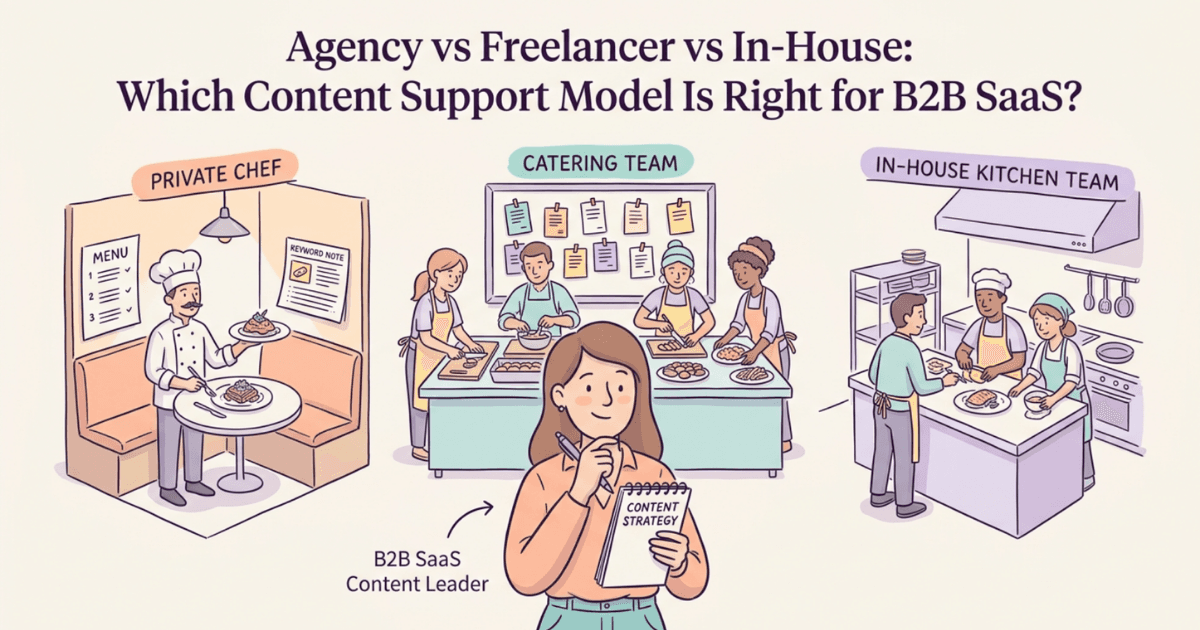

Choosing between a freelancer and an agency is a bit like deciding whether to hire a private chef or a catering company.
Neither is automatically the right call. It depends on the occasion.
If you’re hosting a 400-person wedding, a catering company probably makes more sense. You need a team, a process, backup, logistics, and enough capacity to serve everyone.
But say you’re having a few close friends over for dinner; a private chef may be the better fit. You get a more tailored experience, direct access to the person doing the work, and less logistics involved in the meal.
The freelancer vs. agency decision works the same way.
I’ve been a freelance B2B SaaS content writer for five years. I’ve had clients come to me after burning through an agency retainer for six months and getting content they had to rewrite before publishing. I’ve also worked with teams that clearly needed an agency once their program outgrew what a single writer could handle.
Both decisions made sense given the context. The problem in both cases was picking a vendor type before diagnosing the actual bottleneck.
This piece covers all three options—freelancer, agency, and in-house—and helps you figure out which one fits where your content program is right now.
First, define the content job you need done
Before you compare agencies and freelancers, name the job.
A marketing team that needs a full SEO strategy has a different problem from a team with 20 approved topics and no writing capacity.
Your team may need help with:
- Content strategy
- Keyword research
- Briefs and outlines
- Product-led SEO articles
- Bottom-funnel content
- SME interviews
- Content refreshes
- Editing
- Reporting
- Design and publishing support
The right support model depends on which of those jobs is missing.
I usually see this decision show up when a content leader has too much work sitting between “good idea” and “published article.”
The strategy may exist, and approved topics are sitting in an Excel sheet. Still, the work is stuck because nobody has enough time, product information, or writing bandwidth to get the piece across the line.
That is where the freelancer vs. agency question gets practical.
What a freelancer gives you
A freelancer gives you direct access to an individual specialist.
That person may help with writing, editing, strategy support, briefs, refreshes, or a specific type of content. The best freelancers are not just “hands on keyboard” or foot soldiers. They bring judgment, process, and enough curiosity to improve the draft before writing starts.
For B2B SaaS teams, the direct relationship is a major advantage.
You can talk to the person doing the research. Feedback goes straight to the writer. And product context does not have to travel through an account manager, strategist, editor, and three Slack summaries before reaching the person responsible for the draft.
I’m biased, obviously. But the best freelance relationships work because the company gets senior support without turning the content process into a town hall meeting.
A freelancer works especially well when your team already has a content strategy and needs a reliable person to execute against it.
What an agency gives you
An agency gives you a team.
That team may include a strategist, an SEO lead, an editor, a writer, an account manager, a designer, and a project manager.
You get more coverage and operational support in one place.
Agencies are useful when content is only one part of the problem.
In my experience, agencies are strongest when the work has many dependencies and your internal team does not have time to manage them all.
Where in-house fits into the decision
An in-house hire makes sense when content needs long-term ownership. That person can build product knowledge, work with sales and product, manage the roadmap, and connect content to broader marketing goals.
Still, in-house is not always the immediate answer.
Hiring takes time. Ramp-up takes time, too.
One content hire can also get pulled into planning, reporting, internal reviews, and meetings that eat into the writing calendar.
I like in-house content teams. Most of my freelance work supports them. Often, the best setup is an internal owner, supported by freelancers or agencies, for the parts the team cannot execute well on its own.
Agency vs freelancer vs in-house: side-by-side comparison
| Factor | Freelancer | Agency | In-house |
| Best for | Senior execution | Scale and broader support | Long-term ownership |
| Cost | Lower overhead | Retainers ($5k–$15k/mo) | Salary + benefits |
| Speed to start | Fast | Medium | Slow |
| Product understanding | Strong if specialized | Varies by writer | Strongest over time |
| Management load | Low to medium | Medium | High upfront |
| Strategy depth | Varies | Usually stronger | Strong once settled |
| Writing consistency | Strong with one writer | Can vary across writers | Strong once ramped |
| Scalability | Limited to one person | Strong | Limited by headcount |
The hidden costs in each model
Here are factors to consider as you compare your options.
Hidden costs of freelancers
The wrong freelancer can create more work than they remove.
If the writer does not understand your product, buyer, or content goals, your content manager ends up doing the heavy lifting anyway.
They have to fix the structure, sharpen the argument, add product context, rewrite vague sections, and explain why the draft does not sound like something your company should publish.
Availability can also become a constraint. A strong freelancer may already be close to capacity, and one person can only cover so much. They may be excellent at writing BOFU content, but they probably are not also your designer, technical SEO, analytics person, and publishing manager.
There is also the bit about onboarding.
I tell prospective clients this upfront. That a strong freelance relationship still requires real input from your side. Briefs, feedback, product access, SME availability, sales notes, and customer insight all affect the quality of the work.
A good freelancer should make your life easier. But they still need enough surrounding information to write something specific, useful, and accurate.
Hidden costs of agencies
With agencies, the hidden cost is often the structure around the work.
Account management, strategy calls, reporting decks, project coordination, and internal reviews can all be useful. But they also sit on top of the writing, which means part of your budget goes toward managing the engagement rather than producing the article.
That may be worth it if you need the full system.
But if your real problem is “we need a senior writer to turn these topics into publish-ready articles,” those extra layers can become expensive overhead.
There is also the distance from the actual writer. The person who sells the work may not be the person writing it. The senior strategist may lead the kickoff, while the draft comes from someone who has not spent enough time with your product, ICP, or category.
Your size matters, too, as a client.
A $5K monthly retainer may be meaningful to a small agency. At a larger agency with bigger accounts, that same budget may get less senior attention, slower responses, and fewer of their best people thinking about your content.
Longer commitments can make a bad fit harder to unwind. If the first few drafts miss the mark, you may still be locked into a cancellation window, onboarding period, or minimum contract length. A freelancer is often easier to test with one paid piece before you commit to a bigger relationship.
The best B2B SaaS content writers, whether freelance or inside an agency, will welcome a trial before commitment.
A broad agency may also bring a generic playbook: keyword research, content calendar, blog production, monthly report. Fine for foundational work, but not always enough if you need product-led content that reflects your category, buyer objections, sales motion, and competitive position.
Specialization is important too. A great paid media agency is not automatically the right partner for BOFU content. If the agency does not understand your industry, content type, or buyer journey, your team may still have to do the SaaS-specific thinking internally.
Hidden costs of in-house hires
Recruiting takes time. Ramp-up takes more time after that.
Salary is only the starting point once you add benefits, payroll taxes, equipment, software, management time, and onboarding.
A full-time content hire can also get pulled away from writing faster than expected. Planning meetings, stakeholder updates, reporting, launch support, internal reviews, and “quick copy asks” all chip away at production time.
That does not make in-house a bad option. It just means an in-house hire should solve an ownership problem, not only a bandwidth problem.
If you need someone embedded in product, sales, and marketing conversations, in-house can make sense. When the issue is simply that your approved content backlog is not moving, a freelancer or agency may solve the problem faster.
The real decision factors for B2B SaaS teams
The right choice depends less on the label and more on what your team needs help with.
A freelancer, an agency, and an in-house hire can all support content. The mistake is treating them like interchangeable options. They solve different problems.
For B2B SaaS teams, the decision usually comes down to four things: strategy, bandwidth, content depth, and how much management you want to take on.
Do you already have a content strategy?
If you have a clear strategy and a defined content backlog, you likely don’t need an agency.
A strong freelancer can execute against a brief directly. If the strategy is still unclear, a freelance content strategist for SaaS or a boutique agency can help clarify direction before production starts.
How much internal bandwidth do you have?
A team that can own strategy and briefs but cannot keep up with drafts may only need a strong freelancer. A team that wants someone to manage the entire content engine with minimal internal input may get more value from an agency.
When content needs to sit inside daily product, sales, and marketing conversations, the better answer is usually an in-house hire.
Are you optimizing for volume or depth?
Agencies are better set up for volume. Freelancers tend to do better when the work needs product depth, consistent judgment, and close buyer understanding.
For B2B SaaS, depth usually matters more than teams initially expect. Generic educational content is everywhere. Content that clearly maps to how your product solves a specific buyer’s problem is what actually converts.
What kind of content are you creating?
Broad educational SEO content can work with any of the three models. For BOFU content, comparison pages, alternative articles, and product-led posts, the skill bar is higher.
Launch videos fall into the same high-skill category. Studios like Flowjam specialize in product videos
for AI and SaaS startups, handling script, animation, and creative direction in one engagement.
Product knowledge matters more. In my experience, that’s where the quality gap between a specialist freelancer and a generalist agency writer shows up most clearly.
What does your budget need to cover?
A freelance B2B content writer typically charges per piece, often $50- $2,000+ for B2B SaaS articles, depending on scope.
Agency retainers typically range from $5,000 to $15,000 per month, based on Clutch marketplace data.
An in-house content hire runs $65,000–$90,000 in base salary before benefits and payroll taxes.
But the invoice is only part of the real cost. Budget also includes editing time, onboarding, project management, and the cost of content that ships but doesn’t move buyers. The full breakdown of content writer rates is worth reviewing as well if you’re considering the freelance route.
Vetting questions worth asking
For a freelancer
- Have you written for B2B SaaS companies before, and can I see relevant samples?
- Do you have examples of comparison, alternatives, or buyer-guide content?
- How do you handle product research and SME input?
- What do you need from my team before you start drafting?
- What does your revision process look like?
For an agency
- Who will write the content, and can I meet them?
- How do you gather product knowledge and buyer context?
- How many clients does each writer handle at once?
- What’s included in the retainer versus what triggers additional costs?
- How do you measure success beyond traffic and impressions?
Before hiring in-house
- Do we have enough consistent work to fill a full-time role?
- Do we need a strategist, a writer, an editor, or a content manager?
- Who will manage this person, and what does their first 90 days look like?
- Will they have direct access to product, sales, and customer insight?
My take: hire for the work you need off your plate
The right partner should make your content operation lighter.
For some teams, that means hiring an agency to manage the full system. For others, it means bringing someone in-house to own content long term.
But if your team already knows what needs to be written and the bottleneck is getting high-quality articles shipped, a freelance writer is often the cleaner choice.
Whenever you’re ready, here’s how I can help. I write:
- SEO blog posts: Long-form content that builds topical authority and keeps driving traffic long after they are published
- Comparison & alternative articles: Bottom-funnel pieces that catch buyers mid-evaluation, when they’re closest to pulling the trigger.
- Product reviews & best-of listicles: “best [tool] for X” content that puts you in front of buyers right before they decide.
Frequently asked questions
Is it better to hire a freelancer or an agency?
It depends on what you need. If you have a content strategy and need strong execution, a freelancer is usually faster and more cost-effective. If you need broader capacity and don’t have the internal bandwidth to manage strategy yourself, an agency may be worth the overhead.
Is a freelancer cheaper than an agency?
In most cases, yes. Freelance B2B content writers typically start at $500 per article for B2B SaaS content.
Agency retainers start around $5,000 per month. The right comparison isn’t just price, though. It’s what you’re buying alongside the writing.
When should a B2B SaaS company hire a content agency?
Hire a content agency when you need multiple services bundled together, when content volume exceeds one writer’s capacity, or when you need a fully managed content system with strategy, production, and reporting under one roof.
If an agency fits better, start with the best B2B SaaS marketing agencies or the best SaaS SEO agencies in 2026.
When should a B2B SaaS company hire a freelance writer?
When your bottleneck is drafting, when you need BOFU or product-led content requiring specialist knowledge, or when you want senior writing support without a full-time hire.
Can a freelancer help with content strategy?
Yes. Many experienced B2B SaaS freelancers, including those who work as freelance content strategists, offer strategy support alongside writing. Look for someone with a clear track record in both areas, not just volume output.
When should I hire a full-time content writer?
When content is a core growth channel, the workload is consistent enough to fill a full-time role, and you need someone embedded in internal conversations long-term.
What’s the best model for bottom-funnel SaaS content?
A BOFU freelance writer with B2B SaaS experience tends to be the strongest fit for bottom-funnel content.
This type of content requires close product knowledge, accurate buyer understanding, and a writing style that converts without sounding like a sales pitch. Generalist agency writers can struggle with the product depth these pieces require.