The Pipeline Sprint
Strategy + Writing—my most hands-on serviceTurn the searches your buyers make while evaluating solutions into content your SaaS can own.
A fixed 90-day engagement where I handle the search strategy and the writing—content built to rank on Google and get cited by AI, right when your buyers are comparing options. I use this playbook to rank above the SEO agencies you’re probably considering.
From $7,500. A fixed 90-day engagement—strategy included.
Written for






The problem
Your buyers are searching. You’re probably not showing up.
Most B2B SaaS content teams publish consistently. The problem isn’t volume—it’s intent. You’ve got top-of-funnel posts driving traffic from people who’ll never buy. Meanwhile, the buyers who are actively evaluating solutions right now are searching for things like:
They’re not just Googling either. They’re opening ChatGPT, Claude, and Perplexity, describing their exact situation, and asking AI to shortlist vendors—before they ever land on your site. The companies that show up in those results enter the buying conversation first.
Get that right and the results are concrete. A founder emailed me after one of their articles went live:
One article. One converted lead. That’s what happens when a page is built around what buyers are searching for, not what gets the most traffic.
The live demo
This site runs the same playbook. Here’s what it’s doing.
nathanojaokomo.com is built with the exact same process I’ll run for your Pipeline Sprint. 1,561 organic positions. Multiple #1 rankings. I use this playbook to rank above the SEO agencies you’re probably considering. Every keyword below is verifiable right now.
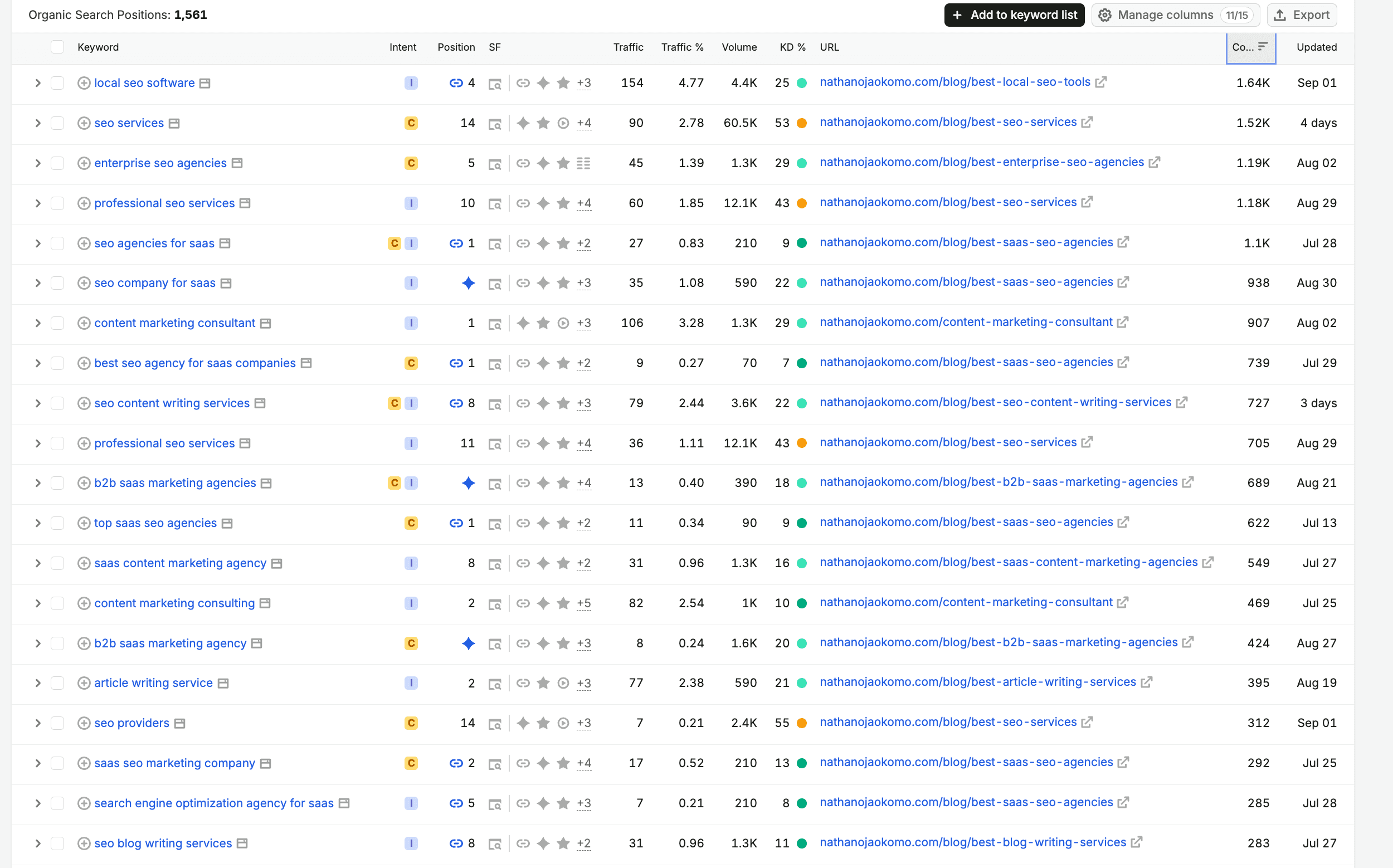
You’re not betting on a theory. The playbook is live, verifiable, and ranking today.
Client work
Pages I’ve written, and what they’re doing right now.
Same playbook. Different markets. Verifiable results.
What’s included
First, understand how your buyers search. Then, find where competitors are winning. Finally, turn the strongest opportunities into finished content.
Three deliverables, each one feeding the next.
The keyword map and competitor gap analysis
Most keyword research starts and ends with a tool. I start with how your buyers talk—sales calls, G2 reviews, Reddit threads, competitor pages—then map every entry point across five columns. Each column is a different buying signal. Together they generate the specific keyword combinations your content is built from.
| Category | Vendors | Buyer | Requirement | Trigger |
|---|---|---|---|---|
| Social media management software | Hootsuite, Sprout Social, Buffer | Marketing teams, agencies | Scheduling, content calendar, analytics | Outgrowing a free plan or overpaying for features they don’t use |
| Link-in-bio tool | Linktree, Later, Beacons | Creators, D2C brands | Audience monetization, storefront, email capture | Wanting to turn followers into revenue with one link |
| Social media analytics tool | Sprout Social, Brandwatch, Iconosquare | Social media managers, content teams | Reporting, engagement tracking, competitor benchmarking | Spending hours building manual reports in spreadsheets |
Buyer has already decided to switch—they just need to know where to go. High intent, low friction to convert.
Use-case specific. Near-zero competition, very high buying intent from the right audience.
Pain-triggered search. Buyer is mid-problem and actively looking for a fix.
You don’t get 500 random keywords. You get a prioritized map of where buyers are already looking—and which combinations to go after first. The map tells us what to create. The SERP tells us how.
From there, I map exactly where competitors are winning those same searches and where they’ve left openings—what they rank for, what they missed, and what it takes to beat them. That shapes which opportunities get prioritized and how each piece is angled to outrank what’s already out there.
6–10 buyer-intent content assets
For each target keyword, I search it in Google and in AI tools to see what format consistently surfaces—listicle, comparison, alternatives page, use-case piece, or landing page—then write the strongest version of that format. Each piece is structured to rank on Google and get cited in ChatGPT, Claude, Perplexity, and AI Overviews, with a clear next step for the reader throughout.
Depending on your market and what each search calls for, the 6–10 pieces could include:
What you leave with for what comes next
The process
An 8-week build, plus a 30-day performance review.
That’s the full 90-day Sprint. Minimal back-and-forth. You approve the keyword map, review drafts, publish. I handle the rest.
The guarantee
If the opportunity isn’t there, you won’t pay for it.
Before the sprint starts, I map 3 real keyword opportunities for your SaaS—the search, who currently ranks, and how I’d angle your page to compete. You see the quality of the work before committing to anything.
If I can’t find at least 6 strong buyer-intent opportunities for your market, I refund your deposit in full. And you keep the research.
No ranking promises. No vanity guarantees. Just a straightforward commitment that I won’t take your money if I don’t believe the opportunity is real.
What clients say
From the teams I’ve worked with.
People who’ve trusted me with their content pipeline.
“Nathan is a detail-oriented, talented freelance writer. He has a wealth of knowledge, allowing him to cover a wide range of topic areas with expertise. His work successfully matches our brand voice and feels like content created in-house.”

“Nathan is a pleasure to work with. He’s super reliable, and his work is really well researched and incredibly thorough. He always digs deep and puts the reader first.”

“Nathan has blown us away with his ability to research and put together incredible pieces of content. He has a captivating writing style that is a perfect blend of friendly and interesting. He is a great communicator and sticks to deadlines.”

“Nathan is a highly dependable and capable writer. His ability to stick to tight deadlines, efficiently handle copy edits, and produce quality work makes him a perfect fit for the Vimeo blog. I’d definitely recommend him to those looking for an SEO-aware, highly effective content creator.”

Pricing
A fixed 90-day engagement.
The content becomes an asset your company owns. It doesn’t stop working when the project ends.
Not ready for a full engagement?
Start with a single buyer-intent article—from $700. See the process and the quality before committing to the full Sprint. Most clients who start with one article come back for it.
Book a call to discuss a single articleIs this for you?
An honest fit check.
I do my best work for a specific kind of client.
Common concerns
What people wonder before booking.
“Will you understand our product?”
Before writing a word, I test the product, review your docs, and talk to whoever knows it best on your team. The keyword analysis I do before you commit will show you how deeply I’ve already dug in. If I can’t get my head around your product, I’ll tell you before we start.
“How do I know the articles will rank?”
You don’t—and anyone who promises that is lying. What I can show you is a track record: Zapier articles ranking for 668 keywords, Taboola at #1, my own site outranking the SEO agencies you’re probably considering. The free keyword analysis also shows you the specific opportunities I’d target and why they’re winnable—before you pay anything.
“$7,500 is a big commitment for someone I haven’t worked with.”
Start with one article from $700. Same process, same quality, fraction of the commitment. Most clients who start with one come back for the Sprint once they’ve seen how the work moves. It’s a low-risk way to find out if we’re a good fit before the bigger engagement.
“How do I justify this to my CMO or founder?”
The ROI case is straightforward: content targeting the searches your buyers make right before purchasing, built to rank on Google and show up in AI answers. You saw the proof earlier on this page—one founder emailed to say a single article had already generated a converted lead. Unlike a retainer or ad spend, the investment is fixed and the assets don’t disappear when the project ends.
“What if something isn’t working mid-sprint?”
Articles ship in batches, not all at once. You see the first two or three before the rest are written, which means there’s a natural checkpoint to adjust tone, product angle, or topic priority if needed. And if the market analysis at the start doesn’t surface enough strong opportunities, I’ll refund your deposit before we’ve written a word.
Not ready to book?
See the thinking first.
Read how I approach buyer-intent content before committing to a call.
Who’s behind this

I got into writing in school, ghostwriting articles for $2 each. I taught myself B2B SaaS content and SEO from the ground up—reading HubSpot, Ahrefs, Backlinko, taking every certification I could find—until I’d built a client list that includes HubSpot, Zapier, Vimeo, and Paddle.
The Pipeline Sprint is the system I’ve been running on my own site. A few weeks ago a prospect found me through Claude—she’d described a problem to the AI and it recommended me unprompted. That’s what this playbook does. It puts you in the conversation before your buyers have even decided who to talk to.
I work with a small number of B2B SaaS companies at a time so the work stays good. Every article that goes out has my name attached to it.
Connect on LinkedInBook a call
Every week you wait is another week your competitors own those searches.
Buyers in your category are searching for solutions right now. Some will find your competitors. Some will ask ChatGPT and get a shortlist that doesn’t include you. The Pipeline Sprint changes that—but it takes time to rank, and the clock starts when you do.
Here’s what happens on the call: I’ll review your site before we speak and identify 3 real keyword opportunities—the search, who currently ranks, and how I’d angle an article to compete. You’ll leave with something useful whether we work together or not.
Or email: hello@nathanojaokomo.com