
B2B software teams understand the basic promise of SEO: publish useful content, rank for relevant searches, and bring more people to the site.
The problem is that traffic alone does not make a content strategy work.
An article can sit on page one and still attract the wrong reader. It can answer the keyword without helping the buyer make sense of their problem. It can avoid the product so carefully that nobody leaves with a clear reason to consider your solution.
That is how you end up with a nice graph in Search Console and very little movement in pipeline.
SEO content marketing should help buyers find you, understand your point of view, compare their options, and take the next step with more confidence.
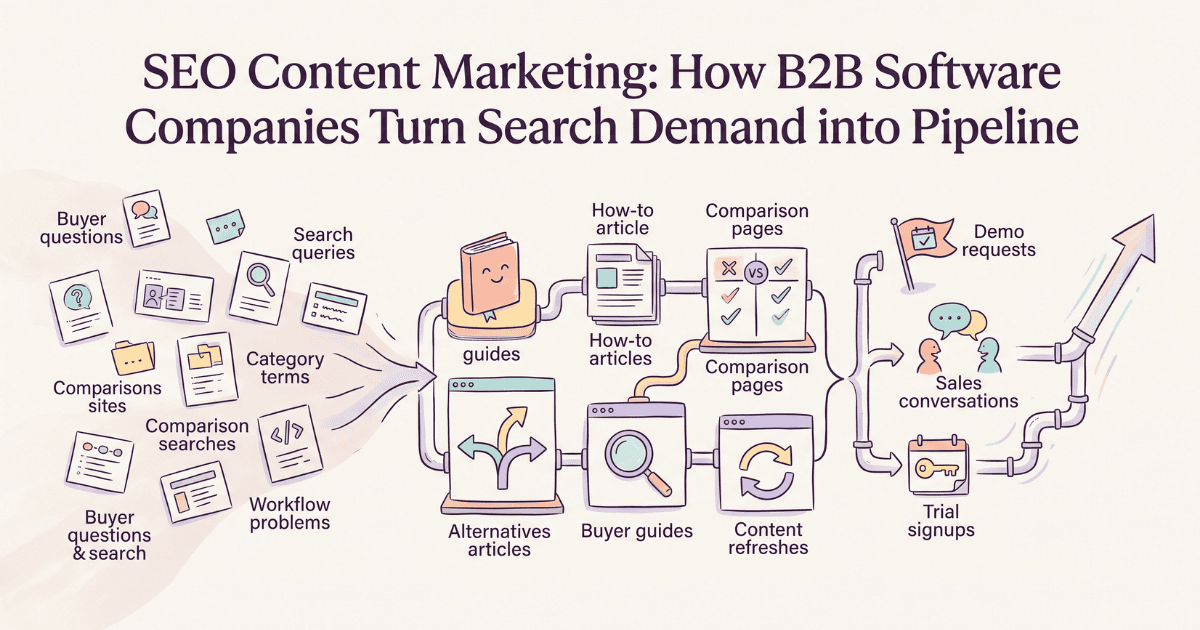
For B2B software companies, that means turning buyer questions, category searches, comparison terms, alternative queries, and workflow problems into content that earns visibility and supports revenue.
Here’s how to build that kind of content.
What is SEO content marketing?
SEO content marketing is the process of creating useful, search-informed content that helps your audience find you, trust you, and move closer to a business decision.
The “SEO” part makes your content discoverable. While the “content marketing” part ensures it is useful, relevant, and persuasive.
Together, they help your company show up when buyers search for problems, categories, tools, and buying questions.
For B2B software companies, SEO content marketing often includes educational guides, workflow articles, product-led how-tos, buyer guides, comparison pages, alternative articles, and content refreshes.
The goal isn’t simply to publish more articles. It’s to create content that matches buyer intent and supports the path from search demand to pipeline.
SEO content marketing vs. SEO vs. content marketing
SEO, content marketing, and SEO content marketing are related, but they aren’t the same thing.
| Term | Main focus | Example |
| SEO | Visibility, rankings, crawlability, search intent, and technical accessibility | Optimizing a page for “best CRM software” |
| Content marketing | Education, trust, demand creation, and audience engagement | Publishing guides, reports, newsletters, videos, and case studies |
| SEO content marketing | Useful content built around search demand and business goals | A buyer guide that ranks for “best CRM for startups” and helps readers compare options |
The mistake is treating SEO as the distribution plan and content as the polish pass. That usually leads to a brief where the keyword is clear, but the buyer, product angle, and business goal are still undecided.
A stronger approach settles the search intent, reader needs, product fit, internal links, and conversion path before the draft is created.
Why SEO content marketing matters for B2B software
B2B buyers do a lot before they ever speak to sales.
They search category terms, compare vendors, ask peers, check review sites, read “best” lists, ask AI tools for recommendations, and skim pricing pages. And then they show up on a demo call with opinions already half-formed.
Your content can influence that research, or your competitors’ content can do it for you.
A few examples:
- A category search like “best customer support software” helps buyers build their vendor shortlist.
- A comparison search like “HubSpot vs Salesforce” helps buyers understand tradeoffs.
- An alternative search like “Asana alternatives” captures people looking to switch.
- A how-to search like “how to automate lead routing” lets you teach the workflow before pitching the tool.
Google’s own guidance says SEO can help search engines discover and understand content when it’s applied to helpful, reliable, people-first content.
That’s the balance B2B software teams need—content built for humans but structured well enough for search systems to understand.
Good SEO content marketing helps your team rank, build trust, support sales conversations, earn AI visibility, and give buyers a clearer path to action.
Traffic is useful. Buying confidence is better.
Where SEO content marketing goes wrong
Weak SEO content strategies usually fail because the content plan is disconnected from the buyer and the business.
Starting with keyword volume instead of business value
A payroll software company might chase “what is payroll” because the volume looks exciting, while ignoring long-tail keywords or terms like “best payroll software for remote teams,” “Gusto alternatives,” or “how to pay international contractors.”
The broader keyword may bring more traffic, but the specific keyword usually brings someone closer to buying.
Publishing posts that don’t connect
Another common problem is publishing disconnected posts with no internal linking architecture.
You might have one article that explains the problem, another that compares tools, and a third that covers a use case. None of them link together, so the reader has to build the journey on their own.
Measuring traffic instead of buyer movement
Organic sessions matter, but they don’t tell the full story.
You also need to know whether the content attracts the right audience, supports demo requests, influences the pipeline, helps sales answer questions, or shows up in AI answers.
Copying the SERP without adding a point of view
Then there’s the classic SERP-copying problem.
You read the top five results, write the same article with 500 extra words, add a table, publish, and repeat. That might get you a page. It rarely gives you a point of view. When I compared 22 ranking B2B SaaS articles, most followed the same skeleton, which I break down in why B2B SaaS content sounds the same.
Waiting too long to refresh old content
Search intent changes. Competitors update their pages. Products evolve. AI answers shift.
A page that worked eighteen months ago may now have outdated examples, weak CTAs, missing competitors, and screenshots from a product UI that no longer exists.
What good SEO content marketing includes
Strong SEO content marketing starts with search intent.
In SEO, intent usually falls into four broad buckets:
| Intent type | Example keyword | What the reader wants |
| Informational | “what is sales forecasting” | Understand a concept |
| Commercial | “best sales forecasting software” | Compare options before buying |
| Navigational | “Clari pricing” | Find a specific brand, page, or product information |
| Transactional | “buy sales forecasting software” | Take action, sign up, book, or purchase |
For B2B software companies, those intent types often show up through more specific keyword patterns.
| Keyword pattern | Example keyword | Likely buyer situation |
| Category | “sales forecasting software” | The buyer is exploring a type of solution |
| Best/listicle | “best sales forecasting software” | The buyer is building a shortlist |
| Comparison | “Clari vs Gong” | The buyer is evaluating two named tools |
| Alternatives | “Clari alternatives” | The buyer is looking for other options |
| Use case | “how to forecast sales pipeline” | The buyer is trying to solve a workflow problem |
| Pricing | “Clari pricing” | The buyer wants cost or plan information before moving forward |
The keyword gives you the surface-level intent. The buyer’s situation tells you what the content needs to do.
A reader searching “what is customer onboarding” is probably trying to understand the concept. By the time they search “best customer onboarding software,” they’re likely comparing tools. And when they search “[competitor] alternatives,” there’s a good chance they’re already feeling some friction with their current product.
Those readers should not land on the same type of article. Each query needs content that matches the reader’s stage, questions, objections, and next step.
Once you understand the intent, map it to the buyer journey.
A reader learning about the problem needs a different page from a reader comparing vendors.
TOFU searches usually need educational guides, explainers, and category content.
MOFU searches often work better as how-to articles, frameworks, templates, and use-case content.
BOFU searches need buyer guides, comparison pages, alternative articles, pricing pages, and product-led content that helps the reader make a decision.
That map helps you avoid treating every keyword the same way. A “what is” keyword should not have the same structure, CTA, examples, or product depth as a “best software” or “[competitor] alternatives” keyword.
Types of SEO content for B2B software
SEO content marketing is broader than publishing blog posts every week.
For B2B software companies, the strongest content usually helps buyers understand the category, solve a workflow problem, compare options, or get more confident about a decision.
The right mix depends on your product, market, and sales motion, but these are the formats worth considering.
Educational guides
Educational guides explain important concepts in your category.
For example, a customer onboarding platform might publish content such as “What is customer onboarding?” or “Customer onboarding best practices.”
These pieces work best when the topic helps buyers understand the problem your product solves, not just when the keyword has volume.
How-to and workflow articles
How-to articles show readers how to complete a specific job.
A lead routing tool, for instance, might publish “how to automate lead routing” or “how to assign inbound leads to the right sales rep.” These articles are strongest when the product can naturally support the workflow through examples, screenshots, templates, or practical steps.
Category and buyer guides
Category and buyer guides help readers understand their options.
A page targeting “best customer success software” should do more than list tools. It should explain the evaluation criteria, show who each tool is best for, and help the reader build a more informed shortlist.
Comparison and alternatives content
Comparison and alternatives pages help buyers evaluate named options.
For example, “HubSpot vs Salesforce” or “Asana alternatives” attracts readers who are already thinking through tradeoffs.
Strong pages in this format are honest, specific, and useful enough to help the buyer make a better decision, even when your product is one of the options.
Content refreshes
Content refreshes improve existing pages that should be working harder.
An old “best content optimization tools” article may need new vendors, updated screenshots, clearer evaluation criteria, stronger internal links, and a CTA that matches the reader’s stage.
Refreshes are especially useful when a page has rankings, backlinks, or historical traffic, but the content no longer reflects the current market.
Use-case pages and templates
Use-case pages and templates turn product value into something practical.
A project management tool might create a sprint planning template. A customer success platform might publish a renewal risk playbook. These assets work well when they help the reader do a real job while showing where the product fits.
A sales-led enterprise software company may lean more on comparison pages, category pages, and sales-objection content. In comparison, a lower-touch SaaS company may need more product-led how-to articles, templates, and use-case pages.
The format should follow the way your buyers research, compare, and decide.
A real example: keyword to ranking page
Say the keyword is “best AI search visibility tools.” The obvious article is a list of tools: add logos, write a few blurbs, publish, and hope for the best.
A stronger page starts with intent. The reader isn’t just looking for “tools.” They’re trying to understand which platforms can help them track brand visibility across AI search systems like ChatGPT, Perplexity, Gemini, and AI Overviews.
They may also need to know what each tool tracks, how reliable its data is, whether it supports their market, and how the tool integrates with SEO, PR, and content strategy.
That changes the outline. Instead of only listing products, the article should include a quick comparison table, “best for” labels, evaluation criteria, what each tool tracks, strengths and limitations, pricing context where available, and who should choose each option.
It should also answer the question of what to do with the data after tracking visibility.
When a tool shows that your brand is missing from AI answers, the next question is what to improve.
Do you need stronger owned content? More third-party mentions? Better reviews? Clearer product positioning? More proof to support the claims on your site?
That is where a listicle becomes more than a listicle. It helps the buyer understand the category, evaluate options, and connect the tool to a business outcome.
A page like that has a better chance of ranking because it satisfies the search intent. It also has a better chance of converting because it helps the reader make progress.
How AI search changes SEO content marketing
AI search changes how buyers discover and process information. Google says AI Overviews help people get the gist of complex topics more quickly and provide links for deeper exploration.
Your content may influence the buyer even when the journey doesn’t look like a clean click from Google to blog post to demo request.
AI tools summarize, compare, and recommend based on sources they can understand. That puts more pressure on structure, clarity, and consistency.
Your content should make direct answers easy to extract. Use clear definitions, structured sections, comparison tables, practical examples, named categories, and specific recommendations.
For B2B software companies, AI search also increases the value of BOFU content. When a buyer asks for the best CRM tools for a Series B SaaS company, HubSpot alternatives for a growing sales team, or project management tools for agencies, AI answers may draw on comparison pages, alternative articles, review sites, third-party roundups, and first-party content.
You can’t control every AI answer. But you can make your own content more useful, specific, and easier to understand. Clear entity descriptions, consistent product positioning, and content that explains who each option is best for can all improve how well your pages support AI visibility.
How to measure SEO content marketing
Measure SEO content marketing in two layers.
First, track search visibility: rankings, impressions, clicks, organic traffic, keyword footprint, featured snippets, and AI citations or mentions.
Then track business impact: demo requests, trial signups, assisted conversions, qualified organic leads, CTA clicks, sales enablement usage, and content-influenced pipeline where trackable.
Not every article ties neatly to revenue. Attribution in B2B software gets messy fast, especially when buying committees, dark social, sales conversations, and AI search all play a role. Still, every article should have a job. Self-reported attribution and traffic value are two ways of measuring content marketing ROI when direct attribution falls short.
How I can help
I write SEO content that helps B2B software teams:
- Get discovered when your target readers search
- Give AI tools a consistent, accurate description of what your company does, and
- Earn a place in the answers AI gives when buyers are comparing options.
My work covers long-form content and refreshes. If you’re evaluating a freelance writer for this kind of work or just want to talk through your backlog, get in touch.
Frequently asked questions
What is the difference between SEO and content marketing?
SEO focuses on helping content get discovered through search. Content marketing focuses on educating, building trust, and moving an audience toward a useful action.
SEO content marketing combines both by creating content that’s search-informed, useful to the reader, and tied to a business goal.
How long does SEO content marketing take to work?
SEO content usually takes months to show meaningful results, especially for newer websites or competitive keywords.
Some pages gain traction faster if the site already has authority, the keyword is less competitive, or the content is supported with strong internal links and distribution.
Refreshes can also work faster than brand-new pages because the URL may already have history.
How do you measure SEO content marketing success?
Measure search visibility and business impact together. Search metrics include rankings, impressions, clicks, organic traffic, keyword footprint, and AI citations.
Business metrics include demo requests, trial signups, CTA clicks, assisted conversions, sales usage, and qualified organic leads. The best metric depends on the job of the article.
How does AI search affect SEO content marketing?
AI search makes clarity, structure, and specificity more important. Tools like AI Overviews, ChatGPT, Perplexity, and Gemini summarize information, compare options, and cite sources.
Content that includes direct answers, clear examples, comparison tables, named entities, and useful recommendations has a better chance of being understood and referenced.
When should you refresh SEO content?
Refresh SEO content when rankings drop, search intent changes, competitors publish stronger pages, product details become outdated, examples go stale, internal links need improvement, or the CTA no longer fits the offer. Comparing date ranges in Search Console shows which pages have content decay, so you can fix the ones closest to revenue first.
For comparison pages, alternative articles, buyer guides, and AI-related topics, review important pages every three to six months.