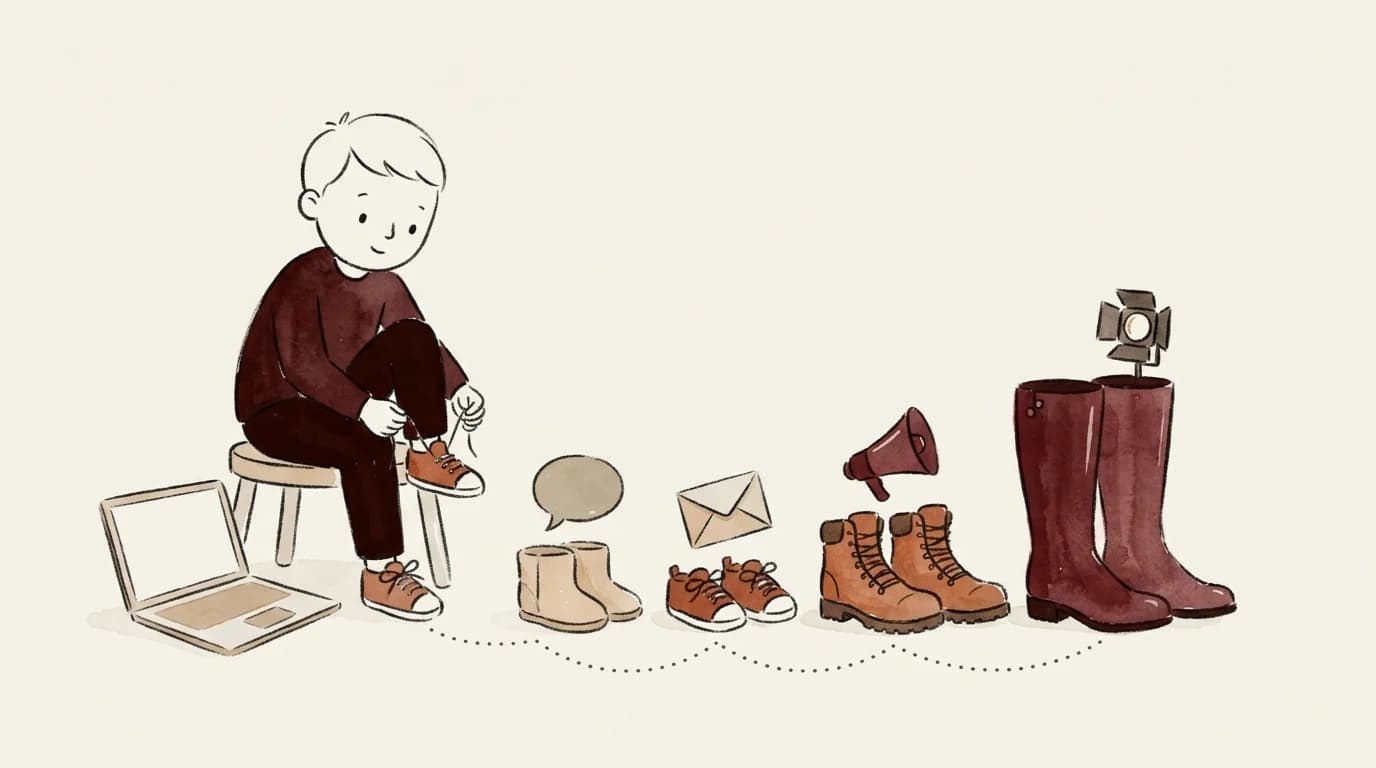

When you buy shoes for a growing kid, you buy the size that fits them now, with a thumb’s width of room at the toe. You don’t buy the pair they’ll fit in two years, because they’d trip over it today. A SaaS marketing plan works the same way, yet most “SaaS marketing strategies” lists hand a seed-stage founder the playbook of a company with a full marketing team: ABM, events, paid social, a podcast and a content calendar.
Before product-market fit, a B2B SaaS company’s marketing is mostly the founder talking to buyers. Outbound and a handful of pages that answer buying questions come next. A content program, paid search at scale and an agency come once you know who buys and why.
This guide gives you a plan for each stage: what to run, what to skip for now, who does the work, roughly what it costs, and the signs you need the next size up. There’s also a free Google Sheet that finds your stage and turns it into a one-page plan for this quarter.
SaaS marketing strategy by stage: the short answer
A SaaS marketing strategy should match your company’s stage. Before product-market fit, the founder sells and learns the buyer’s words. In early traction, you repeat the first sale with outbound and bottom-funnel pages. After product-market fit, you build a steady pipeline from content, paid search and demand generation. At scale, you add an agency, retention and brand. The matrix of 16 SaaS marketing strategies further down shows when to start each one.
| Stage | Main goal | Run | Skip for now | Who does it | Rough budget |
| Before product-market fit | Find people who’ll pay | Founder conversations, manual outreach, communities | SEO, paid ads, agencies | The founder | Founder time, plus free basics |
| Early traction | Repeat the first sale | Outbound, bottom-funnel pages, small paid tests | Brand campaigns, events, top-of-funnel posts | Founder plus a first hire or freelance writer | Up to about $1,500 a month for a writer, plus small tests |
| After product-market fit (seed to Series A) | Build a steady pipeline | Content from sales calls, paid search, demand generation, partnerships | Channels you can’t measure yet | A first marketing lead with a writer or fractional help | About $1,500 to $5,000 a month for content, plus paid search |
| Scaling (Series A and beyond) | Grow efficiently and keep customers | An agency, retention and expansion, brand, ABM, AI answers | Channels that stopped paying back | A marketing team, often with an agency | Median of 8% of ARR on marketing |
What is a SaaS marketing strategy?
A SaaS marketing strategy is the plan a software company uses to find, win and keep customers who pay every month or year. It decides which channels get money and hours, who runs them, and which numbers show whether they’re paying off.
B2B SaaS differs from a one-off product in how revenue arrives, who signs off and how fast the product changes.
- Revenue arrives every month. A customer who leaves in month three never pays back what it cost to win them, so keeping customers counts as marketing too.
- Several people sign off on the deal. The person who finds you is rarely the only one who approves the purchase, so your pages and emails have to answer finance and IT as well as the user.
- The product changes faster than your marketing. Pages, decks and ads describe features that shipped, moved or disappeared, so part of the job is keeping them current.
The ranking guides for this search mostly list channels: content, SEO, ads, email, events. One channel can be the right call at one stage and a waste at another, which is why this guide is organized by stage instead.
Why your stage changes the plan
A bootstrapped founder in r/B2BSaaS asked what got other founders their first 100 paying customers. The top reply split the problem in two: “your first 10 and your next 90 are completely different problems.”
Your first ten customers teach you who buys and why, and you win them by hand. The next ninety come from repeating whatever won the first ten. After that, the job is a pipeline that keeps filling when the founder is busy with something else.
The same reply describes what happens when a company skips ahead. Its author hired a salesperson too early and spent effort on directory listings, a rebrand and a content calendar instead of conversations with buyers. Each of those can make sense later, but none of them fit a company that hasn’t found its first ten.

Before product-market fit: the founder is the marketing
Goal. Find people who’ll pay, and learn the words they use for the problem.
Run these.
- Founder conversations and manual outreach. Message the people who have the problem, one at a time, and ask how they handle it today before you pitch anything. This is founder-led marketing and cold outreach at their smallest.
- Communities where your buyers already ask questions. Answering in Slack groups, subreddits and forums teaches you the buyer’s words before you write a single page.
- A one-line message and a homepage that says it. Who it’s for, what it does, and why it beats what they use now.
Founders who start this way report small, real results. Two founders building a sales analytics tool reached three customers and $500 MRR about six weeks after launch, all through the founder’s own manual outreach. They also noticed each new sale got harder, which is the sign the next stage is close. A solo founder in r/startups had two paying customers and eight companies in trials from a few Reddit posts, with zero paid marketing, while their site sat on page three of Google. Both are self-reported.
Skip these for now.
- SEO. My rule is to hold off on SEO before product-market fit. There aren’t enough pages, buyers or proof yet for it to pay back, and the message usually changes before the pages could rank. Set up Search Console and make your homepage and product pages clear, then put your time into customers until the signs that a startup is ready for SEO show up.
- Paid ads. Without a known conversion rate, you can’t tell a bad ad from a bad offer, and the bill arrives either way. The per-demo math in SEO vs PPC for B2B SaaS only works once you know how many visitors become demos.
- Agencies. An agency can write and run campaigns well, but it can’t decide who your customer is.
More volume doesn’t replace conversations. About a month after building a workforce management tool, one founder had sent more than 1,000 cold emails and had “a few responses, but no customers yet.” Twenty conversations with the right buyers usually teach more than a thousand emails.
Who does it. The founder. Nobody else knows the buyer and the product well enough yet.
Budget. Mostly the founder’s time. The basics (Search Console, clear product pages, a one-line message) cost little and will be ready when searches start to arrive.
Signs you need the next size up. People you didn’t know before are paying. You can say who buys and why in one sentence. The same three or four objections keep coming up on calls.
Early traction: repeat the first sale
Goal. Turn whatever won the first customers into something you can repeat every month.
Run these.
- Outbound with a list and a sequence. Take the message that worked in conversations and send it to a list of the same kind of company.
- Bottom-funnel pages. Comparison, alternatives, use-case and pricing pages, written from your sales calls, for searches people make when they’re choosing a tool. Under my rule, this is where SEO starts.
- Small paid tests on the searches closest to a purchase. Competitor alternatives and “best X for Y” searches, with a budget you can afford to lose while you learn your cost per demo.
- Marketplace listings and review sites, if your product lives inside another platform or you have happy customers to ask. One marketplace listing can bring a large share of early demos.
- Onboarding emails and referrals. Onboarding emails help new users reach a first result, and word of mouth starts once people like what they use.
A bootstrapped Shopify app is a good picture of this stage. Its founder reported that the first 20 customers came from cold calling. After that, App Store ads brought about one customer a week, Facebook groups brought four customers in two months, and targeted cold email added about one a week, on the way to $12K MRR after a year and a half of sales. The channels changed once the first sale was understood, and each one was small enough to measure.
Outbound at volume can carry this stage on its own. In a thread where a developer asked what to do about marketing, one B2B founder replied that they went from $0 to $2,600 MRR in three months, mostly through LinkedIn outreach and cold email, and summed it up as “Cold outreach will be your best friend the first 90 days.”
It doesn’t work for everyone, which is why pages matter here too. Another founder’s Apollo emails “go unopened or straight to spam,” while their search impressions grew from about 10 to 300 a day and brought one or two signups a day. All three accounts are self-reported, but together they show the pattern: outbound for speed, pages that answer buying questions for the signups outbound misses.
Skip these for now. Brand campaigns and events you can’t tie to pipeline, and a content calendar full of top-of-funnel posts. Awareness content tends to pay off once there’s a pipeline to feed, not before.
Who does it. The founder, plus a first marketing hire or a freelance writer who can turn sales calls into pages. A comparison page from a B2B SaaS writer usually costs about $800 to $1,500.
Budget. Small and testable: up to about $1,500 a month for a freelance writer, plus paid tests you can switch off.
Signs you need the next size up. One or two channels bring customers every month without the founder doing the selling, and you know your cost per demo on at least one of them.
After product-market fit: build a steady pipeline
Goal. A pipeline that keeps filling when the founder is busy with product, hiring or fundraising.
Run these.
- A content program built from sales calls. The objections, switching reasons and questions from calls become pages, planned the way a SaaS content strategy built from customer research plans them, with something written for each person on the buying committee, from finance to IT.
- Paid search on the searches that convert. Once you know which searches turn into demos, buy those and rank for the rest.
- AI search visibility. Getting named in AI answers builds on the pages and reviews you already have.
- Demand generation. Webinars and podcasts, LinkedIn content and newsletters that teach the problem to people who aren’t searching yet.
- Creators and paid social tests. Creator content and retargeting start to pay off once there’s steady traffic.
- Partnerships and integrations, where your buyers already work.
Skip these for now. Channels you can’t measure yet, and a bigger company’s event calendar. A trade-show booth can make sense at Series B and still be the wrong spend at seed.
Who does it. A first marketing lead, with a writer or fractional help. One person who owns the plan, and protects it from every new request, tends to matter more here than more ideas.
Budget. About $1,500 to $5,000 a month covers a writer and a steady content program, with paid search on top once it pays back. Agencies usually come in the next stage, and B2B SaaS SEO agencies charge a median of $4,250 a month for their cheapest tier.
Signs you need the next size up. Several channels work, retention is steady, and each new customer costs a little more than the last.
Scaling: grow efficiently and keep customers
Goal. Keep growth efficient as each new customer gets more expensive, and keep the ones you have.
Run these.
- An agency or an in-house team for strategy, content and links as one program.
- Retention and expansion marketing. Lifecycle emails, customer stories and customer marketing that help customers use more of the product.
- Brand, ABM and events for larger deals, where a known name shortens the sales cycle.
- Showing up in AI answers. More buyers now ask AI assistants for shortlists, so keep the pages and mentions behind AI search visibility current.
Who does it. A marketing team, often with an agency.
Budget. SaaS Capital’s survey of more than 1,000 private B2B SaaS companies puts median marketing spend at 8% of ARR, unchanged from the year before, and equity-backed companies spend twice as much on marketing as bootstrapped ones. At $5 million ARR, 8% is $400,000 a year, or about $33,000 a month.
Boards at this stage often judge the spend with the Rule of 40: your growth rate plus your profit margin should add up to at least 40%. A company growing 50% a year can run at a loss, while one growing 15% needs to be profitable.
16 SaaS marketing strategies and the stage each one fits
The matrix below shows when to start each strategy. Run means make it a core channel at that stage, Test means try it small and measure, and Not yet means skip it for now.
| Strategy | Before product-market fit | Early traction | After product-market fit | Scaling |
| Founder-led marketing | Run | Run | Run | Run |
| Cold outreach | Run | Run | Run | Run |
| Communities | Run | Run | Run | Run |
| LinkedIn and X content | Run | Run | Run | Run |
| Content marketing and SEO | Not yet | Run | Run | Run |
| AI search visibility | Not yet | Test | Run | Run |
| Paid search | Not yet | Test | Run | Run |
| Paid social and retargeting | Not yet | Not yet | Test | Run |
| Email marketing | Test | Run | Run | Run |
| Review sites and marketplaces | Not yet | Run | Run | Run |
| Partnerships and integrations | Not yet | Test | Run | Run |
| Referrals and word of mouth | Not yet | Run | Run | Run |
| Free tools, templates and freemium | Test | Run | Run | Run |
| UGC, creators and affiliates | Not yet | Test | Run | Run |
| Webinars, podcasts and events | Not yet | Not yet | Run | Run |
| ABM and customer marketing | Not yet | Test | Test | Run |

The examples below are the companies’ own reported numbers unless a line says otherwise.
1. Founder-led marketing
Founder-led marketing means the founder sells, posts and shows up in communities in their own voice. Buyers trust the person who built the product, and the founder hears every objection firsthand. Austin Hughes, a co-founder of Unify, posted on LinkedIn five times a week, and the company got 420 inbound demo requests in the 48 hours after announcing its seed round, then more than $15 million in inbound pipeline over the next year. It stops scaling when the founder’s calendar becomes the bottleneck. Hand off the repeatable parts first, such as outbound sequences and pages written from sales calls, and keep the founder’s voice in the posts.

Best stage. From day one, handing off the repeatable parts after product-market fit.
2. Cold outreach
Cold outreach means emailing, messaging or calling people who haven’t heard of you yet, from a list you chose on purpose. Before product-market fit, it’s the fastest way to test a message, because every reply and every silence tells you something. Retool’s founders bought Crunchbase data and cold emailed CTOs at recently funded companies, which is how they won DoorDash, and Zip’s founders got their first 10 customers by asking for advice in cold LinkedIn messages. Reply rates tend to fall as volume grows, so pair outreach with pages that answer the buyer’s questions.

Best stage. Before product-market fit and early traction, then with a sales team after that.
3. Communities
Communities are the places your buyers already ask each other for help: Slack groups, subreddits, Discord servers, forums and Facebook groups. Answer first, mention the product only when it fits, and treat every thread as research into the words buyers use. dbt Labs grew its own Slack to 2,100 members while its growth was “happening with $0 invested in sales and marketing.” Tally built a Slack community of about 400 people before launching on Product Hunt, then doubled from 1,500 to 3,000 users after the launch.

Best stage. From day one in other people’s communities, and your own once there are enough users to keep it busy.
4. LinkedIn and X content
This means posting from the founders’ own accounts first, and later from employees and the company page. LinkedIn suits most B2B buyers, while X suits developer tools and startup audiences better than enterprise ones. Pylon’s three co-founders post on LinkedIn every day, and LinkedIn became Pylon’s biggest source of pipeline, based on what buyers say when they book a demo. Posting every week for months tends to beat a burst of polished posts, because the audience builds before the inbound does.

Best stage. Founder posts from day one, and company and employee content after product-market fit.
5. Content marketing and SEO
Content marketing and SEO means publishing pages that answer what buyers search for, from comparison and alternatives pages to guides. Under my rule, it waits until product-market fit, and then the pages closest to a purchase come first. Grow and Convert found that alternatives and comparison keywords had the highest average conversion rate across its client articles, at 8.43%. Plausible reached $1 million ARR without running ads, mainly from blog posts that reached the front page of Hacker News. Zapier’s pages for every app and app pairing bring an estimated 16% of its organic traffic, by Ahrefs’ estimate. Planning the program starts with a SaaS content strategy built from customer research.

Best stage. Bottom-funnel pages in early traction, a full program after product-market fit.
6. AI search visibility
AI search visibility means getting your product named when buyers ask ChatGPT, Claude, Perplexity or AI Overviews for a shortlist. It grows from the same pages, reviews and mentions that help in Google, so it rarely works before you have those. Tally reported that ChatGPT became its #1 referral source while it grew from $2 million to $3 million ARR in four months, and Vercel said ChatGPT refers about 10% of its new signups. Both already had years of content and word of mouth behind them. The steps for getting named in ChatGPT answers start with the pages you already have.

Best stage. Test in early traction, run after product-market fit.
7. Paid search
Paid search means ads on Google or Bing for searches people make when they’re looking for a tool. It works when the search has buying intent and you know your conversion rate, and it struggles when nobody searches for your category yet. Dropbox learned this early. Its first search ads cost $233 to $388 to win each customer for a $99 product, and the team moved its effort into a referral program instead. Start with competitor-alternative and “best X for Y” searches, and work out what a demo costs from ads and from SEO before you scale.

Best stage. Small tests in early traction, scaled after product-market fit.
8. Paid social and retargeting
Paid social means ads on LinkedIn, Meta or X aimed at job titles and companies, and retargeting shows ads to people who already visited your site. Retargeting needs traffic to retarget, so it tends to pay off after product-market fit. Fivetran offered content downloads through LinkedIn’s lead forms and got 891 leads that influenced $2.4 million in pipeline for about $70,000, according to LinkedIn’s case study. Paessler, a network-monitoring software company, cut its cost per lead by 75% after adding retargeting for site visitors, also in a LinkedIn case study.

Best stage. Test after product-market fit, and scale once site traffic is steady.
9. Email marketing
Email marketing covers onboarding emails that help new users reach a first useful result, lifecycle emails that bring back quiet accounts, and a newsletter for people who aren’t ready to buy. PostHog rewrote its onboarding emails seven times, and one version reached a 52% open rate, with 6% of readers turning on billing within a week. Baremetrics raised trial conversion from 15% to 31% by sending emails only when a trial user’s activity dropped, alongside in-app messages.

Best stage. Onboarding emails from your first users, and a newsletter and lifecycle emails after product-market fit.
10. Review sites and marketplaces
This means listings on G2 and Capterra, and in the app marketplaces of platforms your buyers already use, such as HubSpot, Salesforce, Shopify or Atlassian. Both need happy customers, so they fit once you have some. QuotaPath built a certified HubSpot integration and added a demo video to its listing, and in one month, 40% of its demo requests came from the marketplace. Snitcher asked for G2 reviews inside its product and onboarding and won seven new customers, adding $4,000 in monthly revenue over six months. Both figures come from the platforms’ own case studies.

Best stage. Early traction onward.
11. Partnerships and integrations
Partnerships mean building integrations with tools your buyers use, then marketing and selling alongside those partners through joint launches, co-selling and partner directories. Klaviyo’s Shopify integration became the core of its business, and its IPO filing says about 77.5% of its ARR came from customers who also use Shopify. On a smaller scale, QuotaPath reported a 75% close rate on deals where it brought HubSpot’s account executives in, in the same HubSpot case study.

Best stage. Test in early traction, run after product-market fit.
12. Referrals and word of mouth
Word of mouth is customers telling other people about you, either on their own or through a referral program that rewards them. It tends to follow product-market fit rather than create it. Dropbox’s two-sided referral program, which gave both people free storage, permanently increased signups by 60%. In B2B, Atlassian’s IPO filing says it reached more than 51,000 customers without a direct sales force, relying on word of mouth and spread inside companies.

Best stage. Early traction onward, with a formal program once customers already recommend you.
13. Free tools, templates and freemium
This means a free plan, a free tool or templates people can use without talking to sales, each bringing in users who may upgrade later. It’s how product-led companies sell, and sales-led companies use free tools to start conversations. Tally gives away unlimited forms on its free plan, and each free form carries a small “Made with Tally” badge. It reached $3 million ARR with more than 800,000 users, about 2% of whom upgrade. HubSpot’s free Website Grader graded more than 2 million websites in its first few years.

Best stage. Test before product-market fit, and run from early traction for product-led companies.
14. UGC, creators and affiliates
User-generated content (UGC) means customers or paid creators making short videos and posts about your product, and affiliates are paid for each customer they send. It suits products people can show in under a minute. In B2B, a few committed creators usually beat hundreds of hired ones. Wispr Flow, the voice dictation app, is the clearest recent case. Hector Serrano, who built its paid UGC program, says in his own video that the team started with five handpicked creators, each filling a gap in its ads (a new format, a new audience or a new region), before growing the roster. It now runs about 50 creators making 500 to 600 paid UGC ads a month, and its CEO said the program hit 500 million views in 60 days. Gamma took a similar route, using more than 1,000 micro-influencers instead of big names.

Best stage. Test in early traction, scale after product-market fit.
15. Webinars, podcasts and events
Webinars and podcasts teach your market and build a list, and events put you in a room with buyers. All three need an audience and someone to follow up, which makes them a better fit once there’s a team to run them. HubSpot ran an educational webinar that drew 24,961 registrants and 3,529 new leads. Drift’s Seeking Wisdom podcast reached more than 50,000 downloads a month, an audience number rather than a pipeline figure.

Best stage. Webinars and podcasts after product-market fit, and your own events at scale.
16. ABM and customer marketing
Account-based marketing (ABM) picks a list of target companies and runs ads, content and outreach for each one. Customer marketing turns current customers into case studies, references and bigger contracts. ABM needs a sales team and larger deals to pay off. Snowflake’s director of ABM said its one-to-one program tripled the SDR meeting rate and raised average deal size 2.5x, and that campaigns aimed at existing customers produced a 50% new-opportunity rate. Both figures come from vendor case studies. Case studies fit much earlier, because one good story helps every sales call.

Best stage. Case studies from early traction, ABM and expansion campaigns at scale.
SaaS lead generation vs demand generation
Lead generation captures people who are already looking. Demand generation teaches people that they have a problem, so there are more of them to capture later.
- Lead generation. Demo requests, free trials, outbound replies, comparison pages and paid search on buying terms. You can count the results this month.
- Demand generation. Webinars, LinkedIn posts, newsletters, podcasts and guides that teach the problem. The results show up later, in more people searching for you and more replies to outbound.
Early stages live on lead generation and founder conversations, because there’s no pipeline to fill yet. Demand generation pays off once lead generation is steady and you want more people entering it. Teams that start with demand generation tend to grow an audience before they’ve worked out who buys.
Product-led vs sales-led: how the plan changes
- Product-led. People sign up and try the product on their own. Marketing optimizes signups and activation, and free plans, templates and in-product prompts do much of the selling.
- Sales-led. People book a demo and talk to sales. Marketing optimizes demos and pipeline, and bottom-funnel pages, outbound and case studies matter more.
Many B2B SaaS companies mix the two, with self-serve for small teams and sales for larger ones. Plan around whichever brought your first paying customers, and add the other once the first one is steady.
How to tell your marketing is working at each stage
Pick one or two numbers per stage and ignore the rest until you outgrow it:
| Stage | Numbers to watch |
| Before product-market fit | Conversations booked, paying customers, how often buyers repeat your one-line message back to you |
| Early traction | Cost per demo or signup by channel, customers per month from each channel |
| After product-market fit | Pipeline created by marketing, payback period, demos from organic search |
| Scaling | Net revenue retention, expansion revenue, marketing spend as a share of ARR |
On the search side, a short list of SEO KPIs for SaaS keeps reports to the numbers leadership acts on, and content marketing ROI measured in pipeline says more than traffic does.
Free SaaS marketing plan template
I built a free Google Sheet that turns this guide into a plan. Answer five yes-or-no questions, and it names your stage, highlights what to run and what to skip, compares your planned budget with the SaaS Capital median, and builds a one-page plan you can print. Make a copy of the SaaS marketing plan template.

It has six tabs:
- Start here. How to use it, in about 20 minutes.
- Stage check. Five questions that name your stage, plus a budget check against your ARR.
- Channels by stage. The table from this guide, with your stage highlighted. Edit it to fit your market.
- Strategies. The 16 strategies from this guide, marked Run, Test or Not yet for each stage, with an example of each.
- Quarter plan. Two or three channels, each with an owner, a monthly budget, a number to watch and a status.
- One-pager. Your stage, goal and channels on one printable page.
The grey rows are made-up examples for a project management tool. Delete them once you’ve seen the format.
SaaS marketing strategy FAQs
What is a SaaS marketing strategy?
It’s the plan a software company uses to find, win and keep paying customers: which channels get money and hours, who runs them, and which numbers show they’re working. For a B2B SaaS company, the right plan depends mostly on its stage.
What are the best SaaS marketing strategies?
The ones that fit your stage. Founder-led marketing, cold outreach and communities work from day one. Content and SEO, review sites, referrals and paid search tests come in early traction. Paid social, creators, webinars and partnerships follow product-market fit, and ABM and events usually wait until you have a sales team.
What is a SaaS go-to-market strategy?
A go-to-market strategy covers how you launch and sell the product: who it’s for, how it’s priced, and whether sales or the product does the selling. The marketing strategy is the part of it that decides which channels bring those buyers in.
How much should a SaaS company spend on marketing?
Private B2B SaaS companies spend a median of 8% of ARR on marketing, and equity-backed companies spend about twice what bootstrapped ones do. Before product-market fit, the founder’s time counts for more than any budget. In early traction, up to about $1,500 a month for a writer plus small paid tests is enough to learn what works.
What is the Rule of 40 in SaaS?
Your annual growth rate plus your profit margin should add up to at least 40%. Boards and investors use it to judge whether a company’s spending on growth, including marketing, is in balance.
When should a SaaS startup start SEO?
Once it has product-market fit and a settled message. Before that, set up Search Console and make your core pages clear. The first SEO pages should be the ones closest to a purchase: comparisons, alternatives and use cases.
What to do this quarter
Use the signs at the end of each stage to name the one you’re in. Pick two or three channels from that stage’s list, give each one owner and one number to watch, and drop anything from the skip list, even if a bigger competitor is doing it. Then check the signs again at the end of the quarter. Like a kid’s shoes, the next size up tends to arrive sooner than you expect. The free template does the first two steps for you.
If you’re past your first customers and want bottom-funnel pages that turn your sales calls into demos, book a call with me.