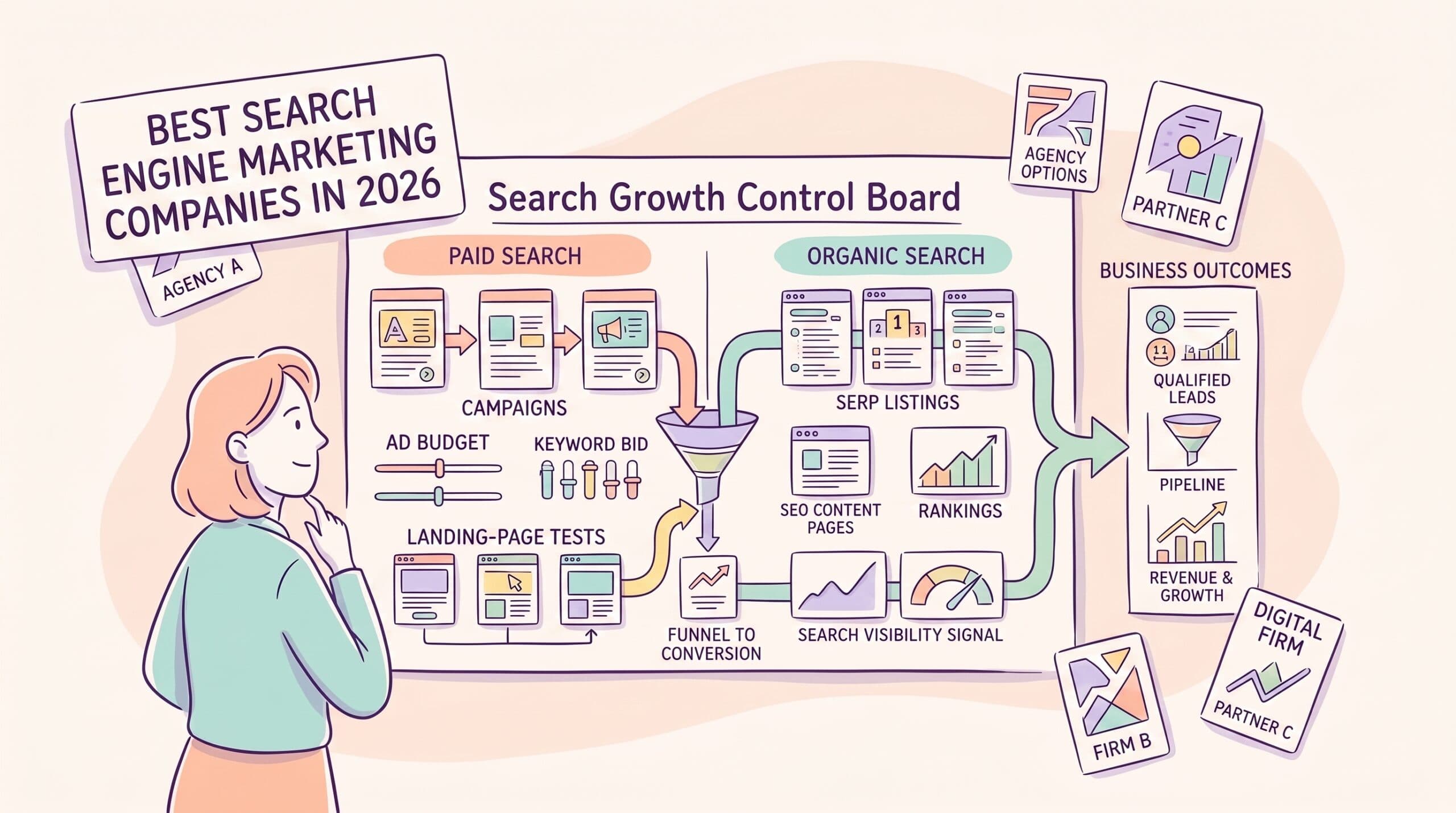

At some point, running more budget through the same search program stops producing proportionally better results.
The clicks and impressions are there. But qualified pipeline isn’t growing the way the spend suggests it should, and nobody can clearly explain why.
Search engine marketing companies exist to solve exactly that problem: not just to run ads, but to connect search activity to real business outcomes across paid campaigns, organic visibility, conversion rate, and attribution.
This guide covers 14 of these search engine marketing agencies, matched to the business model, sales cycle, and current search program maturity where each one makes the most sense.
I reviewed each company’s current services, public pricing, case studies, and stated client fit. The rankings reflect the situation each firm appears best equipped to handle rather than a universal measure of agency quality.
The best search engine marketing companies at a glance
| Company | Best for | Search services | Pricing |
| OuterBox | Managing paid and organic search together | PPC, SEO, Shopping, CRO | Custom |
| Power Digital | Data-led performance marketing | Paid search, SEO, creative, analytics | Custom |
| Directive | B2B SaaS campaigns tied to pipeline | Paid search, SEO, CRO | Custom |
| Konstruct Digital | Complex B2B lead generation | PPC, SEO, landing pages | Custom |
| KlientBoost | PPC and landing-page testing | Paid search, CRO, creative | Custom |
| HawkSEM | Connecting search campaigns to revenue | PPC, SEO, CRO, analytics | From $1,200/month |
| JumpFly | Ecommerce and Shopping campaigns | PPC, Shopping, feed management | Custom |
| Disruptive Advertising | Rebuilding weak paid media programs | Paid search, CRO, analytics | Custom |
| Searchbloom | SEO and PPC under one partner | PPC, SEO, CRO | PPC from $2,000/month |
| Straight North | B2B lead generation and validation | PPC, SEO, landing pages | Custom |
| WebFX | Full-service search programs at scale | PPC, SEO, content, CRO | From $750/month |
| Ignite Visibility | Search within a wider digital strategy | PPC, SEO, creative, CRO | Custom |
| SmartSites | Small and midsize businesses | PPC, SEO, web design | Custom |
| NinjaPromo | Flexible marketing support for startups | Paid media, SEO, creative | From $3,200/month |
What is a search engine marketing (SEM) company?
A search engine marketing (SEM) company helps businesses appear in front of buyers when they’re actively searching for a product, service, or solution.
The core of that work is paid search: building and managing campaigns through Google Ads and Microsoft Advertising so your ads show up for the right queries, at the right bid, with copy that earns the click.
The term gets used more broadly too. Many SEM companies also cover SEO, landing-page optimization, conversion tracking, and analytics.
In practice, paid and organic search share keyword intelligence, compete for the same buyer attention, and influence each other’s results. Companies that treat them as one program generally get better outcomes than those that manage them separately.
Is SEM the same as PPC or SEO?
SEM is not another name for PPC or SEO. Instead, it’s the broader discipline that brings both approaches together.
Search engine marketing, or SEM, covers the strategies a business uses to increase its visibility in search results. That includes earning organic rankings through search engine optimization and paying for prominent placements through search advertising.
SEO is the organic side of SEM. It involves improving your website, content, and authority so your pages can rank without paying for each visit. PPC is the paid side. Businesses bid on keywords, display ads in search results, and typically pay whenever someone clicks.
The terms can become confusing because some marketers use SEM to refer only to paid search. Under the broader definition, however, SEM is the complete search visibility strategy, while SEO and PPC are the two main ways to execute it.
What services do search engine marketing companies provide?
Paid search strategy and management
This is the foundation of most SEM engagements. It covers keyword research (including which terms to exclude through negative keyword lists), campaign architecture, match type selection, bid strategy, ad copy testing, and budget pacing.
A good firm will also review search term reports weekly to catch irrelevant spend before it compounds.
Landing-page optimization
A campaign can be built perfectly and still underperform if the page behind the click doesn’t match what the ad promised.
SEM agencies that include conversion rate optimization (CRO) services will audit message match, page structure, form design, load speed, and mobile experience.
Some run A/B tests on headline variations or form length. Others build landing pages from scratch.
Conversion tracking and attribution
Search platforms can report clicks and form submissions, but your business still needs to know which leads were useful.
For ecommerce, that may mean tracking purchases and order value. A B2B company may need to send qualified opportunities and closed deals back to Google Ads through its CRM.
Google supports offline conversion imports so advertisers can connect ad interactions with later events such as qualified leads and sales.
Search engine optimization
Some SEM companies manage paid and organic search together. Keyword data from paid campaigns can reveal high-intent terms worth targeting organically. Building bottom-of-funnel content around those terms can reduce long-term dependence on paid spend.
SEO can also lower your long-term dependence on ad spend. A page that earns a strong organic position may keep attracting buyers without charging for every visit.
The work may include technical fixes, service pages, product content, and links. Companies that mainly need organic support can compare the best SaaS SEO agencies instead.
Shopping and marketplace advertising
Ecommerce search marketing may include Google Shopping, Microsoft Shopping, Amazon Ads, and product-feed management.
These campaigns rely on accurate product data. Prices, stock status, images, and titles can all affect whether the right item appears for a search.
Google creates Shopping ads from product information supplied through the campaign and charges advertisers through a cost-per-click model.
What makes an SEM agency worth hiring?
They understand the economics behind the campaign
The agency needs to know what a customer is worth and how much you can afford to spend to acquire one.
That calculation should account for margins and close rates. It should also reflect the sales cycle. A campaign can generate low-cost leads and still lose money when very few become customers.
They measure lead quality
A B2B search campaign that produces 80 form submissions per month looks strong in reporting. If sales closes two of them, that’s a different story.
Agencies that connect ad activity to CRM outcomes and pipe qualified pipeline back to the platforms make smarter bid decisions.
They improve the experience after the click
Campaign management cannot compensate for a poor website forever.
The agency you hire should be willing to question the offer and the page. In practice, better performance may require a new landing page or a shorter form rather than another bid adjustment.
They control wasted spend
Ask how the team handles search terms, negative keywords, locations, schedules, devices, and campaign exclusions.
“We optimize every week” is not enough. The agency should be able to explain what it reviews and how those decisions protect the budget.
They connect activity to revenue
Clicks, impressions, and cost-per-click tell you about the campaign. Pipeline created, opportunities influenced, and revenue generated tell you about the business.
The best agencies can articulate the difference and build toward the latter.
They keep the account transparent
Your company should own the Google Ads account, the Microsoft Advertising account, all campaign history, and any tracking infrastructure.
If the agency holds the account and you part ways, you lose everything. Confirm account ownership before signing anything.
How I selected these search engine marketing agencies
I reviewed each company’s current paid search services and wider search capabilities. I also looked at its public pricing, stated market focus, and available client evidence.
The shortlist favors companies that explain how their work connects to leads or revenue. I also looked for expertise beyond ad setup, including landing pages and conversion measurement.
I have not hired every company in this guide. Therefore, use the profiles to narrow your options and prepare better questions for your calls.
1. OuterBox: Best for integrating SEO and paid search
OuterBox treats search engine marketing as a connected program rather than a single advertising channel.
The company brings PPC, SEO, Shopping campaigns, Amazon advertising, analytics, content, design, and development together. That range is useful when campaign performance depends on work outside the ad account. For example, poor tracking or a weak product feed may need to be fixed before bidding changes can improve revenue.
OuterBox works with ecommerce brands, B2B companies, and service businesses. Its search program uses paid-query data to guide organic content and apply organic insights to ad copy.
Services
OuterBox offers Google Ads and Microsoft Advertising management, SEO, Google Shopping, Amazon PPC, CRO, analytics, content, web design, and development. It can manage the whole program or support selected workstreams.
Pricing
Pricing is custom. OuterBox bases its proposal on campaign complexity, ad spend, site condition, tracking needs, and the level of implementation support required.
2. Power Digital: Best for data-led performance marketing
Power Digital positions itself as a performance marketing agency with paid search as part of a larger growth program. Its paid media offer spans Google Ads, Microsoft Ads, Shopping, Performance Max, display, YouTube, programmatic, Amazon, and remarketing.
The firm uses a proprietary platform called Nova to support audience analysis and budget allocation decisions.
This model suits growth-stage or enterprise brands that want paid search integrated with paid social, creative, and broader strategy. A small business that needs straightforward Google Ads management may find the scope larger than what the situation calls for.
Services
Services include paid search, Shopping, YouTube, programmatic advertising, paid social, SEO, CRO, creative, public relations, and analytics. The company also has paid media programs designed for SaaS acquisition.
Pricing
Power Digital does not publish standard paid-search retainers. Pricing is based on the channels, campaign scale, and support required.
3. Directive: Best for B2B SaaS paid search tied to pipeline
Directive specializes in B2B and technology marketing.
Its paid search model is built around high-intent demand and long sales cycles. Rather than optimizing only for form completions, Directive can use CRM data and buying-stage context to assess which campaigns generate sales-ready opportunities.
That focus is specifically useful for SaaS companies. Several people may influence the purchase, and the person who clicks the ad may not be the final decision-maker. A low-cost demo request can also have little value when the company does not match the ideal customer profile.
Directive coordinates paid search with SEO, CRO, and broader lifecycle work. It is less relevant to a local company or small online store that does not need a B2B-specific model.
Services
Directive offers paid search, paid social, SEO, conversion optimization, content, lifecycle marketing, and revenue measurement. Its technology services also cover high-intent product queries and post-click testing.
Pricing
Pricing is custom. Ask about minimum ad spend, the expected contract length, and the data required to connect campaigns with pipeline.
4. Konstruct Digital: Best for complex B2B lead-generation campaigns
Konstruct Digital focuses on B2B paid search for companies selling technical, industrial, or complex services to decision-makers with longer evaluation cycles. Its positioning centers on reaching the right buyers, reducing cost per qualified conversion, and producing fewer but better leads.
This is a strong fit when the target market is narrow, the average deal size is meaningful, and standard campaign structures built for broad consumer intent don’t perform well. Konstruct also provides SEO and broader digital support, which helps when organic and paid search need to share research and reporting.
Services
Services include Google Ads, Microsoft Advertising, LinkedIn Ads, programmatic advertising, paid social, SEO, content, analytics, and B2B website design.
Pricing
Pricing is custom. Ask what ad budget the agency recommends and whether landing pages, creative, and tracking setup are part of the retainer.
5. KlientBoost: Best for PPC and landing-page experimentation
KlientBoost is a performance marketing agency known for connecting ad campaigns with the pages visitors see next.
That makes it useful when traffic is not the problem. Your ads may be generating clicks, but the offer or landing page may fail to turn enough of them into leads.
KlientBoost works across Google Ads and paid social. It also provides CRO, creative, and SEO support. The team’s approach emphasizes testing new angles instead of limiting optimization to bids and keyword changes.
The company has a strong fit with SaaS and lead-generation businesses that can test offers and landing pages at a meaningful pace. A smaller campaign with limited traffic may take longer to generate enough data for frequent experiments.
Services
Services include Google Ads, paid social, landing-page design, conversion optimization, performance creative, and SEO.
Pricing
KlientBoost provides custom pricing based on the account, goals, and required services. Confirm whether landing-page design and creative production are included in the quoted scope.
6. HawkSEM: Best for linking search campaigns to revenue
HawkSEM is a full-service SEM company with a clear emphasis on measurement.
Its ConversionIQ technology is designed to connect revenue with the keywords, ads, pages, and channels that influenced it. That can help a company move beyond platform-reported conversions and understand which campaign variables lead to valuable customers.
HawkSEM combines paid search with SEO and CRO. Therefore, the team can improve the ad account while also reviewing the website experience and organic search program.
The agency works with local companies and larger brands. That range is reflected in its public pricing, which starts with a smaller local plan and increases for more complex accounts.
Services
Services cover PPC, paid search, Shopping, Amazon Ads, SEO, content marketing, CRO, remarketing, analytics, and video advertising.
Pricing
Local plans start at $1,200 per month. Full-service PPC management is listed at $3,450, while larger programs start above $10,000 per month. HawkSEM does not charge setup fees or require long-term contracts.
7. JumpFly: Best for ecommerce and Shopping campaigns
JumpFly has been a Google Premier Partner since the program’s early years and focuses on paid search for ecommerce brands. Its services cover Google Ads, Google Shopping, Microsoft Advertising, Amazon, paid social, feed management, CRO, and SEO.
The firm is a strong fit when product feeds, Shopping campaign structure, non-brand performance, and return on ad spend are the primary concerns.
Its month-to-month engagement model is worth noting for companies that want flexibility rather than long-term contracts.
Services
Services include Google Ads, Microsoft Advertising, Shopping, product-feed management, Amazon Ads, paid social, SEO, creative, and CRO.
Pricing
Management pricing is custom, while contracts are month-to-month. Feed management for one feed is publicly listed at $250 per month.
8. Disruptive Advertising: Best for rebuilding an underperforming paid media program
Disruptive Advertising is a performance agency that combines paid search with conversion and lifecycle support.
Its model can suit a company that already spends on advertising but cannot explain why results have stalled. Their work may involve restructuring campaigns, correcting tracking, changing the landing-page experience, or shifting the budget between channels.
Disruptive also brings paid social, creative, email, and CRO specialists into the account. That wider team can help when the problem does not sit inside Google Ads alone.
However, the breadth may be unnecessary when your only need is ongoing search-ad maintenance. During the sales process, ask how much of the proposed program will be assigned to paid search.
The agency works across B2B and ecommerce, among other markets.
Services
Services include paid search, paid social, retargeting, CRO, creative, analytics, email, SMS, and lead nurturing.
Pricing
Pricing is custom. Confirm whether the agency uses a fixed retainer, a percentage of ad spend, or a combined model. Also ask whether the audit and landing-page work cost extra.
9. Searchbloom: Best for combining SEO and PPC under one partner
Searchbloom describes SEM as the combination of PPC and SEO, which shapes how it builds programs.
Its PPC offer covers Google Ads, Microsoft Advertising, Shopping, conversion tracking, landing-page work, and continuous testing through its A.C.E. (Authority, Content, Experience) methodology.
The firm also manages local SEO, AI SEO, ecommerce search, and link building.
This integrated approach is useful when the same commercial terms matter across both paid and organic search.
A keyword driving strong paid performance is often worth owning organically too, and a team that manages both can share intelligence between channels without requiring you to coordinate separate agencies.
Services
Services include Google Ads, Microsoft Advertising, Shopping, SEO, local search, ecommerce SEO, CRO, links, analytics, and web development.
Pricing
Google Ads management starts at $2,000 per month. SEO starts at $3,000 per month, with higher pricing based on competition and scope.
10. Straight North: Best for B2B lead generation and validation
Straight North manages paid campaigns for lead-generation and ecommerce companies.
Its lead-validation process is especially relevant to B2B service firms. Instead of treating every phone call or form as a useful conversion, the agency can help separate genuine sales inquiries from spam and other poor-fit contacts.
That distinction provides a better view of campaign quality. Otherwise, a keyword may look successful because it produces many forms even though sales cannot use them.
Straight North also provides SEO, web design, and landing-page support. As a result, it can manage both the campaign and parts of the website that influence conversion.
The agency is a solid option when the path from click to sale involves a sales team rather than an immediate online purchase.
Services
Services include Google Ads, Microsoft Advertising, Shopping, paid social, SEO, landing pages, website design, campaign tracking, and lead validation.
Pricing
Custom pricing.
11. WebFX: Best for full-service search programs at scale
WebFX combines PPC management with SEO, content, web services, and proprietary reporting technology.
Its service range can support companies that need several parts of the search program handled by one large provider. The agency manages Google Ads and Microsoft Advertising, along with Shopping and programmatic campaigns.
It has also added support for advertising in newer AI-driven environments. For instance, RevenueCloudFX helps connect marketing activity with calls, leads, and sales. That reporting layer may appeal to larger teams that need a consistent view across several campaigns.
Its breadth is useful at scale. However, a small search account may not need the wider technology and service structure.
Services
Services include PPC, Shopping, programmatic advertising, SEO, content, CRO, landing pages, call tracking, web development, and revenue reporting.
Pricing
The Lite plan has a first-month management fee of $1,200, followed by $750 monthly. Pro costs $2,250 in the first month, then $975 or 15% of ad spend. Enterprise costs $5,800 initially, followed by $4,500 or 12% of spend.
12. Ignite Visibility: Best for search within a multichannel strategy
Ignite Visibility is a full-service agency that coordinates paid search with SEO, CRO, creative, and other marketing channels.
Its PPC team manages Google and Microsoft campaigns, along with Shopping, remarketing, display, and video. The agency also supports landing pages and message testing.
Ignite has developed RevIntel, a closed-loop attribution system that connects qualified CRM outcomes with bidding decisions. That capability is useful for lead-generation companies that need ad platforms to optimize toward sales quality rather than raw form volume.
The wider service mix makes Ignite a fit for established companies that want one partner across several channels. A narrow paid-search engagement may be simpler to run with a smaller specialist.
Services
Services include paid search, SEO, paid social, creative, CRO, email, digital PR, AI search optimization, and web design.
Pricing
Ignite Visibility provides custom pricing based on the channel mix, campaign goals, and required team.
13. SmartSites: Best for small and midsize companies needing search and website support
SmartSites offers PPC, SEO, ecommerce marketing, and website design.
That mix can help a smaller company whose campaign problems are tied to the website. The same agency can manage ads while improving the page or rebuilding parts of the site.
SmartSites works across local services, B2B, legal, medical, retail, and ecommerce. Therefore, it has broader industry coverage than the specialist B2B agencies higher on this list.
Its PPC service includes local and national campaigns, as well as ecommerce advertising. SmartSites also supports Microsoft, Amazon, LinkedIn, Meta, and other platforms.
The agency suits companies that value one accessible provider for paid search and web support. Businesses with complex enterprise attribution may prefer a more specialized measurement model.
Services
Services include Google Ads, Microsoft Advertising, Amazon Ads, paid social, local PPC, SEO, email, CRO, ecommerce marketing, and web design.
Pricing
SmartSites uses custom pricing. Request a proposal that separates campaign management from web development, landing-page work, and advertising spend.
14. NinjaPromo: Best for startups needing flexible cross-channel support
NinjaPromo runs paid media across Google, LinkedIn, Meta, TikTok, and other platforms, with a flexible subscription-style engagement model.
Its approach emphasizes CAC, LTV, ROAS, and contribution margin rather than clicks and impressions. The firm also has experience in regulated industries including fintech and crypto.
NinjaPromo is a reasonable fit for startups testing several acquisition channels simultaneously who need a team that can manage search alongside social and creative.
A company that needs deep SEO and paid-search integration over the long term may find one of the more search-specialized firms a better match.
Services
Services include Google Ads, paid social, creative testing, landing pages, SEO, content, public relations, analytics, design, and development. Clients can place most or all of their hours into one service when needed.
Pricing
Starter costs $3,200 per month for 40 hours. Growth costs $5,600 for 80 hours, while Scale costs $9,600 for 160 hours. Longer commitments receive discounts.
How the SEM companies compare by business need
Best for B2B SaaS
Directive is the clearest fit for SaaS companies with pipeline goals and long sales cycles. Konstruct Digital is worth considering for technical or industrial B2B. HawkSEM adds revenue attribution if that’s the specific gap.
Best for ecommerce
JumpFly is the strongest specialist for Shopping and product-feed work. OuterBox provides a wider option when ecommerce SEO and website changes also need attention.
SmartSites may suit smaller stores that want PPC, SEO, and site design from one provider.
Best for SEO and paid search together
OuterBox offers the broadest integrated search model. Searchbloom is a more focused option that defines SEM as PPC plus SEO.
WebFX also covers both channels at scale, while HawkSEM adds a strong measurement layer.
Best for landing-page optimization
KlientBoost is the clearest choice when landing-page experimentation is central to the engagement.
Disruptive Advertising and HawkSEM can also address post-click performance. The better choice depends on whether you need a wider lifecycle program or a search-led measurement model.
Best for large multichannel programs
Power Digital, WebFX, and Ignite Visibility have the broadest service coverage.
Power Digital leans toward data-led performance marketing. WebFX brings extensive implementation support and published packages, while Ignite connects paid search with a wider digital strategy.
How much do search engine marketing companies charge?
SEM companies use several pricing models.
The most common is a retainer. A fixed monthly retainer gives you a predictable management fee.
Other companies charge a percentage of ad spend.
Some agencies combine a fixed minimum with a percentage. You may also pay a setup fee for research, tracking, and campaign creation.
The full search marketing budget can include:
- Advertising spend paid to Google or Microsoft
- Agency management fees
- Landing-page design
- Creative production
- Tracking implementation
- SEO or content added as a separate scope
A low management fee does not guarantee a lower customer acquisition cost. The agency’s strategy and the quality of your landing pages will affect the amount you pay for each useful result.
Wider service packages also carry more operating costs. Similar factors shape content marketing agency pricing, where the team size and breadth of work influence the retainer.
Nathan Ojaokomo: An alternative when organic search content is the gap
The agencies above manage paid search campaigns, bidding, budgets, and platform operations. That’s not what I do.
I’m Nathan Ojaokomo, a freelance B2B SaaS content writer and strategist. I’m a better fit when your company already has paid search or marketing leadership but lacks the organic pages buyers need during their research.

Paid campaigns often reveal valuable commercial queries. The opportunity may be a category search or a comparison between two products. Turning those findings into strong organic content can help your company earn visibility without paying for every future click.
What I write:
- Best-of software roundups and category comparison pages
- Alternatives and comparison content built for decision-stage buyers
- Product-led how-to content that earns rankings for use-case queries
- SEO and GEO content refreshes for pages that have lost performance
The process starts with understanding the product, the buyer, and what the search result needs to do commercially. Much of my work starts with bottom-of-funnel keywords that reflect active buyer evaluation: category searches, comparison queries, and alternatives research.
I also write for AI search visibility alongside traditional SEO—the overlap I’ve covered in my piece on the GEO content writer role. If you’re evaluating that side of content strategy, the best AEO writers for SaaS roundup covers writers who specialize in answer engine optimization.
This model works best when your team already has search strategy and paid campaigns handled, and needs an experienced writer to execute the organic side. You can see available engagement options on my SEO content writing services page.
How to choose the right search engine marketing agency
Start with the business result, not the channel. Are you trying to generate more qualified leads, reduce cost per acquisition, improve conversion rate, or capture demand you’re currently losing to competitors? The answer shapes which type of firm makes sense.
Match scope to the actual problem. If campaigns are running and the issue is lead quality, look at agencies that validate conversions and connect to CRM data (Straight North, Directive, HawkSEM). If the campaign is underperforming and you’re not sure why, an audit-first firm like Disruptive Advertising might be the right starting point. If you need paid and organic search coordinated, Searchbloom or OuterBox are worth the conversation.
Ask how they measure lead quality. For B2B, the question to ask is: how does your team distinguish qualified pipeline from low-quality contacts in campaign reporting? Agencies that optimize toward platform conversions without this step can produce misleading results.
Request a case study with comparable economics. A shared industry label matters less than a comparable sales cycle, deal size, and buyer type. Ask for an example where they managed similar economics and improved a result you care about.
Confirm account ownership before signing. Your Google Ads account, Microsoft Advertising account, campaign history, and tracking infrastructure should remain yours if the engagement ends.
Meet the people who will work on the account. Ask who makes weekly campaign decisions, not just who presents during the pitch. The senior strategist in the proposal isn’t always the one managing your campaigns day to day.
The same questions apply when hiring an SEO consultant: examine the process, evidence, account ownership terms, and team composition rather than the pitch deck. And if the decision is between an agency and a freelancer for the search content side, the agency vs freelancer breakdown covers the trade-offs in more detail.
Frequently asked questions about search engine marketing companies
What does a search engine marketing company do?
A search engine marketing company helps businesses attract customers through search engines.
This may include Google Ads, Microsoft Advertising, keyword research, bidding, landing pages, conversion tracking, and reporting. Some companies also provide SEO.
Is SEM the same as PPC?
Not exactly. PPC (pay-per-click) is an advertising model where you pay per click rather than per impression, applied to search ads but also to social, display, and Shopping.
SEM refers specifically to search engine marketing, which can mean paid search, organic search, or both.
In common usage, many people use SEM and PPC interchangeably when referring to Google Ads campaigns.
What is the difference between an SEM company and an SEO agency?
An SEM company focuses on paid search, though many also offer SEO.
An SEO agency focuses on earning organic search visibility through content, technical improvements, and link building.
If you need both, look for a firm that coordinates them as a unified program.
For organic-only content work, a freelance B2B content writer or content writing agency may be a more cost-effective option than a full-service SEM firm
Can one agency manage SEO and SEM?
Yes, and in many cases it’s worth doing. Paid search reveals high-intent keywords, and organic pages built around those terms can reduce long-term paid dependence.
Whether consolidating makes sense depends on the agency’s depth in each channel and whether coordination benefits outweigh the risk of mediocrity in either.