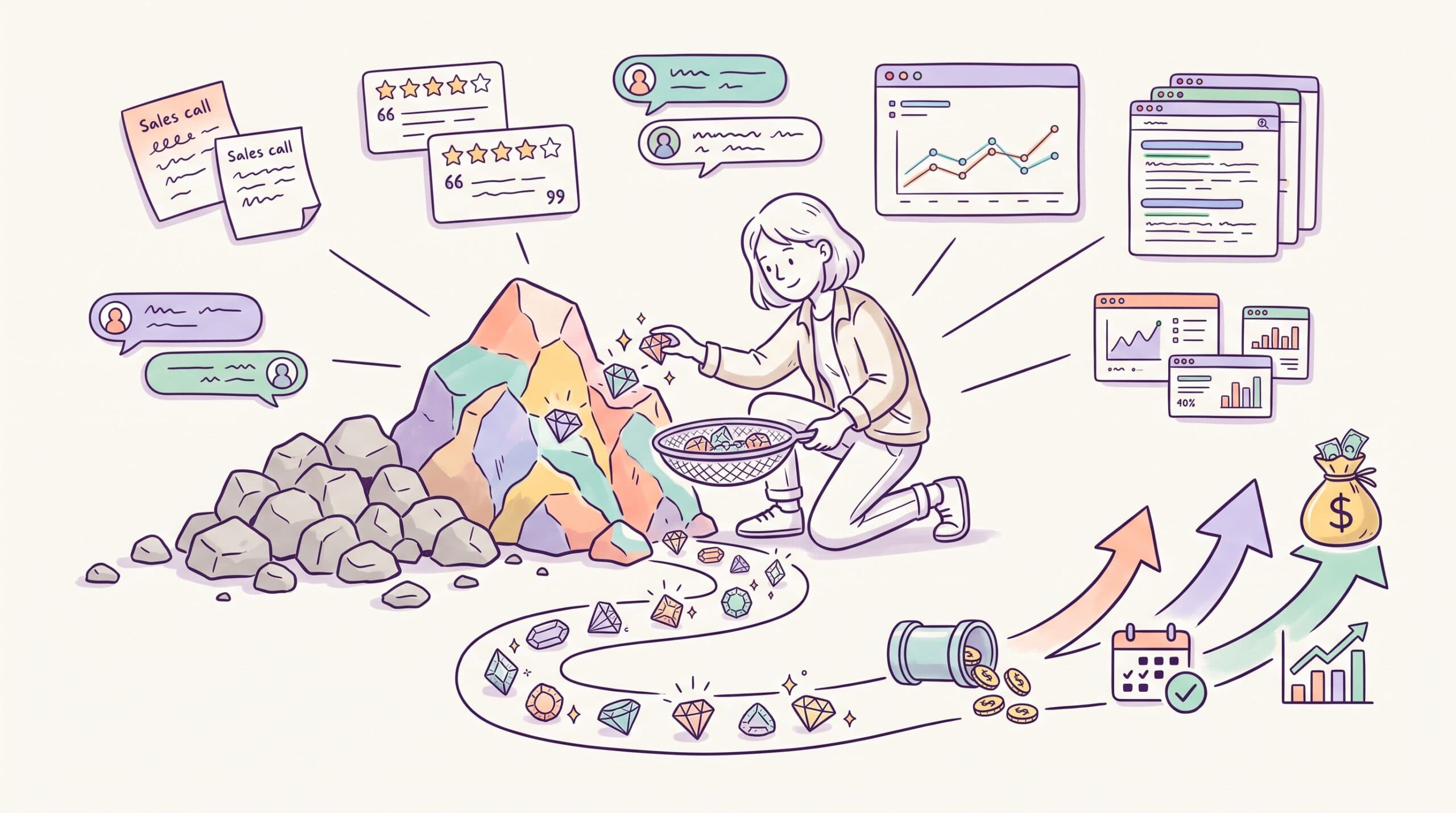

You already know traffic alone won’t keep your content budget safe. When the CFO asks what the blog contributed to the pipeline last quarter, “sessions grew 40%” is a weak answer.
Bottom of funnel keywords give you a better answer.
In this guide, I’ll walk you through six ways to find these keywords for your B2B SaaS company, plus a simple way to decide which ones to write first.
What are bottom of funnel keywords?
Bottom of funnel (BOFU) keywords are search queries people use when they’re close to buying.
Someone searching “Mixpanel alternatives” has a problem, a budget, and a shortlist. Your job is to get on that shortlist before they book a demo with someone else.
Top-of-funnel keywords sit at the other end. They come from people learning about a topic, with no signal that they’ll ever pay for a solution.
| Top of funnel | Bottom of funnel | |
| Example query | “what is product analytics” | “Mixpanel vs Amplitude” |
| Searcher’s goal | Understand a topic | Choose a product |
| Distance from revenue | Far | One or two clicks |
| Typical conversion | Under 0.5% | 2 to 8%+ |
That conversion gap is well documented. Grow & Convert tracked conversions across hundreds of client blog posts and found that comparison and alternative keywords converted at 8.43% on average, with category keywords at 4.85%.
Their broader analysis found that BOFU posts converted thousands of percentage points better than top-of-funnel ones.
Finding the keywords is step one. Turning them into pages is a separate job: creating bottom of funnel content means answering the questions that decide a purchase.
The 6 types of bottom of funnel keywords
Buying-intent searches fall into five groups: category, comparison and alternative, use case, pricing, and review keywords.
Each one maps to a question your buyer asks as they move toward a purchase decision.
Once you know the five shapes, you’ll spot them everywhere.
Category keywords
These name the thing you sell. Think “subscription analytics software” or “SOC 2 compliance platform.”
The person searching is shopping the category and building a list of options. If your product fits the description, this keyword belongs to you as much as to anyone else.
Comparison and alternative keywords
These are searches like “Ahrefs vs Semrush” or “Jotform alternatives” that come from buyers who already know the players.
They’re weighing options and are often one bad experience away from switching. These convert better than any other keyword type, which makes them the crown jewels of BOFU research.
Use case keywords
These keywords mix a category team with a job, role, or industry. Examples here include “CRM for real estate agents,” and “helpdesk software for Shopify stores.”
Specificity is the intent signal here. Nobody adds “for Shopify stores” to a search unless they run one and plan to fix the problem.
Pricing keywords
Searches like “Gong pricing” or “how much does a B2B case study cost” come from someone building a budget. A live purchase decision lies behind each of them.
I rank for a pricing keyword myself with my article on B2B case study costs, and the leads it brings arrive knowing what they want to spend.
Review keywords
Searches like “Todoist review” or “is Apollo worth it” are last-mile due diligence. The buyer has a favorite and wants confirmation before they commit. Content targeting these keywords catches people hours or days from a decision.
Jobs-to-be-done keywords
These describe a task or problem your product solves, phrased the way someone experiencing it would type it.
Examples of these keywords could be “how to automate invoice reminders,” “how to run standups across time zones.”
The searcher may not know your category exists yet, but they have the problem right now, and whoever solves it in front of them earns the first shot at the sale.
These sit furthest from the purchase of the six types, but they convert far better than generic informational content because the pain is live.
6 ways to find bottom of funnel keywords
Start with the people closest to your buyers, then widen out to tools. Working in this order keeps your list grounded in the language real customers use, instead of whatever a keyword database happens to contain.
1. Mine your sales calls and customer reviews first
Your sales team hears bottom of funnel language all day.
Ask them three questions:
- Which products do prospects compare us to?
- What frustrations do they mention about their current tool?
- What objections come up before they sign?
Every answer is a keyword seed.
Say your sales team comes back with a statement like, “They keep asking if we integrate with HubSpot.” You can map it to a keyword like “[your category] with HubSpot integration.”
Competitor reviews turn that same idea outward.
Try it now.
Open your biggest competitor’s G2 profile, scroll to the reviews, and filter by 1- and 2-star ratings.
Angry customers spell out exactly why they’re leaving or what they’re frustrated with about their current tool.
If five reviews complain about the same missing feature, you’ve found both a keyword and the opening section of your alternatives page.
Here’s an example from Vista Social’s G2 page. You can see that billing issues were consistent in both 1-star reviews.

If you run product-led growth without a sales team, add one question to your onboarding survey: “What did you search for when you were looking for a tool like ours?” The answers are keywords straight from the source.
2. Build a product-times-modifier keyword list
Write down every feature, product, and use case you serve.
Then cross each one with the standard buying-intent modifiers: software, tool, platform, vs, alternative, pricing, cost, review, and “for [industry or role].”
The five keyword types above become your modifier groups.
Say you sell a social media scheduling tool; your keyword list might look like this:
| Modifier group | Pattern | Example keywords |
| Category | [product] + software/tool/platform | social media scheduling software, social media scheduler tool |
| Comparison | [competitor] vs / alternatives | Hootsuite alternatives, Later vs Buffer |
| Use case | [product] for [role/industry] | social media scheduler for agencies, scheduling tool for real estate |
| Pricing | [competitor/product] + pricing/cost | Sendible pricing, social media tool cost |
| Review | [competitor] + review | Sprout Social review |
A product with ten features and five target industries can produce a few hundred candidates in an afternoon. For a deeper set of modifiers across every funnel stage, Noah Lerner’s funnel-stage term list is the best free resource I’ve found.
Don’t judge any keyword yet. This step is about the volume of ideas. Methods five and six will filter them.
3. Listen in communities where your buyers ask for recommendations
Buyers ask their peers before they ask Google.
I’m in Superpath and Exit Five, two Slack communities for content marketers, and time and time again, someone posts a question about tools/software and what they want to achieve with them.
Here are two examples:


Find the two or three private communities where your buyers hang out and read the recommendation threads. The phrasing people use when asking peers is often looser than what tools suggest, and it’s the phrasing they type into search five minutes later.
Reddit is a goldmine as well.
Rather than browsing subreddits and hoping, search Google for “site:reddit.com [competitor] alternatives” or “site:reddit.com switching from [competitor]”.
The threads that surface show you the exact complaints driving people to switch and the tools commenters recommend as replacements. Each recurring complaint is a subheading for your alternatives page, and each recommended tool is a “vs” keyword candidate.
Here’s a simple search for “site:reddit.com profound alternatives”

When you click through the threads, you’ll notice a consistent theme: users consider Profund geared towards enterprise companies and are looking for cheaper options.
Facebook and LinkedIn groups work the same way, with one caveat. Public threads are easy to find, so your competitors have likely already mined them. Private Slack and Discord communities give you language nobody else is watching.
4. Check Search Console for keywords you already rank for
Your fastest BOFU wins are usually hiding in Google Search Console.
Open the performance report, set the date range to the last three months, then filter your queries for buying-intent terms. The quickest way is a custom regex filter on the Query dimension:
vs|alternative|pricing|review|best|tool|software
Turn on the average position, then look for queries ranking between 5 and 20.
These are keywords Google already associates with your site. You just haven’t given them a strong enough page.
Here’s what that looks like for my website:

Notice how most of these keywords have a commercial intent behind them.
When you find one, resist the urge to create something new. Find the page that’s ranking, add the query to a heading, and build out a section that answers it directly. Updating an existing page can move rankings in weeks, while a new page takes months to earn the same position.
I’d run this check before any other method if you have an established blog. It costs nothing, and the keywords come pre-validated since you’re already appearing for them.
5. Validate intent on the SERP before you write
Google every keyword before adding it to your calendar. The search does two jobs: it confirms the keyword’s real intent and hands you more keywords for free.
First, the intent check.
Look at what’s on page one. If you see product landing pages, comparison posts, and review sites, buying intent is confirmed.
If you see definitional guides and beginner explainers, Google has decided the keyword is informational, and no amount of commercial copy will rank there.
Modifiers can mislead you. “Best practices for onboarding” contains “best,” but the SERP is all how-to guides, so it’s an informational keyword wearing a BOFU costume.
Then, mine the SERP features while you’re there:
- Autocomplete. Type your seed term and pause before hitting enter. The suggestions are searches that real people run. “Hootsuite alternatives,” for instance, autocompletes into “Hootsuite alternatives free,” “Hootsuite alternatives for small business,” “Hootsuite open source alternatives,” which all deserve their own distinct pages.

You can find more keyword ideas by replacing “alternatives” with “vs,” “best,” or other letters of the alphabet.
- People Also Ask. Expand a few PAA questions, and Google loads more. Questions like “Is [competitor] worth the price?” become FAQ entries or full review articles, and they show you the exact phrasing buyers use.

- Related searches. Scroll to the bottom of the page. This block often surfaces use-case variations (“[tool] for small teams”) you didn’t brainstorm.

This step takes a minute per keyword and saves you from the most expensive mistake in content: writing a bottom of funnel page for a top-funnel search.
6. Use keyword tools last, and don’t trust the volume
It’s time to bring out your tools now.
Notice how it’s the last method I mention? It is by design. As marketers, we’re often tempted to start with these tools, which, in most cases, help us find keywords that hundreds of companies have already covered.
Here’s a better way to use these keyword tools.
- Expand your list in Ahrefs or Semrush.
For this article, I’ll stick with Semrush.
Let’s use “crm software” as the seed term. Drop the seed term into Keywords Overview.

Click “View all keywords” under Keyword ideas.

Add an “Include keyword” filter with your modifiers (vs, alternative, pricing, for, review), then click “Apply.”
This surfaces every variation the tool knows about, with difficulty scores to gauge what’s winnable.

I like to sort the keywords by CPC to find the most “valuable” ones in terms of how much brands are willing to bid on them.

- Run a content gap against competitors.
Compare your domain to two or three rivals and filter the results by the same modifiers. The keywords they rank for and you don’t are a pre-built roadmap.
- Add Keywords Everywhere if you don’t have an enterprise tool.
It’s a browser extension that costs a few dollars a month and overlays volume and CPC data directly on Google as you work through method five. The CPC column is useful: when advertisers pay $15 a click for a keyword, that’s the market telling you it converts.
One warning applies to every tool. Don’t let the volume column make your decisions.
Niche B2B comparison keywords often show 10 to 30 searches a month, and tools get shaky at the low end because they estimate from sampled data. A keyword with 20 monthly searches from people holding budgets beats one with 2,000 searches from casual browsers.
Some of the highest-converting pages I’ve written target keywords a tool would tell you to skip.
How to prioritize which keywords to target first
Run every keyword through three filters: revenue proximity, ranking feasibility, and existing assets.
Revenue proximity asks how close the searcher is to a purchase.
Ranking feasibility asks whether page one is winnable, based on the SERP check..
Existing assets ask whether you already have a page that could rank with an update.
That gives you a natural sequence:
- Search Console quick wins. Existing pages, existing rankings, fastest results.
- Comparison and alternative keywords. Highest conversion rates of any type.
- Pricing and review keywords. Buyers at the decision point, usually low competition.
- Category keywords. High value, but often the hardest SERPs, so build authority first.
- Use case keywords. A long tail you can expand into for months.
Volume sits nowhere in that list on purpose.
A single well-placed BOFU article can carry serious commercial weight. One comparison-style piece I wrote for Zapier saves them around $20K a year they’d have otherwise spent on ads for the same amount of traffic.
Once you’ve picked your first five keywords, the production side is writing SEO content that ranks and converts, with one page built around each buyer’s question.
How bottom of funnel keywords show up in AI search
BOFU queries are exactly the kind of queries AI search loves to answer directly.
Ask ChatGPT or Google’s AI Overviews “best subscription analytics tools for SaaS,” and you get a synthesized shortlist instead of ten blue links.
If your product and your content aren’t feeding those answers, you’re invisible at the highest-intent moment.
Three things follow from that. Being a cited source now matters as much as ranking because AI answers pull from pages it trusts.
Structured content wins, since comparison tables and clear headers are what these systems extract.
And brand mentions across reviews and communities feed the models, which makes methods one and three double as AI visibility work.
This is the same way I’ve been able to show up on AI answers when prospects ask about my services.

More proof.

I’ve written a full guide on optimizing content for AI search, and if you want to track where your brand appears in AI answers, start with these AI visibility tools.
Your buyers are searching. Someone else is showing up.
Right now, people are Googling “[your competitor] alternatives” and “[your category] for [their industry]” with budget in hand.
If your pages aren’t ranking for those searches, those buyers book demos with whoever is. Every month that gap stays open, you’re paying for it twice: once in the pipeline that goes to competitors, and again in the ad spend covering keywords your content should own organically.
I’m Nathan, a freelance content writer and SEO strategist for B2B SaaS companies, and I can help you close that gap:
- I map the bottom of funnel keywords worth targeting. Everything in this article, done for you: your comparison, use case, pricing, and review keywords, validated against the SERP and prioritized by revenue proximity, so you know exactly what to publish first.
- I write the content that captures them. Comparison pages, alternatives roundups, and bottom of funnel articles built to rank and convert, with your product woven into the piece instead of bolted on as a CTA.
Frequently asked questions about finding bottom of funnel keywords
What is an example of a bottom of funnel keyword?
“Hootsuite alternatives” is a classic one. The searcher already uses or has evaluated Hootsuite, wants something different, and is actively comparing replacements. Other examples include “CRM for real estate agents,” “Gong pricing,” and “Clari review.”
How do I know if a keyword is bottom of funnel?
Google it and study page one. If the results are product pages, comparison posts, and reviews, the keyword has buying intent. If the results are guides and explainers, it’s informational, regardless of how commercial the phrasing looks.
Are low-search-volume keywords worth targeting?
Yes, especially in B2B SaaS. A comparison keyword with 50 monthly searches can generate more pipeline than an informational keyword with 5,000 monthly searches, because every searcher is a potential buyer. Keyword tools also underestimate volume at the low end, so the real number is often higher than reported.
What’s the difference between bottom of funnel keywords and long-tail keywords?
Long-tail refers to length and specificity, while bottom of funnel refers to intent. Many BOFU keywords are long-tail (“helpdesk software for Shopify stores”), but plenty of long-tail keywords are informational.
The useful long-tail keywords for B2B are the buyer-focused kind, with a product, use case, or problem in the query.