A professionally written B2B case study typically costs between $800 and $2,000.
Where you land in that range depends on whether customer interviews are included, how complex the product and outcome story are, and how much back-and-forth you expect before final approval.
Rush fees, legal review cycles, and multi-stakeholder sign-off can push the total cost higher than the writing fee alone.
Case study pricing is one of those areas where the sticker price and the actual cost to your business are two different things.
A $200 case study that sits unused on your website is more expensive than a $1,500 one that your sales team sends to every prospect in late-stage evaluation.
What drives case study pricing
Case studies cost more than standard blog posts, and there are concrete reasons for that.
It’s worth understanding the difference and the factors affecting case study pricing before you evaluate any quote.
Customer interviews
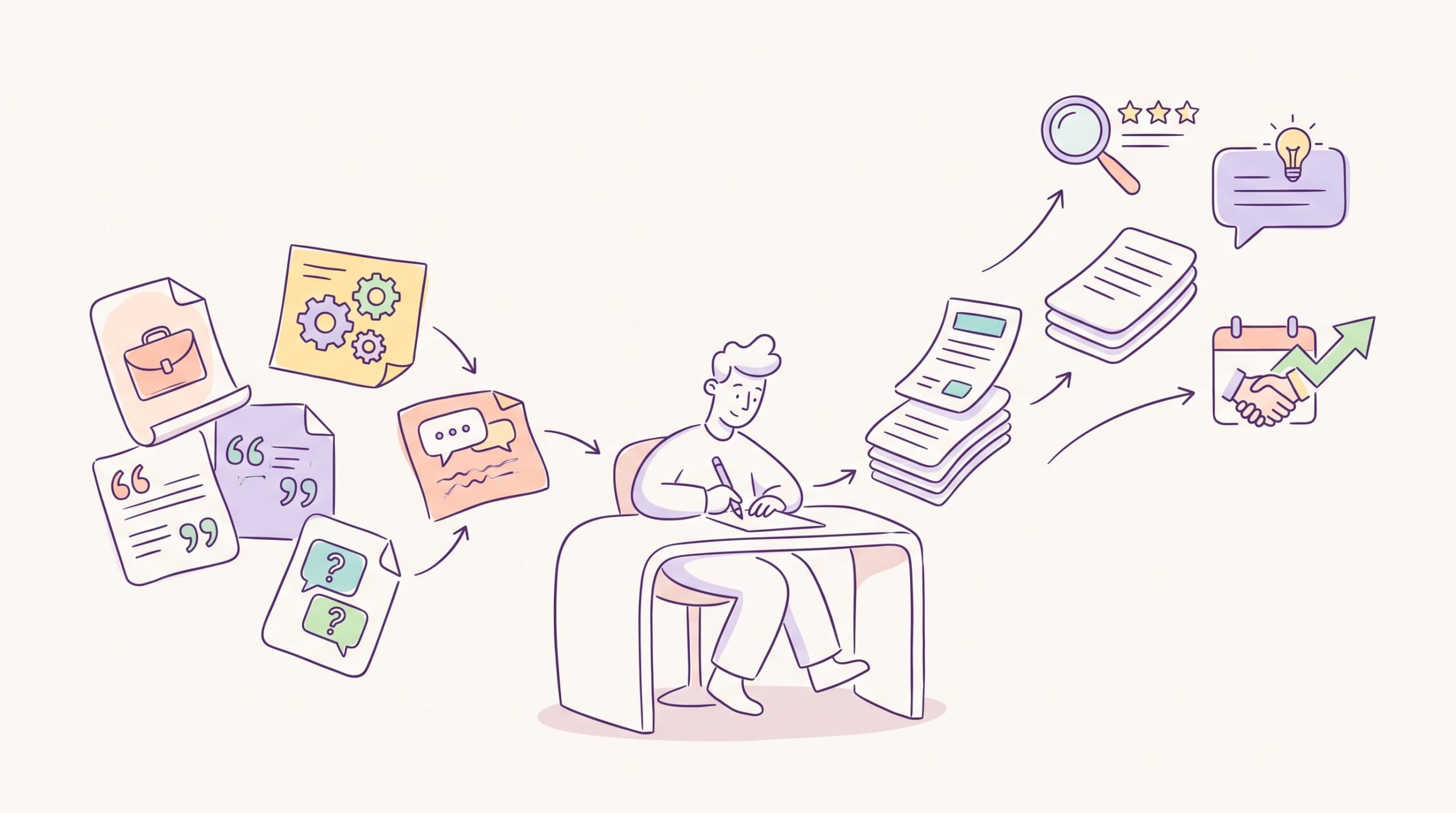
A well-written case study requires scheduling a call with your customer, conducting a structured interview that draws out specific outcomes and honest friction. And then turning 45–60 minutes of conversation into a narrative that prospects will read.
That’s a different skill set from writing a how-to article, and it takes more time.
Multi-party coordination
You’re not just working with one person. You need sign-off from the customer, their marketing or legal team, your own team, and sometimes a PR contact.
A case study that would take three days to write can spend three weeks in approval limbo.
Writers who have done this before price that coordination into their rate. Writers who haven’t often don’t—and you find out the hard way.
Research depth
Strong case studies require understanding the product, the customer’s situation before they found you, the specific problem they were trying to solve, and the measurable change that followed.
A writer who doesn’t understand your product category will write around the specifics instead of into them, and buyers notice.
Revision cycles
Case studies undergo more rounds of revision than blog posts.
Customers want their story told accurately. Legal wants hedging language added. Your CEO wants the outcome numbers emphasized differently.
A writer with case study experience builds at least two rounds of revision into the scope of work. One who doesn’t will typically charge you extra for each round after the first.
Rates by scope and format
Not all case studies are built the same. Here’s how pricing typically breaks down by format — and how it stacks up against other B2B content types:
| Format | Typical Rate | What’s Included |
| Short-form customer story (500–800 words) | $400–$800 | Light interview or existing quotes, single outcome, minimal research |
| Standard case study (1,000–1,500 words) | $800–$1,500 | Customer interview, problem-solution-result structure, 2 revision rounds |
| Long-form case study (1,500–2,500 words) | $1,200–$2,000 | Deep interview, multiple outcomes, stats, supporting quotes, full narrative arc |
| Case study + sales one-pager | $1,500–$2,500 | Full case study plus a condensed PDF version formatted for sales use |
| Full case study program (3+ pieces) | $600–$1,200/piece | Volume discount, consistent template, writer learns your product once and carries that context forward |
If a writer is quoting you $200 for a “full case study,” ask what that includes.
Nine times out of ten, it means they’ll write from whatever you send them — no interview, no independent research, no follow-up with the customer.
The output will read exactly like what it is: a polished version of your internal notes with a few quotes sprinkled in.
What cheap case studies actually cost you
The $200 you paid to produce it is not the real cost. The deals it doesn’t move are.
One of the following usually happens when a case study is written without a real customer interview:
The outcomes are vague
You see phrases like, “Streamlined their workflow” instead of “cut reporting time from 4 hours to 40 minutes.”
“Improved team collaboration” instead of “reduced Slack back-and-forth by about 60%, according to their ops lead.”
These vague outcomes give a prospect nothing to hold onto and read like marketing copy because that’s exactly what they are.
No one talks like that. Buyers know no one talks like that. When a case study reads like a press release, the reader assumes the customer didn’t really say anything worth quoting—because they’re right.
The problem section is too thin
Most cheap case studies spend one paragraph on the challenge and four on the solution. But buyers in evaluation mode spend most of their mental energy on the problem.
If your case study doesn’t describe the customer’s situation before your product in specific, recognizable terms, the reader won’t see themselves in it. And if they don’t see themselves in it, the case study won’t move them.
Sales teams don’t use them
This is the real tell. Ask your sales team how often they send a given case study. If the honest answer is “we have it but don’t really use it,” that’s a problem.
What a case study that closes deals looks like
The case study I wrote for SimpleTexting about Makers Collective is a good example here.
Makers Collective is a non-profit that hosts the Indie Craft Parade, an annual two-day event that draws 9,000+ attendees in Greenville, South Carolina.
Their specific problem: because the venue handled ticket sales directly, they had no way to collect attendee contact information after 13 years of running the event.
That’s a concrete, structural constraint. Any event organizer reading that piece would immediately recognize it. And that recognition is what makes a case study feel credible rather than promotional.
To get there, the piece was built from call transcripts of two real conversations—with Lib Ramos, the creative director at Makers Collective, and Jackie Soladay, the marketing consultant who recommended SMS marketing as a solution.
Both transcripts surfaced details you’d never get from a brief. Lib mentioned they’d been doing billboard ads and radio ads since 2010. Jackie cited the 98% open rate specifically for SMS. The client conducted the interviews. My job was to turn a raw transcript into a narrative that actually moved people—which is its own skill.
The result: Makers Collective grew their SMS contact list from zero to 472 subscribers. 472—a specific number your sales team can put in front of a prospect, not “significantly grew their list.”
That gap between a vague outcome and a specific one is what determines whether a case study gets forwarded or forgotten.
The interview is the work
Most clients underestimate how much the customer interview determines the quality of the final piece.
A writer who conducts a strong interview can build a compelling case study from a product with modest outcomes.
A good case study interview takes 45–60 minutes and covers:
- What the customer was doing before (the old way, with its specific friction points)
- What made them decide to change
- What the evaluation process looked like—who was involved, what almost made them choose something else
- What implementation was actually like (the messy middle matters to buyers)
- What changed after, with specific numbers where possible
- What they’d tell someone who was considering the product today
What to ask before hiring a case study writer
A few questions worth putting to any writer before you commission a case study:
- Do you conduct the customer interview yourself, or do you write from a transcript I provide?
Both approaches can work. But a writer who conducts the interview can ask follow-up questions in the moment, which is where most of the best material comes from.
- What’s your approach to getting usable quotes?
This reveals a lot about whether they’ve actually done this before. A good answer involves specific techniques, such as asking for the customer to describe a moment rather than a feeling, asking what they’d tell a colleague who was considering the product, circling back to earlier answers.
- How do you handle approval cycles?
A writer who hasn’t dealt with legal, CS, and customer sign-off before will give you an optimistic answer here. Someone who has will tell you to expect weeks or even months from first draft to final approval, and they’ll ask you to own the customer relationship so they can focus on the writing.
Frequently Asked Questions about what case studies cost
Is it worth paying more for a writer who conducts the customer interview vs. writing from notes I provide?
Usually yes. A writer conducting the interview can ask follow-up questions in real time, which is where the specific details that make case studies credible tend to come from.
If you provide a transcript, you’re limiting the writer to what was already asked. The upside of handling the interview yourself is speed and control.
Why do case studies take so long to produce?
The writing itself is usually the shortest part. What kills timelines is approval and the multiple loops the case study has to go through.
Customers need to review it. Their legal team often does too. Your own team has notes. Three weeks from interview to published piece is considered good. Six weeks is common. Build that into your expectations before you start.
Should I use a case study template to save money?
Templates are useful for structuring the output, but they don’t replace the research and interview that make a case study worth reading.
A template filled in with generic information produces a generic case study. The structure is the least important part.
How many case studies do I actually need?
A useful minimum for most B2B SaaS companies is one strong case study per target segment or buyer persona. If you sell to both SMB and enterprise, you need at least two.
If you serve multiple verticals, each vertical should have its own. One all-purpose case study trying to speak to every buyer usually speaks convincingly to none of them. If you’re a B2B SaaS company looking for case studies that give your sales team something they’ll use, book a discovery call and let’s talk about what you’re trying to build.