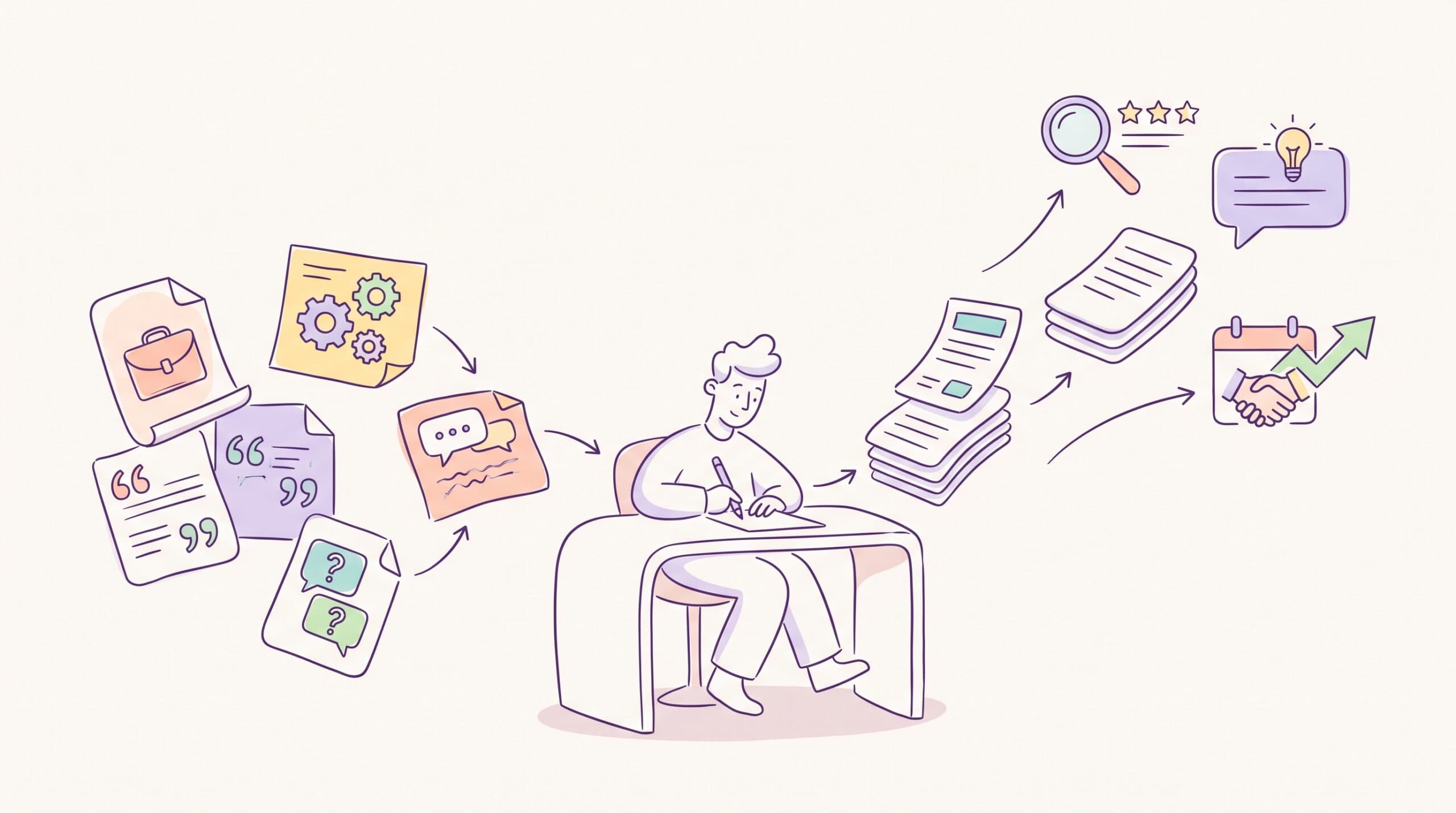

Think about the last time you ordered at a restaurant. You opened the menu, read two lines about a dish, and pointed at it. Those two lines had one job, and they did it in about ten seconds. Now think about a cookbook from a chef you love. Each recipe gets a page or two, and by the end you can cook the dish yourself, and you trust that kitchen a little more than you did before.
That’s the whole difference between a copywriter and a content writer. Copywriters write menus. Content writers write cookbooks. Your SaaS site needs both, and a few of its pages need both on the same page, which is where hiring tends to go sideways.
So let’s sort it out. I’ll walk you through which writer each page on a B2B SaaS site needs, what each one costs as of November 2026, how to tell them apart from a portfolio, and a small paid test you can run before you sign anyone.
Copywriter vs content writer at a glance
Before we go page by page, here’s how the two jobs compare side by side.
| Copywriter | Content writer | |
| Main job | Get the reader to act now | Teach, rank and earn trust over time |
| Typical B2B SaaS pages | Homepage, pricing page, product pages, ads, landing pages, emails | Guides, comparison and alternatives pages, case studies, newsletters |
| Usual length | A few words to about 1,000 | About 1,200 to 3,000 words |
| How you judge the work | Conversion rate, demo requests, clicks | Search traffic, mentions in AI answers, sign-ups and pipeline from the page |
| What they research | Your buyer’s objections and your positioning | The topic, the search results and your experts |
| Typical rate (EFA 2026 median ranges) | 32¢–87.5¢ a word or $65–$75 an hour for business and marketing writing | 25¢–45¢ a word or $74.50–$87.50 an hour for blog posts |
The rates come from the Editorial Freelancers Association’s 2026 rate chart, which sorts work by type rather than job title, so read them as a starting range, not a quote.
What a content writer does at a B2B SaaS company
Content writing is long-form writing that teaches, ranks in search and earns trust over months. In restaurant terms, it’s the cookbook. A content writer’s pages answer the questions your buyer types into Google, or asks ChatGPT at 11 p.m. the night before a vendor call. How do I fix this? Which tool should I pick? What will it cost? Has a company like mine done this before?
Gong’s blog shows the job well. Its guide to sales discovery questions walks a sales rep through the questions to ask at each stage of a deal, down to aiming for 11 to 14 targeted questions per call. Nobody finishes that guide and books a demo on the spot. They read it, run a better call on Tuesday, and remember who taught them. That memory is what a content writer is building.

Behind a page like that sits a lot of work you never see.
- Research. Reading the pages that already rank, finding the questions behind a keyword, and checking every number before it goes in.
- Interviews. Talking to your product team, your customers or a subject expert, so the page says something your buyer can’t find on ten other blogs.
- Structure. Laying the page out so a skimming reader, Google and an AI tool can each pull out the answer they came for.
- Patience. A good guide usually takes months to rank and bring in pipeline, so you judge a content writer on traffic, AI answer mentions and the demos a page brings in over a quarter or two, not over a weekend.
This is most of my week. As a B2B SaaS content writer, I write guides, comparison pages and alternatives pages for software companies, the pages a buyer reads while they’re still deciding.
What a copywriter does
Now flip back to the menu. Copywriting is short, persuasive writing that gets a reader to act now. A copywriter writes the words your buyer reads at the moment of deciding: the homepage, the pricing page, the ad, the subject line, the button. The Bureau of Labor Statistics describes copywriters as writers who “prepare advertisements to promote the sale of a good or service.” In SaaS, that sale is usually a demo or a trial.
Look at Gong’s homepage. The headline is seven words: “Revenue AI built to close deals faster.” Its ending rotates, so on another visit it reads “predict pipeline risk.” Each version makes one promise, and two buttons sit right under it. That’s the job in one screen: one promise and one next step, read in the time it takes to scroll.

If you’ve ever stared at your own homepage and felt it says everything except why anyone should care, that’s a copywriting job. A copywriter fixes it with skills a content writer uses less often.
- Positioning. Deciding the one thing the page says, and what it leaves out.
- Objections. Knowing why a buyer hesitates (price, the pain of switching, whether the team will use it) and answering that worry in a line.
- Testing. Writing three versions of a headline or subject line, so you can find out which one people click.
Copy gets judged fast. Change a pricing page headline on Monday, and you can often see the effect on demo requests within a couple of weeks.
Where the two jobs overlap
Back to the restaurant one more time. The best line on any menu is the dish description: “Slow-roasted lamb, smoky aubergine, mint yogurt.” It tells you what’s on the plate, and it makes you hungry. Teaching and selling, in six words.
Some SaaS pages need that same double act, only at 2,000 words. A comparison page or an alternatives page has to rank in Google, explain two products fairly, and then ask for the demo without sounding rigged from the first line. Use-case pages and case studies sit in the same spot. And every blog post, however long, still has a headline someone has to click and a call to action at the end.
This is where teams usually hire the wrong person, and it stings, because you only find out weeks later. Hand a comparison page to someone who has only written ads, and you tend to get a page that sells hard and falls apart the moment a buyer checks a price against the vendor’s own pricing page. Give it to someone who has only written top-of-funnel blog posts, and you get a fair, thorough page that never asks for anything. Either way, the page gets traffic and nobody books.
For these pages, hire one person who can do both, or pair a content writer with a copywriter’s edit on the headline, the intro and the call to action. If I could only pick one, I’d pick the researcher. A buyer forgives a plain sentence much faster than a wrong price.
Which writer each B2B SaaS page needs
Here’s the test I’d teach your whole team, because it fits in one breath: ask what the reader should do the second they finish the page. If the answer is “act now” (book, buy, start, reply), that’s copy. If it’s “understand this and remember us when they’re ready,” that’s content. If it’s both, you need someone who writes both.

Run the same test on every page a B2B SaaS site usually has, and you get this table.
| Page | Who should write it | Why |
| Homepage | Copywriter | One promise, read in seconds |
| Pricing page | Copywriter | Answers price and plan objections |
| Product and feature pages | Copywriter, with help on long use-case detail | The job is a demo or a trial |
| Paid ad landing pages | Copywriter | Judged on conversion within days |
| Onboarding and sales emails | Copywriter | One action per email |
| Sales one-pagers | Copywriter | Short and persuasive |
| Blog guides | Content writer | Research, search and teaching |
| Newsletter | Content writer | Teaching on a regular schedule |
| Case studies | Content writer with copy skills | An interview and a story, then a call to action |
| Comparison and alternatives pages | One person with both skills | Has to rank, explain fairly and close |
| Use-case and industry pages | One person with both skills | Search demand plus a conversion job |
| Help docs and API docs | A technical writer | Accuracy over persuasion |
If you’re hiring for the first time, start with the pages closest to a purchase. Comparison and alternatives pages are usually where one good page turns into demos soonest, and they’re the work a bottom-of-funnel content writer does all day.
What each costs
Money is where these conversations usually get awkward, so let’s put the numbers on the table. All of them are as of November 2026.
Content writers. The EFA’s 2026 chart, built from more than 1,100 survey responses about work done in 2025, puts work-for-hire blog posts at a median range of 25¢ to 45¢ a word, or $74.50 to $87.50 an hour. At those rates, a 1,500-word post comes to about $375 to $675. Writers who know B2B SaaS and can interview your experts usually charge more. My articles start at $700.
Copywriters. The same chart puts business and marketing writing at 32¢ to 87.5¢ a word, or $65 to $75 an hour. ProCopywriters’ 2026 survey of 573 UK writers puts the median freelance day rate at £440, up 10% in two years.
Per-word rates make copy look cheap. Gong’s seven-word headline packs in more decisions per word than a typical blog post: what to promise, what to leave out, which version to test. That’s why copywriters usually price a homepage or a pricing page as a project or by the day. Ask for a fixed price, and ask what it includes, like the number of drafts and the versions you get to test.
One person or two. For a small team, one writer who does both usually costs less than two specialists, because you write one brief, run one onboarding and give feedback once. Two specialists start to make sense when a content program and paid campaigns run side by side. Before you sign, compare any quote against content writer rates by experience level and what an SEO copywriter charges.
How to tell them apart in a portfolio
Portfolios can be confusing, because one person might show you a homepage, an ebook and a blog post on the same page. Ask for the samples that match the job you’re hiring for.
- From a content writer, ask for two long pieces with live links. One that ranks, with a screenshot from Search Console or a rank tracker, and one built from an interview with an expert or a customer.
- From a copywriter, ask for a before-and-after. The old page or email, their version, what changed in conversion, reply rate or clicks, and the brief they worked from.
- From anyone, ask who edited the work. A heavily edited sample shows you the editor’s skill as much as the writer’s.
Some gaps in a portfolio call for one more question before you decide.
- Ghostwritten samples you can’t verify. Ask for a reference from that client instead.
- Results with no time frame. Ask “over how long?”
- Long pieces with no sources. Ask how they research a topic they don’t know yet.
- Copy with no stated goal. Ask what the page was supposed to make the reader do.
A paid test brief for each role
A portfolio only shows you the finished dish. To see how someone cooks in your kitchen, what they ask, how they take feedback and whether they get your product, run a small paid test. Good writers usually turn down unpaid tests, and paying keeps it fair to both sides. Keep it small enough to finish in a few hours.
The content writer test. Ask for one section of a comparison page or guide, about 600 to 800 words. Give them the keyword, your notes and a 20-minute call with someone on your team who knows the product. A good result starts with questions before any writing, describes your product correctly, and answers the reader in the section’s first two lines instead of warming up.
The copywriter test. Ask them to rewrite your pricing page header and three email subject lines, with one line explaining each choice. A good result names the buyer’s worry it’s answering and gives you options to test, rather than one “perfect” line.
You’ll learn more from those few hours than from any interview. Pay attention to how the questions feel. A writer who asks about your buyer before they ask about word count is usually the one you want.
One person or two? It depends on your stage
The right answer changes as your company grows, the same way a SaaS marketing plan changes by stage.
- Before product-market fit. The founder writes. Nobody else knows the buyer’s words yet, and those words are the raw material every writer you hire later will need.
- Early traction. One freelancer who writes both, starting with comparison and alternatives pages.
- After product-market fit. A content writer, or two, for a steady program, plus a copywriter for launches, ads and the homepage.
- Scaling. An in-house content team, with copy owned by product marketing or a dedicated copywriter.
What AI changes for each role
If you’re wondering whether you need either of them now that ChatGPT can write a homepage in seconds, you’re not alone. Writers are asking the same question about themselves.
In Orbit Media’s 2026 survey of 1,042 bloggers, 92.4% use AI for blogging, yet only 13.9% say their blog delivers strong results, the lowest share in the survey’s history. Orbit’s conclusion is blunt: using AI doesn’t improve content performance. Copywriters are in the same place. 74% of UK copywriters now use generative AI, and 64% say they’d erase it from the world if they could. The Bureau of Labor Statistics projects no job growth for writers and authors from 2025 to 2035 and expects AI to “dampen demand.”
So a first draft is cheap now. It was also never the hard part. What you pay a writer for is everything around the draft: the interview with your customer, the decision about what your homepage leaves out, the price they checked twice, and the call that a paragraph is accurate but boring. When you interview a writer, ask how they use AI, and then ask where they refuse to.
FAQs
What’s the difference between copywriting and content writing?
Copywriting persuades a reader to act now, in short pieces like a homepage, an ad or an email, and it’s judged on conversions. Content writing teaches and builds trust over time, in longer pieces like guides and case studies, and it’s judged on search traffic and the pipeline a page brings in. Comparison and use-case pages need both.
Which is better, a copywriter or a content writer?
Neither is better. Each fits a different page. If the page’s job is to make someone act now, hire a copywriter. When its job is to teach and rank over time, hire a content writer. For comparison and use-case pages, hire someone who does both. The page-by-page table shows which writer fits each page.
Do copywriters or content writers earn more?
There’s no reliable split. The BLS counts both as writers and authors, who earned a median $76,910 in May 2025, and that figure leaves out self-employed writers, who make up 65% of the field. Freelance rates overlap too: the EFA’s 2026 median ranges run 25¢–45¢ a word for blog posts and 32¢–87.5¢ for business and marketing writing.
Is AI replacing copywriters and content writers?
AI is replacing first drafts faster than it’s replacing writers. 92.4% of bloggers and 74% of UK copywriters already use it, but Orbit Media found that using AI doesn’t improve results. The interviews, the positioning, the fact-checking and the judgement still need a person.
Can one person be both a copywriter and a content writer?
Yes, and for comparison, alternatives and use-case pages, that’s often who you want. Check their samples for both: a long piece that ranks and a short page or email with a result.
What’s the difference between an SEO copywriter and a content writer?
An SEO copywriter writes pages that have to rank and convert, like service and landing pages, while a content writer usually focuses on longer educational pieces. The roles overlap on bottom-of-funnel pages, so the line between an SEO copywriter and a content writer usually comes down to whether a page’s main job is ranking or converting.
So, which one do you hire?
Next time someone on your team asks which writer to hire, give them the restaurant. If people visit your site and don’t book, the menu needs work, so hire a copywriter. When nobody finds you, write the cookbook with a content writer. And if the page in question is a comparison page, find the person who can write the dish description, someone who teaches and sells in the same breath.
If your comparison and alternatives pages need to rank and win demos, book a call with me.