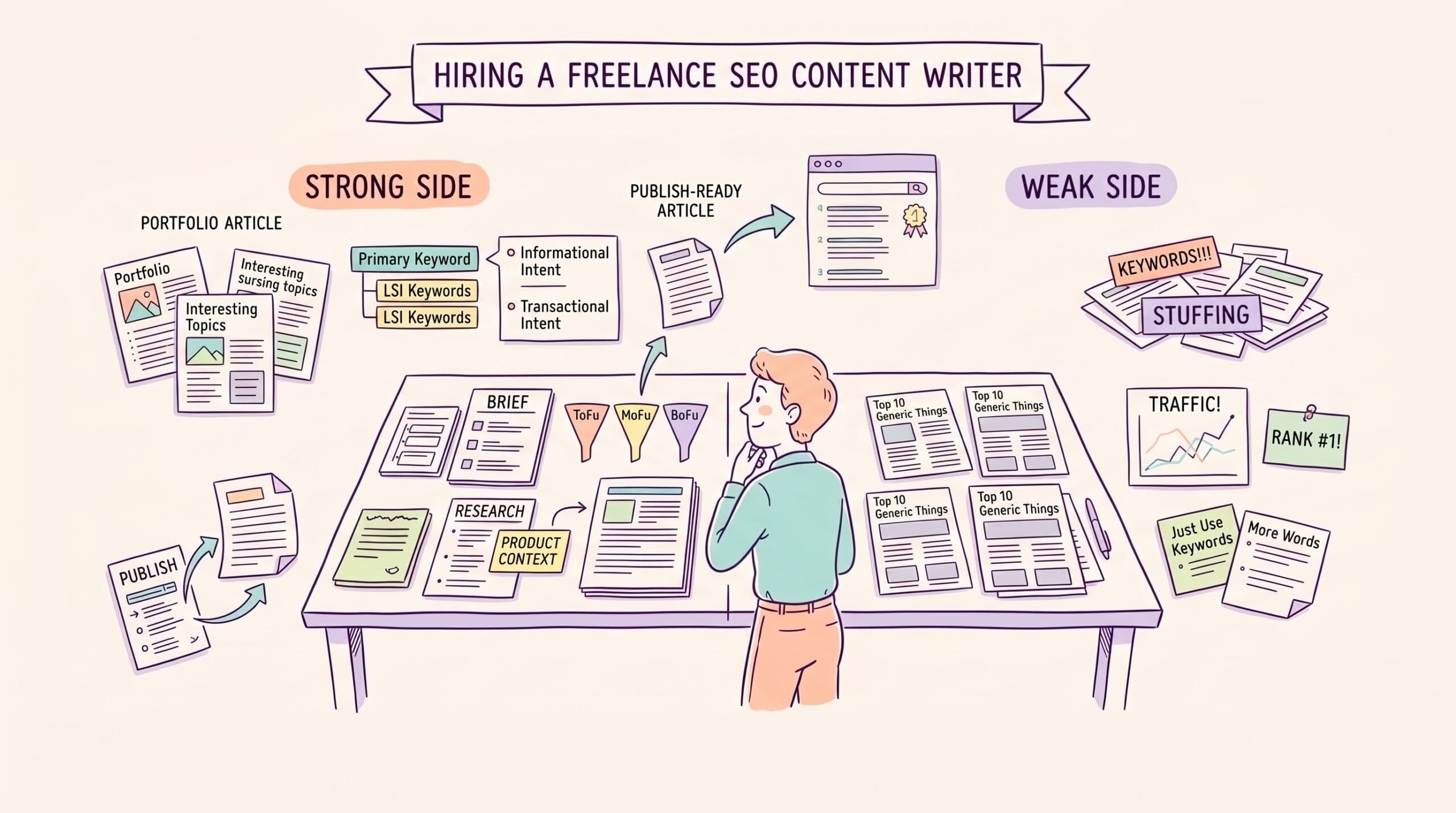

You’ve probably come across a few freelance SEO content writers who turned in articles that ranked decently but brought in zero leads. Or maybe you hired someone cheap, watched months go by, and realized the articles published during that time haven’t moved the needle on anything that matters.
The problem usually isn’t finding someone who can write. The problem is knowing what to look for before you hire—and understanding what a good freelance SEO content writer does, so you can tell the difference.
This guide covers both.
What does a freelance SEO content writer do?
The job title suggests someone who only writes articles with keywords in them. The actual job is more specific than that.
A freelance SEO content writer handles the research, structure, and writing that goes into a piece of content designed to rank organically and serve a reader at a specific stage in their decision process.
In practice, that means:
Keyword and intent research
Before writing, a good SEO writer figures out why someone is searching a particular keyword—not just what the keyword is.
For instance, “Project management software” and “project management software for small teams” might look similar, but they call for completely different articles.
The first is likely someone early in research mode. The second is someone with a specific need who’s comparing options.
SERP analysis
They look at what’s already ranking and why. What format does Google reward for this keyword? What do the top articles get wrong or leave out? That gap is where the angle comes from.
Outlining before drafting
A strong SEO writer builds the structure first. They decide which sections to include, what order makes sense for the reader, and where the product or service fits naturally—before writing.
Writing for a specific reader
The draft is written toward one person: someone with a specific job, a specific problem, and a specific thing they need to understand or decide after reading.
A generic article that addresses “marketers” broadly ends up useful to nobody in particular.
On-page optimization
After drafting, they handle a bit of the technical side. This could be keyword placement in the title, headings, and opening paragraph; internal links; a meta description; image alt text if relevant.
Coordination with your team
Depending on the engagement, they may interview subject matter experts, request product access, work from briefs your team writes, or collaborate with an SEO strategist who handles keyword research separately.
What they’re not responsible for: Your content strategy, your publishing calendar, or your distribution. Those belong to your team, or to a content strategist. A writer’s job is to take a well-defined assignment and turn it into a publish-ready article.
Freelance SEO content writer vs. SEO copywriter vs. content strategist
These titles get used interchangeably, and they shouldn’t.
An SEO content writer focuses on long-form organic content. This type of content includes blog posts, comparison pages, and product-led tutorials—content designed to rank and educate a reader.
An SEO copywriter typically works on shorter, higher-conversion pieces. Examples of an SEO copywriter’s work typically include landing pages, ad copy, product descriptions, and email subject lines.
The emphasis is on driving an immediate action, not ranking for an informational query. Some writers do both well, but the skills are built around different primary goals
A content strategist plans what content to produce, for whom, and why. They map topics to buyer stages, identify keyword gaps, set publishing priorities, and make sure the overall content program supports business goals. Most strategists don’t write the articles themselves.
If you don’t have a strategy yet, a strategist is the first hire. If you have a strategy and need someone to execute it, that’s where a freelance SEO content writer fits.
What skills does a freelance SEO content writer need to have?
Here are the things you should test for:
Search intent comprehension
This is the most important skill, and the hardest to screen for.
Give a candidate three different keywords and ask them to describe what format each article should take and why.
A query like “Best CRM software for startups” likely calls for a comparison roundup.
Something like “How to migrate from Salesforce to HubSpot” calls for a step-by-step guide.
“Is HubSpot worth it” calls for a piece closer to a review or cost-benefit breakdown.
A writer who can explain those distinctions without prompting understands search intent. One who says “they’re all blog posts about CRM software” does not.
Research depth
Good SEO content comes from doing the work others skip. That means going beyond the first page of Google, reading product documentation, interviewing subject matter experts when available, and pulling from primary sources rather than recycling what competing articles already say.
Ask to see research notes alongside a portfolio sample, not just the final draft. The draft can be polished after three editorial rounds. The notes show you the writer’s actual process.
On-page fundamentals
Title structure, heading hierarchy, meta descriptions, internal link placement, keyword use that doesn’t feel forced—a senior SEO content writer handles these without being reminded.
If you find yourself re-teaching someone what a meta description is every time you start a new piece, they’re not yet at the level you need.
Understanding where content sits in the funnel
A strong SEO writer asks: what should the reader do after finishing this article? That answer changes the structure, the CTA, and even the tone.
An article targeting someone in early research mode should end differently than one targeting someone actively comparing vendors.
If a writer can’t articulate the difference, their content will do the former job regardless of what you need it to do. If you’re producing bottom-of-funnel content meant to support buying decisions, this distinction is crucial.
The ability to work from a brief
Senior SEO writers don’t need to be managed paragraph by paragraph. They read the brief, ask clarifying questions before drafting, produce an outline for review, and return a first draft that’s close to publish-ready.
Watch for this during your trial piece. A writer who asks zero questions before starting, then returns a draft that misses the angle, is showing you what the working relationship will look like.
The one thing that wrecks good writers
Clients sometimes blame the writer when content doesn’t perform. But in my experience, writers aren’t always at fault.
Sometimes, the work often falls apart before the draft even starts.
Giving a great writer a bad brief is like giving a great chef a bad recipe. The food won’t turn out right regardless of the chef’s skill.
A bad brief might be a one-line Slack message: “Can you write something about project management for our target audience?” A good brief tells the writer the keyword, the specific reader, the funnel stage, the product angle, which competitors are already ranking, and what success looks like for that piece.
The clients who get the best work from freelance SEO content writers usually have clear briefs, a product angle the writer can work from, and access to product context or a subject matter expert. Those who get mediocre work often give the writer nothing to start with or just the keyword.
This isn’t unique to writing. Any skilled contractor produces better work when the inputs are good. If you want to know whether your briefs are part of the problem before evaluating the writer, check them against the context a writer needs when onboarding freelancers for content work.
Where to find a freelance SEO content writer
Freelance marketplaces
Upwork, Contra, and similar platforms give you fast access to a wide talent pool. The quality variance is significant, though. You’ll find entry-level writers and experienced specialists side by side, with no easy way to tell them apart from a profile alone.
Marketplaces work better when you have a low budget or a tight brief and a strong editorial process, so your team can catch weak drafts before they publish. If you’re relying on the writer to bring both the strategy and the execution, this channel is a harder bet.
Referrals and writer communities
Slack communities, LinkedIn searches, and direct referrals from people whose content you respect are where mid-to-senior writers tend to be found. This channel is slower to start but tends to produce more reliable results because someone has already vouched for the work.
Direct outreach to writers you’ve already read
If an article impressed you, say it ranks, is clear, and tinkles your fancy, find the byline.
Writers who’ve already produced the specific type of output you need are lower risk than unknown candidates.
The downside: they’re often booked out. But they’re also more likely to take on work that fits their specialty, which means a better result for you.
Enjoying the article so far? Want something similar for your company?
How to vet a freelance SEO content writer
Check whether their articles are ranking
Pull a few samples from their portfolio and run them through Ahrefs or Semrush. A well-written article that ranks for nothing is useful information. Good writing and ranking ability aren’t the same thing—you want to see both.
Ask them to explain one piece
“Walk me through how you approached this article” is a better signal than any portfolio review.
A strong answer covers why the article is structured the way it is, what the reader was trying to figure out, and what the writer chose to include or leave out and why. A weak answer summarizes the topic instead of explaining the decisions.
Run a paid trial
Use a real topic from your backlog. Pay for it. A 1,500-word test piece at the writer’s standard rate costs far less than two months of mediocre work on a retainer. Watch what happens when you give feedback—whether revisions land cleanly or open new problems tells you more than the first draft did.
Look at their own site
A writer who produces SEO content for a living and ranks for relevant keywords on their own site has put their method to the test publicly. That’s a stronger signal than testimonials. It’s not a dealbreaker if their site doesn’t rank—some strong writers don’t prioritize their own marketing—but when it’s there, it’s a plus.
For a more detailed breakdown of how to evaluate a candidate before hiring, the guide on evaluating freelance writers walks through the process step by step.
Red flags to watch for
Some of these only appear when you watch someone work, not when you read their portfolio.
They can’t name the keyword they targeted in a piece they’re proud of. If a writer submits their best work but can’t explain the search intent behind it, they may have produced that article under heavy editorial direction. Without it, the quality is likely different.
Their portfolio is all TOFU. If every sample is a “what is” article or an introductory guide, they’ve never had to produce content close to a buying decision. Comparison pages, alternatives articles, and buyer guides require different judgment. Someone who hasn’t written them can’t reliably do so.
They propose a word count before understanding the topic. Word count follows intent, not the other way around. A writer who leads with “I can do 2,000 words on this” without first asking who the reader is or what the article needs to accomplish is optimizing for deliverables, not outcomes.
They haven’t looked at your existing content before the first call. A writer who comes to an intro call without having read any of your published work is telling you something about how they approach context.
They ask zero questions before drafting. Good writers ask about the audience, the product angle, the CTA, and what success looks like. A writer who takes a one-line brief and goes quiet for three days usually comes back with a draft that misses the brief.
What to pay a freelance SEO content writer
There are three common tiers, and understanding what you get at each one makes the pricing make sense.
Entry tier: $75–$200 per article
The writer can produce a clean, readable draft that includes the target keyword in the right places. Research is mostly surface-level, usually pulling from the top Google results. They’ll need detailed briefs, may take several revision rounds, and typically won’t catch search intent issues on their own.
This tier works if your editorial process is strong enough to catch and fix gaps before publishing. If it isn’t, the revision time your team spends often costs more than the article did.
Mid tier: $250–$500 per article
At this level, the writer understands intent, does independent research, asks useful questions before drafting, and returns work that needs light editing rather than restructuring. They handle TOFU and MOFU content well and are starting to develop real judgment around product angle.
Most B2B SaaS teams should be working at this tier at minimum. It’s where the ratio of output quality to management time starts to make sense.
Senior or specialist tier: $500–$1,500+ per article
This is a writer who can handle complex BOFU content, develop their own angles, work effectively with SMEs, and function more like a strategic partner. They’ll produce comparison pages, alternative articles, and product-led content that goes beyond ranking to support actual conversion.
At this tier, most engagements move to a monthly retainer. The per-piece math works in your favor when you’re publishing consistently, because the context compounds—the writer doesn’t have to re-learn your product and audience on every brief.
Freelance B2B content writer costs rise at each tier with experience, specialization, and research load.
Want content that ranks in Google and gets cited by AI? Let’s talk.
Retainer vs. per-piece pricing
Per-piece works well for one-off engagements or early-stage testing. Retainers make more sense once you know the working relationship is solid and you have consistent publishing volume.
Some companies also hire SEO content writing services instead of individual freelancers. These services are useful when you need higher volume or a managed process, though the tradeoff is usually some depth and specialization.
If you’re comparing the two approaches, agency vs. freelancer covers where each option tends to make more sense.
How to set a freelance SEO content writer up to succeed
Most hiring conversations focus entirely on evaluating the writer. Far fewer focus on what the company brings to the engagement.
Here’s what a freelance SEO content writer needs from you to do strong work:
A brief that explains the job, not just the topic
The keyword, the specific reader, the funnel stage, what the article should help the reader understand or do, and what success looks like for this piece. If you can point to two or three competitor articles already ranking and note what they get wrong, even better.
Product access or an SME to interview
A writer who can only use your homepage and a product PDF will produce shallower work than one who can ask your head of product, “what objection do prospects usually raise about this feature?” That context doesn’t come from Google. It comes from inside your company. If your writer isn’t getting it, the article will reflect that.
Feedback that explains the why
“Make this more strategic” tells the writer nothing. “The comparison section needs to explain the tradeoff more clearly for someone who’s already been using HubSpot for six months” tells them exactly what to revise and why.
Performance data after publishing
A writer who never knows whether their articles ranked, converted, or got shared has no way to improve their work. Closing that loop—even once a quarter—produces better work over time.
Frequently asked questions about freelance SEO content writers
What’s the difference between a content writer and an SEO content writer?
A general content writer focuses on producing well-written, useful content. An SEO content writer does that and also structures the work around a search query—targeting a specific keyword, matching the search intent, and handling on-page elements that help the article rank.
The writing quality bar is the same; the additional layer is understanding how Google evaluates and ranks content.
Do I need a freelance SEO content writer or a content strategist?
If your team doesn’t have a content plan—no keyword targets, no topic clusters, no clear map of what content you’re missing—start with a strategist.
A writer without strategy direction produces well-written articles that don’t connect to business goals. If you have a strategy and need someone to execute it, that’s where the writer fits. A freelance content strategist can help if you need both.
How many articles can a freelance SEO content writer produce per month?
At the senior specialist tier, four to eight well-researched long-form pieces per month is realistic. Pushing significantly past that usually means something gets cut—research depth, revision quality, or the time spent on SME interviews. Volume is less useful than you might think if the articles that ship aren’t ranking.
What should a brief include?
At minimum: the target keyword, the intended reader and their context, the funnel stage, the content goal, two or three competitor articles already ranking, and the product angle—where and how your product fits into this topic.
Access to an SME or product materials, when available, makes the brief substantially more useful. If you want to know more about how to find bottom-of-funnel keywords worth briefing on, that’s a useful place to start.
Do freelance SEO content writers handle keyword research?
It depends on the writer and the engagement. Many can, but it’s often scoped separately—or handled by your in-house SEO or an SEO consultant—because it requires access to your site’s existing rankings and your business priorities. Clarify this in scope before the first brief.
What’s the best way to find a freelance SEO content writer?
Referrals from people whose content you respect tend to produce the strongest results. If you don’t have a network to tap, start by finding articles in your category that you wish you’d written—then track down the byline.
For a curated list of strong SEO writers, start with the best SEO content writers. If you’re specifically looking for SaaS-focused help, compare the best content writers for B2B SaaS.
If you’re looking for a freelance SEO content writer now
The writer who produces the best results for your team is usually the one who understands your product well enough to make judgment calls without asking permission on every paragraph—and who knows how to build an article around what the reader needs to decide, not just what the keyword suggests.
That’s a specific kind of work. It involves understanding how SEO and content writing fit together, how to research a topic without just reorganizing what’s already ranking, and how to write in a way that earns both a ranking and a reader’s trust.
If your team has high-intent topics sitting untouched because nobody has the bandwidth or the specific skill to write them, book a 30-minute call to see if it’s a fit.