
I’ve been a freelance content writer for B2B SaaS companies for over five years, with clients like Zapier, HubSpot, and Taboola.
Which means every dollar I’ve earned came from a marketing leader deciding to outsource.
So you’d expect this article to be a sales pitch. It’s not.
I’ve seen outsourcing work brilliantly, and I’ve watched it fail in ways that cost teams six months and a chunk of their budget. The difference was never the writer. It was whether the company was set up to outsource in the first place.
Here’s the pressure you’re under. You’re managing more channels than your team can feed. An SEO roadmap that assumes four articles a month when you’re shipping one. Sales asking for comparison pages. A CEO who wants thought leadership. And a headcount freeze.
Outsourcing looks like the obvious answer. Sometimes it is. Sometimes it’s an expensive way to discover you don’t have a content strategy.
This article helps you answer one question: will outsourcing help your team produce better, more consistent content at a lower total cost than you can achieve internally?
By the end, you’ll know whether to outsource, hire in-house, or run a hybrid model.
What does outsourcing content writing mean?
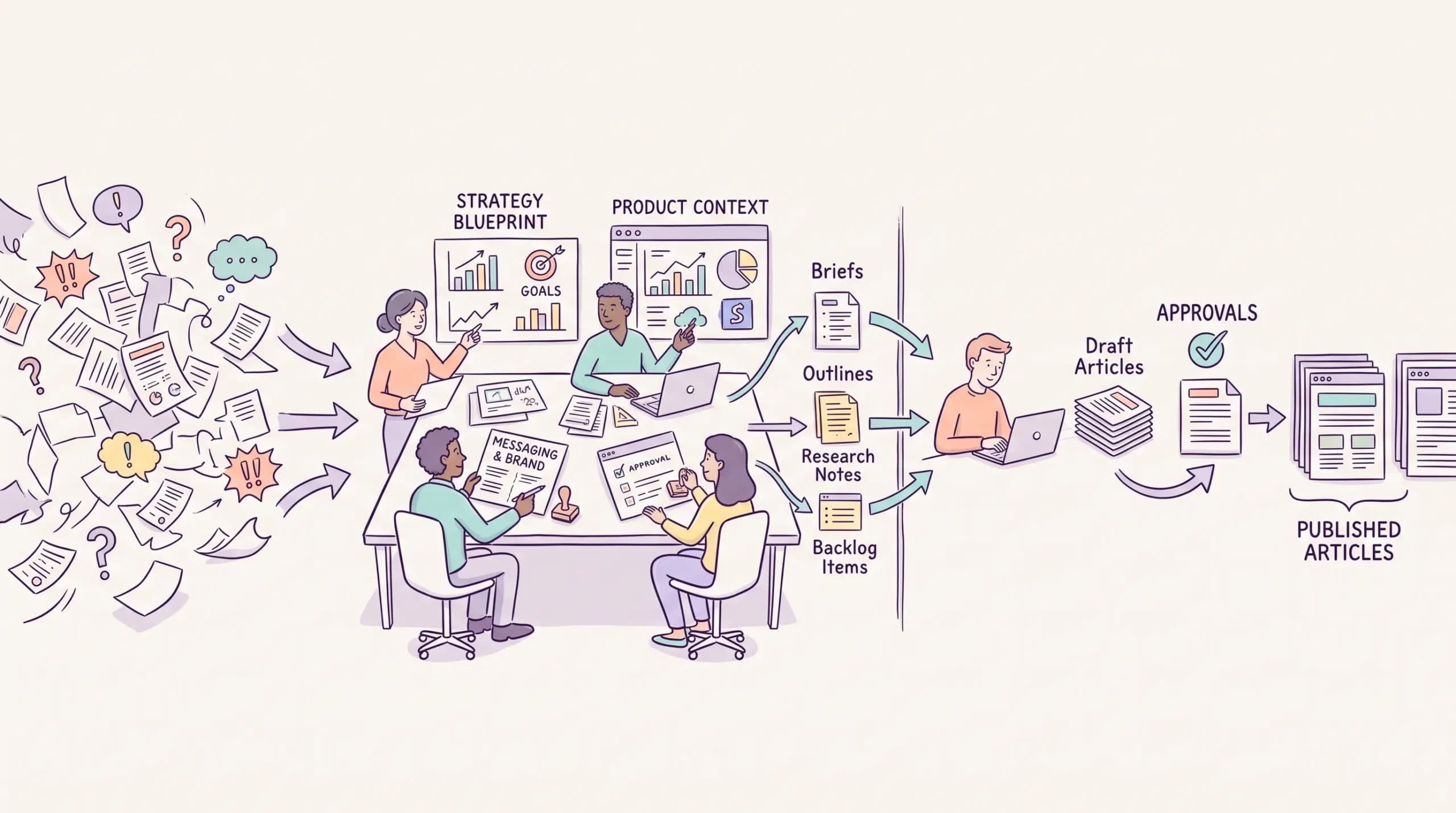
Outsourcing content writing means paying someone outside your company to produce content your team would otherwise write internally. You keep ownership of strategy, messaging, and approval. But the drafting and production happen off your payroll, usually through a monthly retainer or per-piece fee.
Outsourced content covers far more than blog posts. Companies routinely outsource SEO articles, white papers, case studies, website copy, email campaigns, social content, sales enablement assets, and first drafts of executive thought leadership.
There are usually four models, each solving a different problem.
Freelance writers
A freelancer is an independent writer you work with directly, with no agency or platform in between.
Most of us specialize in a format or channel. For me, it’s long-form SEO and bottom-funnel content like comparison pages. For other freelancers, it could be email or executive ghostwriting.
That focus is the advantage. I’ve written comparison and alternatives articles for years, and that repetition builds pattern recognition a generalist can’t match on that specific content type.
Freelancers fit best when you have overflow work, a recurring content type you want handled by an expert, or a budget that can’t stretch to agency fees.
Content agencies
A content agency gives you a team, not a single person. You get strategists, writers, editors, and an account manager coordinating it all. You’re paying for that coordination layer on top of the writing itself.
That markup is worth it when nobody on your team has time to build briefs, manage writers, and run editorial review. It might be a waste of money when you already have a content manager who can do those things.
If you’re weighing freelancers and agencies, I’ve broken down agency vs. freelancer in more depth separately.
Managed content services
These are platforms that sit between agencies and freelancers. They match you with vetted writers from their network and handle the workflow, assignments, deadlines, and payments through their software.
They fit teams that want volume, say 10 to 20 pieces a month, without managing individual writer relationships. The tradeoff is less consistency. You won’t always get the same writer, so voice and context reset more often.
Specialist subject-matter writers
These writers bring deep domain expertise rather than format expertise. They can interview your CTO without a glossary and write about SOC 2 or payment infrastructure without getting it wrong.
If your content requires technical accuracy that a smart generalist can’t fake, this is its own category with its own pricing, often 2 to 3 times standard freelance rates. You’re paying for the years it took them to learn the domain, not just the writing.
The model you pick matters less than the fit between the model and your actual gap. Which brings us to the real question.
When does outsourcing content writing make sense?
Outsourcing works when you have one of five specific gaps.
Your internal team is at capacity
Your content manager is running strategy, campaigns, product launches, analytics, and stakeholder reviews. If they’re also writing every article, everything ships late. Writing is the most delegable part of their job.
You need to increase output
SEO doesn’t reward publishing one article a quarter. Neither does a newsletter or a LinkedIn presence. If your strategy assumes a cadence your team can’t hit, you either cut the strategy or add capacity.
You lack a specific skill
Long-form SEO writing, technical writing, executive ghostwriting, and conversion copywriting are different jobs. Most internal teams have one of these skills, not all four.
Your publishing is inconsistent
If your blog shows three posts in March and nothing until July, an external writer on retainer fixes that faster than most internal process changes.
Hiring is too slow or too expensive
A senior content writer costs $88,000 to $152,000 a year (according to Glassdoor) in most US markets before benefits, recruiting, and onboarding. A retainer with a strong freelancer runs $2,000 to $5,000 a month, starts in two weeks, and ends whenever you want it to.
Here’s the simplest diagnostic I can give you: if content is important to your growth model but your team can’t produce it consistently, you should consider outsourcing.
When should you not outsource content writing?
While I am all for businesses to outsource writing (cos more work for me, yaay), I understand there are times when outsourcing isn’t the right move to make.
You don’t have a content strategy
A writer can’t fix unclear positioning or a missing audience insight. I’ve had clients hand me a keyword list with no ICP, no messaging doc, and no opinion on what the content should argue. Those engagements produce words, not results.
The content depends on deep internal knowledge
Some pieces live or die on executive perspective, proprietary data, or product nuance an outsider can’t access. If getting a writer the context takes longer than writing the piece, keep it in-house.
Nobody internally owns the process
Outsourced writers still require briefs, feedback, and approvals. If no one on your team has bandwidth to review drafts within a week, your outsourced content will sit in a queue, and your cadence problem will remain unsolved.
You expect perfect first drafts with zero input
Even a writer who’s covered your category for years still can’t know your customers, your roadmap, or your sales objections without being told—at least not on the first try.
Your budget only supports $50 articles
Cheap content creates editing work and, at worst, damages the brand. If the budget can’t support quality, wait until it can.
Outsourcing works best when it extends a strong marketing function. It fails when it’s used to replace strategy, messaging, or editorial judgment.
What content should you outsource versus keep in-house?
Not all content carries the same strategic weight. The split depends on which types of content marketing you’re producing, but the pattern is predictable.
Good candidates for outsourcing are repeatable, briefable, or research-driven:
- SEO blog posts and educational articles
- Content refreshes and updates
- Comparison and alternatives pages
- Newsletter drafts and social variations
- Case study drafts built from customer interviews
- Webinar summaries and repurposed content
- Ebooks and white papers with strong briefs
Content to keep in-house requires internal context or carries reputational risk:
- Core brand messaging and positioning
- Product launch narratives
- Executive points of view
- Sales-critical messaging
- Crisis communications
- Anything highly confidential
Outsource production-heavy content. But keep strategy-heavy and reputation-sensitive content close to the business.
Most of my best client relationships run a hybrid version of this. The internal team owns strategy, voice, positioning, and final approval.
I own research, drafting, and production. Zapier didn’t outsource its content strategy to me. They outsourced execution against a strategy they’d already built, and that division of labor is why the work performed.
Outsourcing versus hiring an in-house writer
The honest answer is that this comes down to volume and embeddedness.
Hire in-house when:
- You have enough work for a full-time role, roughly 8 or more substantial pieces a month
- The writer must sit in on product, sales, and leadership conversations
- You want institutional knowledge that compounds over years
- Content is so central to your growth that you want dedicated ownership
Outsource when:
- Content needs fluctuate month to month
- You want multiple specialties (one person rarely writes great SEO articles, great white papers, and great emails)
- You’re testing content as a channel before committing headcount
- You can’t justify another full-time salary
- You want to scale up in weeks, not quarters
On cost, compare totals, not sticker prices.
In-house means salary, benefits, recruiting fees, onboarding time, management overhead, tools, and training. Outsourcing means retainer or per-piece fees, internal review time, revisions, and an onboarding period of a month or two before the writer hits stride.
A $2,500 monthly retainer looks expensive next to a per-article rate and cheap next to a $90,000 salary. The right comparison depends on how much content you actually plan to ship.
The benefits of outsourcing content writing
The case for outsourcing rests on six advantages, and they’re clear when the setup is right.
Consistent production
A writer on a retainer publishes on schedule, whether or not your internal team had a chaotic month. Cadence is the single most common thing clients tell me improved after outsourcing.
Faster execution
External writers clear backlogs. A campaign that stalled for a quarter because nobody had time to write the assets can ship in three weeks.
Specialized expertise on demand
You can bring in a writer who’s spent years on exactly your content type.
An article I wrote for Zapier on authenticator apps has held positions 1 through 4 for its target keywords and gets cited in Google’s AI Overviews, Perplexity, and ChatGPT. It offsets more than $20,000 a year in paid search spend for those terms.
That result came from pattern recognition built across dozens of similar articles, which is exactly what you’re buying when you outsource to a specialist.
Lower commitment than hiring
Scale up for a launch, scale down after. You cannot try to do that with a full-time employee (at least with a clean conscience.
Fresh perspective
External writers ask the naive questions your team stopped asking. Those questions surface unclear messaging and gaps that your customers hit, too.
Better use of internal time
Your strategists return to strategy, distribution, and performance rather than drafting.
The risks and downsides of outsourcing
Every one of those benefits has a failure mode, and I’ve seen all of them from the writer’s side of the table.
Generic content
Without strong briefs and access to real expertise, outsourced content converges on the same interchangeable article everyone else has published. This is the number-one point of failure, and it’s usually a brief problem, not a writer’s problem.
Brand voice drift
External writers take two to five pieces to internalize your tone and vocabulary. Teams that quit after one rough draft never get past this.
Subject-matter gaps
A writer who doesn’t understand your product will oversimplify or, worse, get it wrong. Fact-checking has to live somewhere in your workflow.
More editing than expected
Budget internal review time. A good writer reduces it draft over draft, but it rarely hits zero.
Slow review cycles
If drafts sit for three weeks waiting on feedback, the cadence you paid for disappears. Half the failed engagements I’ve seen died in the client’s approval queue, not in the writing.
Poor vendor fit
Some providers optimize for volume. If a vendor never asks about your audience, your goals, or your product, they’re selling words by the pound (or dollar?).
Notice the pattern. The biggest risk is outsourcing without a clear strategy, strong briefs, and a content owner inside the company.
How to choose the right content writing partner
Evaluate every candidate against three lists: what to look for, what to ask, and what to run from.
Look for:
- Published samples in your industry or an adjacent one
- Evidence that they can adapt their voice (samples that sound different from each other)
- A described editorial process, not just “I write and send”
- SEO fluency if search is part of the goal
- Interviewing skills for expert-driven content
- Transparent pricing and reliable communication
- Strategic questions about your business, not just word counts
Ask before hiring:
- Have you written for companies like ours, and can I see results?
- How do you learn our brand voice?
- Walk me through your process from brief to final draft.
- How do revisions work, and how many are included?
- How do you handle subject-matter expert input?
- What do you need from our team to do your best work?
I like this last question. A writer who answers “nothing, I’m fully hands-off” is telling you the content will be generic. The right answer names specifics: access to sales calls, customer interviews, product demos, a point of contact for questions.
If SEO content is the main job, I’ve written a full guide on how to hire freelance SEO services, including what to check in samples.
Red flags:
- No relevant samples, or samples that all sound identical
- Pricing that seems impossible ($50/article? Something’s being cut)
- Promises of rankings on a specific timeline
- AI-generated drafts
- Zero questions about your audience or goals
How to set outsourced writers up for success
The quality of outsourced content is roughly 50% the writer and 50% what you give them. I can tell within one brief whether an engagement will produce great work.
Write real briefs
A strong brief includes the target audience, the search intent or business goal, the primary argument, key points, SME notes or internal sources, voice guidance, structure, the CTA, and an example of what good looks like. A keyword and a word count is not a brief.
Build a brand and editorial guide
Send the writer a doc detailing your tone, preferred terminology, words to avoid, formatting standards, point of view, and messaging pillars. And please don’t make it too long. 7-10 pages would do just fine.
Give access to experts
For differentiated content, the writer needs interviews, call recordings, or some internal docs. The best client setups I’ve worked in gave me recorded sales calls and a Slack channel for questions. The worst gave me a Google Doc titled “Blog Ideas.”
Define the review workflow
Decide upfront who checks accuracy, who checks voice, and who approves. One consolidated round of feedback beats four contradictory reviewers.
Give specific feedback
“Make it punchier.” Okay Ali.
What does punchier mean?
Instead, say something clearer like, “Our audience is technical, so cut the definitions in section two and add a config example.”This feedback produces a better writer within three drafts.
The better the input, the better the draft.
Outsourcing doesn’t remove the need for marketing leadership. It only amplifies it.
How to measure ROI from outsourced content
Define success before the first brief goes out, because different content has different jobs.
For:
SEO content
Organic traffic, keyword rankings, click-through rate, backlinks, and assisted conversions. Increasingly, citations in AI Overviews and tools like Perplexity and ChatGPT belong here too, since that’s where a growing share of buyer research happens.
Demand generation content
Leads, conversion rate, downloads, email engagement, and pipeline influence.
Sales enablement content
Check whether sales actually use it, deal support, and feedback from reps.
Brand and thought leadership
Engagement quality, shares, newsletter growth, and inbound opportunities that mention the content.
On measuring ROI, first, count the total cost: outsourcing fees plus internal editing time, SME time, design, and distribution. Then measure the return with one of the four methods for calculating content marketing ROI, from a quick traffic-value estimate to CRM attribution.
And then, set realistic timelines. SEO content typically takes 3 to 9 months to rank and compound.
Campaign assets show impact in weeks.
Judging a six-month strategy at week eight guarantees you’ll kill work that was about to pay off.
A practical decision framework
You have three options, and you might already be considering which model to choose.
Outsource if you have a clear strategy, more content demand than internal capacity, someone to manage writers, and the ability to provide briefs and timely feedback.
Hire in-house if you have full-time volume, content that requires deep embeddedness with product and leadership, and a long-term commitment to content as a channel.
Go hybrid if your internal team owns strategy and messaging while external writers handle production, and your needs span multiple formats or fluctuate month to month. Some teams take this further with a fractional content marketing setup, where an external person also owns the strategy part-time.
For most Series A-Series C SaaS companies I’ve worked with, hybrid is the answer.
If you want a quick self-assessment, score yourself 1 to 5 on each:
Content volume needed, internal writing capacity, strategic clarity, budget, subject complexity, review bandwidth, and urgency.
High volume + low capacity + high strategic clarity points to outsourcing.
Low strategic clarity points to the need to fix strategy first, because no external writer solves that for you.
Outsourcing is a growth lever, not a shortcut
Outsourcing content writing helps teams scale production, hold a consistent cadence, and access specialists they could never justify hiring.
It works when the company already has clear goals, defined messaging, and an internal owner. It fails when companies expect an external writer to backfill strategy, positioning, or product clarity.
So here’s the decision in one paragraph.
Outsource when it helps your team move faster without sacrificing quality. Keep it in-house when the work demands deep strategic ownership.
And if you’re like most growing SaaS companies, run both: strategy inside, production support outside. That split is where I’ve seen the strongest results in five years of sitting on the outsourced side of the table.
If you decide to outsource, here’s where I fit
I write for B2B SaaS teams that already have strategy covered and want production handled by a specialist.
Three ways we can work together:
1. Bottom-funnel content. Content like [competitor] alternatives, [you] vs. [competitor], and best [category] lists. These pages catch buyers who are actively comparing options, so they convert to leads at a rate that top-of-funnel content never will. They also build topical authority around your product category, which lifts how the rest of your site ranks.
2. Content refreshes. Your best-performing articles decay. Rankings slip, stats go stale, screenshots show a product that no longer exists. I update, restructure, and rewrite existing pieces so they recover traffic without the cost of net-new content.
3. JTBD and middle-funnel keywords. Content mapped to the jobs your buyers are trying to get done. “How-to” and workflow content that catches people solving the problem your product solves, then moves them toward a demo or trial instead of leaving them at a dead end.
I’ve done this work for Zapier, HubSpot, Paddle, Taboola, MoEngage, and CoSchedule. We can work per piece or on a monthly retainer, whichever fits how much content you’re planning to ship.
If that sounds like the gap you’re trying to fill, book a call or reach out by email. Worst case, you leave the call with a clearer picture of what to build in-house.