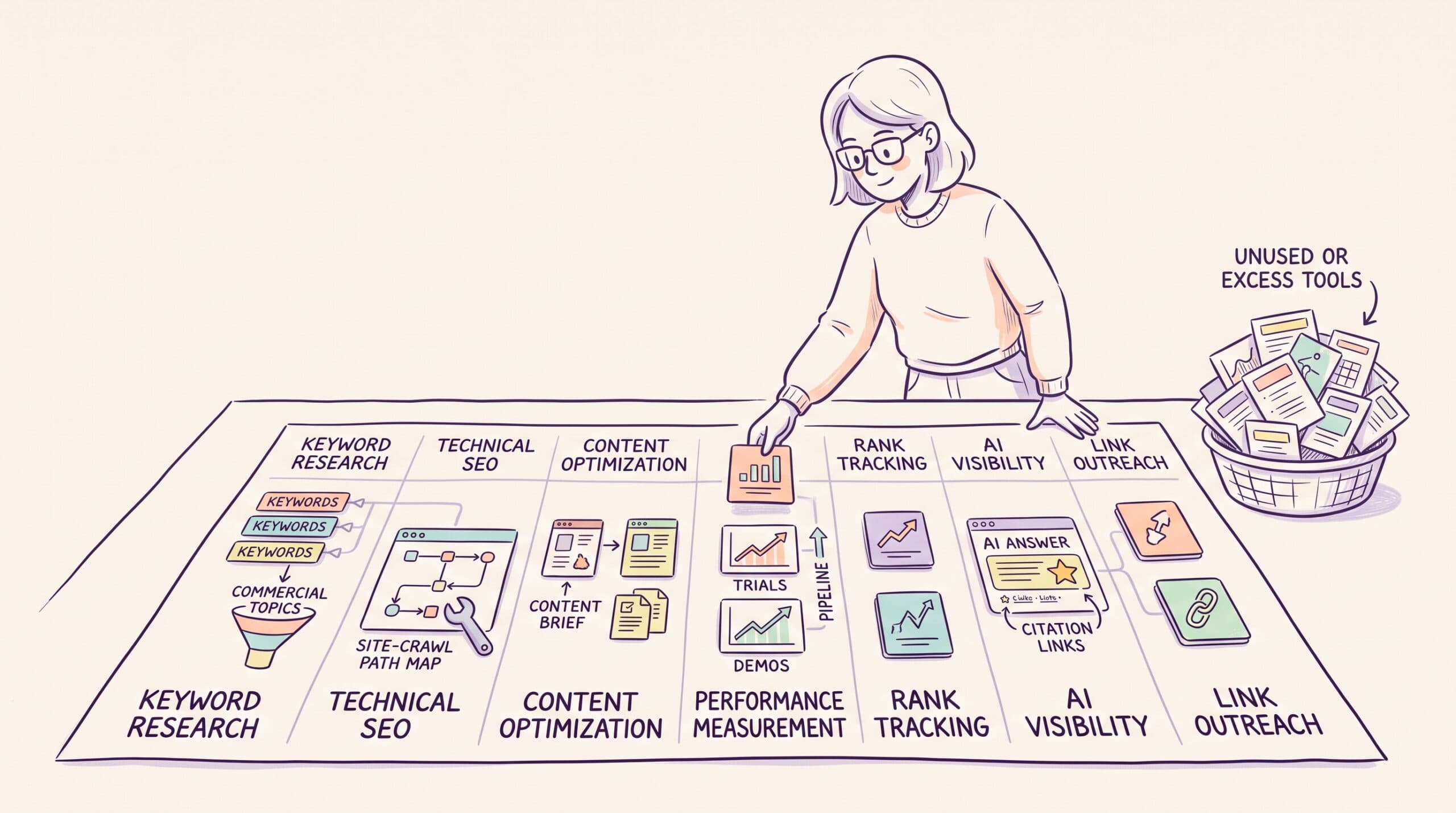

Your buyers are searching for solutions, comparing products, and asking AI tools which software they should choose.
Your job is to make sure your SaaS appears during that research.
That means finding commercial topics worth targeting, fixing issues that hold the site back, and improving pages that have lost ground. You also need to show whether organic visibility is contributing to trials or demos. You may also be responsible for tracking how the brand appears in ChatGPT, Perplexity, and Google’s AI results.
This guide compares 17 SaaS SEO tools that can help with that work. It covers keyword research, technical SEO, content optimization, performance measurement, and AI visibility.
You’ll find free options alongside affordable and premium platforms.
I evaluated each tool against the work a B2B SaaS marketing team needs to do. Where I had direct access, I used my own observations. For the rest, I reviewed official documentation, current pricing, product demos, and recent customer feedback.
You don’t need all 17. By the end, you’ll know which tools fit your current priorities and which ones can wait.
The best SaaS SEO tools at a glance
Prices were checked in July 2026. Some plans cost less when billed each year.
| Tool | Best for | Main job | Starting price |
| Google Search Console | First-party Google data | Search data and indexing | Free |
| Google Analytics 4 | Organic conversion data | Web analytics | Free |
| Keywords Everywhere | Low-cost keyword research | Keyword data | $7/month, billed yearly |
| RevPages | Revenue-focused SEO opportunities | Finding and forecasting high-value keywords | Free to try |
| AlsoAsked | Mapping buyer questions | Topic research | $12/month, billed yearly |
| LowFruits | Finding easier terms | Keyword research | $20.75/month |
| Ahrefs | Competitor and link research | SEO research | $29/month |
| SE Ranking | SEO and AI tracking | Research and tracking | $129/month |
| Semrush | A broad SEO suite | SEO management | $139/month |
| Screaming Frog | Deep site crawls | Technical SEO | Free; $279/year |
| Frase | Lower-cost content scoring | Content work | $39/month, billed yearly |
| Clearscope | Team content workflows | Content work | $129/month |
| OtterlyAI | Low-cost AI tracking | AI visibility | $29/month |
| Peec AI | AI data for growing teams | AI visibility | $95/month |
| Profound | Advanced AI search data | AI visibility | $99/month |
| AirOps | SEO content workflows | Content ops | Free entry plan |
| Respona | Link outreach | Authority building | From $100 per placement |
What are SaaS SEO tools?
SaaS SEO tools help software firms grow through search, whether that’s traditional search engines or newer ones like LLMs.
They can find keywords, spot site errors, improve content, track ranks, and measure leads. Some also track brand mentions in AI answers.
For clarity, the fact that the tools on this list are called SaaS SEO tools doesn’t necessarily mean they have to be web-based. Screaming Frog, for example, is a desktop app. Yet it is still useful for SaaS SEO.
In all, these tools support an SEO content marketing plan. They help your team find the right work and check the results.
What makes a SaaS SEO tool worth using?
It helps you find buyer-led topics
A large keyword list is easy to build. A useful list is much harder.
The best tools help you find terms tied to a real buying need. These may include product terms, “best” searches, use cases, and competitor terms.
Still, the tool should not choose for you. Search volume can hide weak intent. Your team must know which bottom-of-funnel keywords are close to a sale.
It gives you a clear next step
A score has little value on its own.
A good tool should help you see what needs work. It may flag a weak page, a crawl block, or a lost rank. More useful tools also show why the issue may exist.
As a result, you can spend less time sorting through reports and set a fair order for the work.
It fits the tools you already use
SEO tools now share many of the same features.
Ahrefs, Semrush, and SE Ranking all offer keyword data. They also track ranks and audit sites. So, paying for all three can lead to waste. If you’re choosing between two of them, SE Ranking vs Ahrefs comes down to backlink depth versus rank tracking per dollar.
Before you add a tool, write down the gap it will fill. When you cannot name the gap, wait.
It covers the search channels you care about
Google still matters. However, AI answers matter more than they did two years ago.
Not every team needs a stand-alone AI tool. A startup, for instance, may start with manual checks. Meanwhile, a larger team may need daily data across many prompts.
Your stack should match the size of the task.
Your team can use it with ease
A tool can be strong and still fail inside your team.
Writers may avoid a dense SEO suite. A small team may not have time to build a complex workflow. In that case, a simple tool may bring more value.
Ease of use affects return on spend.
The real cost fits your budget
The lowest plan may not support your work.
You may need more seats, more prompts, or more tracked terms. Those limits can raise the cost fast.
So, price the plan you will need in, say, six months. Don’t base the choice on the first number on the page.
How I evaluated the best SaaS SEO tools
I assessed each product against a typical B2B SaaS workflow.
I also checked:
- The main task each tool handles
- The quality of the data or output
- How easy it is to act on the result
- The cost at a useful plan level
- Common points from recent user reviews
- Where the tool overlaps with other products
I did not test every paid plan. So, each review includes an evaluation basis note. That note tells you if the view comes from hands-on use, a free plan, a demo, product docs, or user reviews.
This gives you a clearer picture than treating every review as if it had the same level of hands-on testing.
1. Google Search Console: Best free base for SaaS SEO
Google Search Console should be the first tool in your stack.
It shows the search terms that bring up your pages. It also shows clicks, views, rank data, and index issues. Since the data comes from Google, it gives you a strong view of how the site is doing in search.

Evaluation basis: Hands-on use.
How Google Search Console fits into a SaaS SEO workflow
Start with the Performance report. Sort pages by click, position, impressions, or CTR. Then check the terms tied to each page.
This can show a page that still ranks but no longer gets clicks. It can also show a page that gets views for terms it does not cover well.
Next, use URL Inspection. It can tell you if Google has indexed a page. It can also flag crawl blocks.
That makes Search Console a useful first stop when your website is not showing on Google.
Key features
Search data, page filters, query filters, URL checks, index reports, sitemaps, and Core Web Vitals.
What it does well
It gives you first-party data at no cost. It also finds terms you did not think to track.
Where it falls short
Rank data is an average. It does not show rival data or deep AI search data.
Who should use Google Search Console?
Every SaaS team with a live site.
Pricing
Free.
2. Google Analytics 4: Best free tool for organic lead data
Google Analytics 4 shows what people do after they reach your site.
Search Console tells you what led to the click. GA4 helps you see what came next. That may be a demo form, a trial, or a visit to a key product page.
Evaluation basis: Hands-on use.
How GA4 fits into a SaaS SEO workflow
Build a report for organic landing pages. Then group the pages by type.
You may compare blog posts, product pages, and “best tools” guides. This can show which page types draw the right visits.
Next, add key events. A page with less traffic may still drive more trials. That page may be worth more than a high-traffic guide.
GA4 can also show paths that start with search and end through another channel.
Key features
Landing page reports, events, paths, funnels, source data, and Search Console links.
What it does well
It links search visits to on-site behavior. It is also free.
Where it falls short
The setup can be hard. And bad event rules lead to bad reports.
Who should use GA4?
Teams that need to link SEO traffic to action.
Pricing
Standard GA4 properties are free.
3. Keywords Everywhere: Best low-cost keyword add-on
Keywords Everywhere puts keyword data in your browser.
You can see search volume, cost per click, trends, and related terms as you search. So, you spend less time moving between Google and a large SEO suite.

Evaluation basis: Hands-on use.
How Keywords Everywhere fits into a SaaS SEO workflow
Install the extension and research the product category as you normally would. The tool adds related queries and metrics directly to supported websites—making it easier to follow a line of research without repeatedly exporting terms into another platform.
A content strategist could start with “customer support software,” move into related use cases, check People Also Search For suggestions, and save relevant commercial terms for closer SERP analysis.

Key features
In-browser keyword metrics, related searches, historical trends, domain data, bulk uploads, and keyword-gap analysis.
Where it stands out
The workflow is fast and inexpensive. It gives solo marketers enough directional data to investigate a topic before paying for a larger suite.
Where it falls short
Credits can disappear quickly when Google loads several keyword widgets during one search. It also lacks the project management and reporting depth of a full SEO platform.
Who should use Keywords Everywhere?
Freelance writers, early-stage SaaS teams, and marketers who need affordable keyword data.
Keywords Everywhere pricing
From $84 per year, which works out to $7 per month.
What customers say
Feedback commonly praises its convenience and ease of use. The independent review pool is smaller than the databases available for major SEO suites.
4. RevPages: Best for finding revenue-focused SaaS SEO opportunities
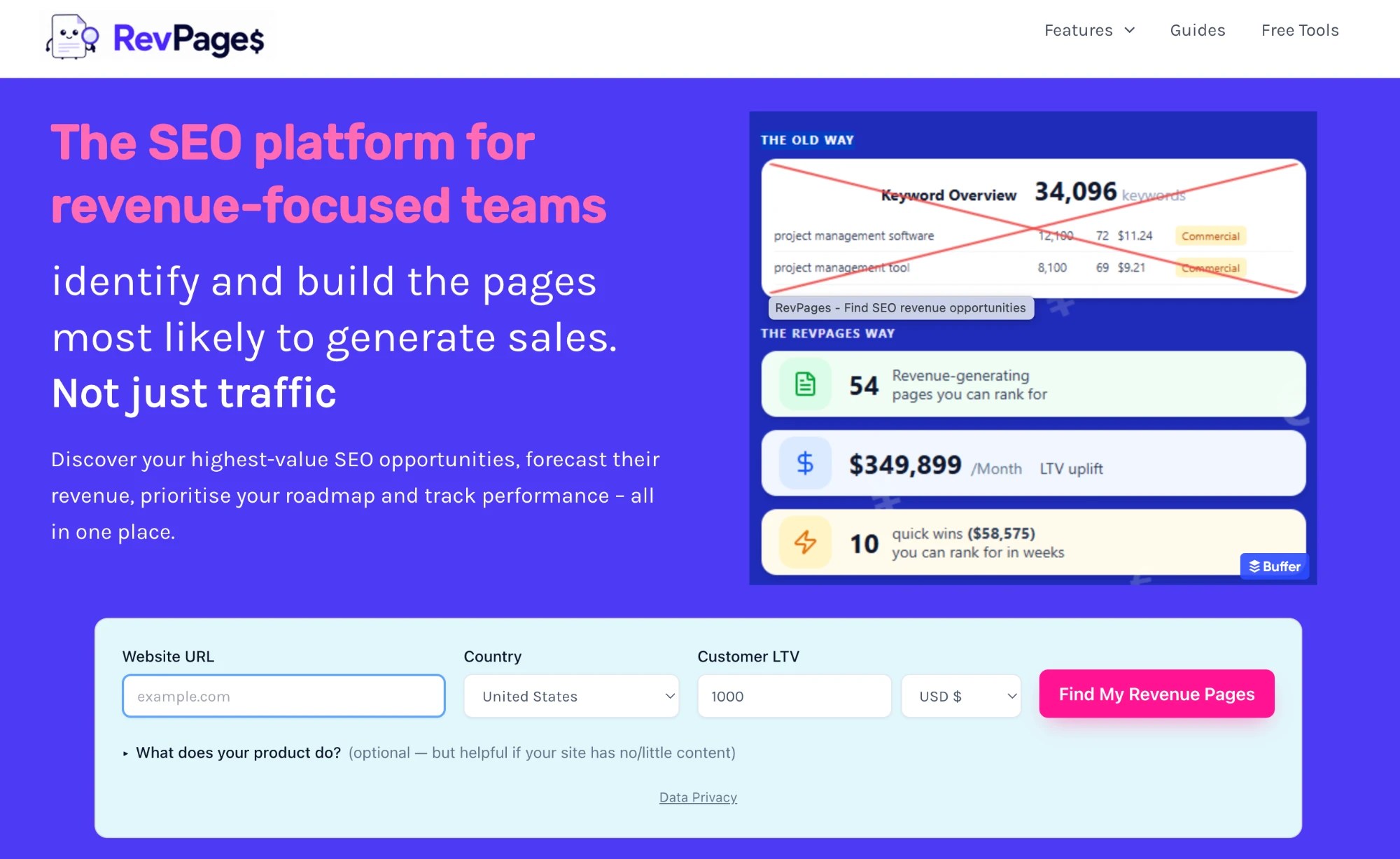
RevPages helps SaaS teams find commercially valuable pages to create or improve.
Rather than returning thousands of loosely related keywords, it focuses on lower-funnel opportunities such as competitor alternatives, comparison pages, feature pages, industry pages, templates, and “best of” listicles, and estimates the value of each one.
You enter your website and average customer lifetime value. RevPages then analyzes your website, existing rankings, and search data to find your most valuable opportunities and estimate the potential revenue uplift from each one.
How RevPages fits into a SaaS SEO workflow
Start by running an opportunity report for your website. RevPages produces a focused list of pages that could attract potential buyers, along with search demand, ranking difficulty, current performance, and estimated revenue potential.
Its Revenue Opportunity score then considers both an opportunity’s potential value and your likelihood of ranking for it. This helps you avoid prioritizing a lucrative-looking keyword that is currently unrealistic for your website.
You can add promising opportunities to a content roadmap. From there, RevPages can generate a content brief, suggested title, meta description, and URL slug for each page.
Key features
Commercial keyword discovery, SEO revenue forecasting, opportunity prioritization, content roadmaps, AI-generated content briefs, and revenue-page tracking.
Where it stands out
RevPages connects keyword research to estimated commercial outcomes. That makes it easier to explain why a page should be created, decide which opportunity to pursue first, and build an SEO roadmap around potential revenue rather than traffic alone.
Its focus on SaaS buyer searches also means teams spend less time filtering large keyword exports for relevant opportunities.
Where it falls short
RevPages is a specialized planning and prioritization tool, not a complete SEO suite. You will still need other software for technical site audits, backlink analysis, and large-scale exploratory keyword research.
Revenue figures are forecasts based on inputs and assumptions, so treat them as estimates rather than guaranteed returns.
Who should use RevPages?
SaaS founders, in-house marketing teams, and SEO agencies that want to identify high-intent opportunities and prioritize content according to its potential commercial value.
RevPages pricing
RevPages is currently free to try, with paid plans coming soon.
5. AlsoAsked: Best for mapping the next buyer question
AlsoAsked turns Google’s People Also Ask results into a visual question tree.

It shows how one query leads to the next. This can help you plan an outline, a FAQ, or a set of linked pages.
Evaluation basis: Hands-on use.
How AlsoAsked fits into a SaaS SEO workflow
Enter a product category, use case, or competitor name. The output shows connected questions and the links between them.
A search around “CRM setup,” for example, may surface questions about migration, training, timelines, and cost.

Those branches can improve an existing article, inspire a content cluster, or reveal objections that belong on a product page.
It’s also useful for GEO research because conversational questions often match the prompts buyers type into AI tools.
Key features
Question maps, search by country, deep search, and CSV or image exports.
What it does well
It adds context that a plain keyword list lacks.
Where it falls short
It does not show how close a question is to a sale. You still need intent checks.
Who should use AlsoAsked?
Content teams that write guides, FAQs, and buyer pages.
AlsoAsked pricing
From $12 per month when billed each year.
6. LowFruits: Best for finding easier terms
LowFruits looks for search results where weaker or lower-authority websites already rank.
That can help a newer SaaS company avoid spending months chasing broad category terms it has little chance of winning.

Evaluation basis: Product docs, public demos, and user reviews.
How LowFruits fits into a SaaS SEO workflow
Start with a seed term tied to your product.
LowFruits will build a long list and scan the top results. It then marks signs of weak sites in the SERP.
Use that data as a first filter. Next, check if the term has buyer value. An easy term can still bring the wrong crowd.
Key features
Long-tail ideas, weak-site checks, SERP data, rival terms, and rank tracking.
What it does well
It makes rank difficulty easier to read for a small team.
Where it falls short
The focus on “easy wins” can push teams toward low-value posts.
Who should use LowFruits?
New SaaS sites and teams with a small SEO budget.
LowFruits pricing
$20.75 per month, with cheaper annual billing and pay-as-you-go options
7. Ahrefs: Best for rival and link research
Ahrefs is strongest when you want to see how other sites win.
Its Site Explorer shows top pages, search terms, and links. Content Gap shows terms that rival sites rank for while your site does not.

Evaluation basis: Hands-on use, product docs, and user reviews.
How Ahrefs fits into a SaaS SEO workflow
Enter three or four direct competitors and inspect their highest-traffic pages.
Filter the results to find comparison pages, alternative articles, templates, integration content, and product-led guides. To make it easier, use filters like “best,” “vs,” and “alternative.”
Next, review the backlinks pointing to those pages. The combination helps you separate topics that rank mainly because of strong content from pages supported by substantial link authority.
This research is valuable before building a content plan because it shows where competitors have already proved demand. It’s the kind of work that goes into bottom-of-funnel content that moves pipeline.
Key features
Site Explorer, Keywords Explorer, Content Gap, link data, site audits, and rank tracking.
What it does well
It gives strong rival and link data in one place.
Where it falls short
The Starter tier is restrictive for sustained research. Lite is expensive for a single user, and standard rank tracking updates are weekly on current core plans.
Who should use Ahrefs?
SaaS content and SEO teams running regular competitor research, content planning, and link analysis.
Ahrefs pricing
From $29 per month. The Lite plan starts at $129 per month.
What customers say
Ahrefs holds a 4.5/5 G2 rating from hundreds of reviews. Users consistently praise its backlink and keyword data, while smaller teams often flag pricing and credit limits as pain points.
8. SE Ranking: Best value for SEO and AI tracking
SE Ranking covers keyword work, rank checks, site audits, and AI prompt tracking.

That range can help a growing team cut down on the number of tools it pays for.
Evaluation basis: Product docs, demos, and user reviews.
How SE Ranking fits into a SaaS SEO workflow
Use the platform to create one project for the website and group keywords by page type.
Product-category terms should sit separately from informational topics so movement in one group doesn’t hide changes in another.
You can then add prompts that reflect questions buyers ask AI platforms. Comparing the two data sets reveals where traditional rankings and AI visibility move together and where they diverge.
Key features
Daily rank tracking, prompt tracking, competitor research, backlink monitoring, site audits, on-page analysis, and Data Studio (formerly Looker Studio) integration.
What it does well
SE Ranking cuts the number of separate subscriptions a growing team needs. The Core plan includes enough keyword and prompt capacity to support a real program rather than a small experiment.
Where it falls short
Its backlink database isn’t as deep as Ahrefs for heavy link research. The broader feature set also creates a learning curve for users who only need one or two reports.
Who should use it
In-house teams and agencies that want traditional SEO plus AI visibility without paying for several premium products.
SE Ranking pricing
$129 per month or $103.20 with annual billing. A 14-day trial is available.
What customers say
SE Ranking has a 4.8/5 G2 rating across more than 1,500 reviews. Ease of use and rank monitoring get consistent praise, while some reviewers want a larger backlink database.
9. Semrush: Best broad suite for one-vendor teams
Semrush gives you a large set of SEO tools in one place.

It covers keyword data, site audits, rank checks, links, and rival research. It also sells AI visibility tools.
Evaluation basis: Hands-on use, product docs, and user reviews.
How Semrush fits into a SaaS SEO workflow
A marketing team can research a category, run a keyword-gap analysis, audit the website, and track rankings without switching vendors.
The breadth is useful when SEO touches several functions. A content manager may work in keyword research while an SEO lead monitors technical health and leadership receives scheduled reports.
Semrush’s AI products can also track custom prompts and analyze how brands appear across platforms like ChatGPT, Gemini, Perplexity, and Google’s AI experiences.
Still, the suite is large. A small team may pay for features it rarely uses.
Key features
Keyword research, competitor intelligence, Position Tracking, Site Audit, backlink tools, AI visibility reporting, and content optimization on higher tiers.
What it does well
The platform offers wide coverage and mature reporting. It can become the central data source for a team that wants fewer vendors.
Where it falls short
Pricing gets harder to compare as SEO, AI visibility, content, and reporting features sit across different toolkits or tiers. Additional users also cost extra.
Who should use Semrush?
SaaS marketing teams that will use several parts of the suite and want their data in one place.
Semrush pricing
SEO Classic starts at $139 per month ($117.33/mo when billed annually). The combined Semrush One Starter plan starts at $199 monthly or $165.17 with annual billing.
What customers say
Customers value having several SEO capabilities together, although the size of the platform can feel excessive when you only need one narrow function.
10. Screaming Frog: Best for deep site crawls
Screaming Frog crawls your site and lists what it finds.

It can spot broken links, bad redirects, noindex tags, weak titles, and crawl depth issues. The free plan works for sites with up to 500 URLs.
Evaluation basis: Hands-on use, product docs, and user reviews.
How Screaming Frog fits into a SaaS SEO workflow
Crawl the full site. Then split the data by site area.
You may check the blog, product pages, help docs, and global pages on their own. This can show if one template has a site-wide fault.
Screaming Frog also helps build a full page list for a content audit.
Key features
Technical crawling, JavaScript rendering, custom extraction, duplicate-content detection, structured-data checks, internal-link analysis, and crawl comparisons.
Where it stands out
Screaming Frog gives granular, page-level data. Experienced users can dig into the details rather than rely on a simplified health score.
Where it falls short
The spreadsheet-style interface can overwhelm new users. Finding an issue is different from knowing whether it matters or how to fix it.
Who should use Screaming Frog?
SEO practitioners auditing a growing or complex SaaS website.
Screaming Frog pricing
Free for up to 500 URLs, or $279 per user per year.
11. Frase: Best affordable content optimization tool
Frase helps with research, briefs, and content scoring.

It scans the top pages for a term. Then it shows common topics and questions. Writers can use that data while they draft.
Evaluation basis: Product use, docs, pricing, and user reviews.
How Frase fits into a SaaS SEO workflow
Open a report for the target term. Review the top pages before you look at the score.
Ask which points match the real search need. Then remove ideas that add length but little value.
Reviewing the pages first keeps the score from driving the article.
Key features
SERP research, content briefs, live optimization scoring, AI drafting, GEO scoring, site audits, and content-opportunity reports.
Where it stands out
Frase gives a lean team several content tools at a low entry price. It can replace a separate briefing tool for writers who need structured direction.
Where it falls short
Content scores are easy to misuse. Chasing every suggested term can produce repetitive writing that covers the vocabulary of the SERP without adding a distinct point of view.
Who should use Frase?
Solo marketers, freelance writers, and smaller SaaS content teams that can’t justify Clearscope’s price.
Frase pricing
From $39 per month when billed annually, with a seven-day trial.
What customers say
Frase users often praise the time saved during research and content creation. Feedback also reinforces the need for human review rather than treating generated drafts or optimization scores as finished work.
12. Clearscope: Best premium content tool
Clearscope is built for teams that want a clean content optimization workflow without giving writers a complex SEO interface.

It is easy to share across a team. It also tracks live pages, which can help with refresh work.
Evaluation basis: Product use, docs, pricing, and user reviews.
How Clearscope fits into a SaaS SEO workflow
A lead can build the report and use it to shape the brief.
The writer can then work in the editor or in Google Docs. After the page goes live, the team can track its score and search trend.
This flow is a good fit for a team with many writers. A solo writer may get enough value from Frase for less.
Key features
Content reports, topic exploration, live grading, page monitoring, prompt tracking, brand visibility reporting, and unlimited collaboration.
Where it stands out
The interface is easy to introduce across a team. Writers can understand the report quickly without learning a full SEO suite.
Where it falls short
The Essentials plan is hard to justify for a company publishing only a handful of articles. Twenty monthly drafts may also require add-on purchases once production picks up.
Who should use Clearscope?
Established SaaS content teams with several writers, an active refresh program, and enough publishing volume to justify a premium workflow.
Clearscope pricing
$129 per month for Essentials. Business costs $399 per month.
What customers say
Clearscope holds a 4.9/5 G2 rating. Ease of use and clear content guidance get strong praise, while cost is the recurring concern for freelancers and smaller teams.
13. OtterlyAI: Best low-cost AI visibility tool
OtterlyAI tracks brand mentions in AI answers.

Its low-cost plan gives a small team a way to move past manual spot checks.
Evaluation basis: Product docs, public demos, pricing, and user reviews.
How OtterlyAI fits into a SaaS SEO workflow
Build a focused set of prompts around the product category and the questions a buyer asks before comparing vendors.
The dashboard can then show whether the brand appears, which competitors get more visibility, and which sources the answer engines cite. Those citations may point to articles worth improving or third-party pages where the company needs a presence.
Key features
Daily prompt tracking, brand visibility metrics, competitor monitoring, citation analysis, prompt research, GEO audits, and multi-country support.
Where it stands out
Small teams can start measuring AI visibility without committing close to $100 per month. The product also covers several answer engines on its entry plan.
Where it falls short
Fifteen prompts won’t cover several products, regions, and buyer personas. Moving from Lite to Standard creates a large pricing jump, and some engines require separate add-ons.
Who should use OtterlyAI?
A SaaS company starting with one market and a carefully chosen group of commercial prompts.
OtterlyAI pricing
$29 per month for Lite. Standard costs $189 per month.
What customers say
OtterlyAI has a 4.8/5 rating from 52 G2 reviews. Users praise its setup and interface, while recurring feedback concerns the gap between tiers and the amount of interpretation still needed after viewing the data.
14. Peec AI: Best for a growing AI search program
Peec AI sits between low-cost trackers and large enterprise tools.

It tracks prompts, brand rank, tone, competitors, and cited sources. It also gives teams more space to group work by use case.
Evaluation basis: Product docs, public demos, and user reviews.
How Peec AI fits into a SaaS SEO workflow
Split prompts by the stage of the sale.
One group may cover broad category terms. Another may cover tool lists and competitor terms. This makes the data easier to act on.
Next, check which sites AI tools cite. Those sites may be review pages, forums, or list posts. The result can guide both content and PR work.
Key features
Prompt tracking, competitor benchmarking, sentiment analysis, source monitoring, prompt suggestions, and multi-model coverage.
Where it stands out
Peec offers a focused interface and enough prompt capacity for an in-house team to move beyond an initial GEO experiment.
Where it falls short
Starter users must choose three models. Broader model coverage and reporting require higher plans, and visibility data still needs to be turned into a content or authority plan.
Who should use Peec AI?
SaaS marketing teams with an active GEO program and a clear set of prompts to monitor.
Peec AI pricing
From $95 per month.
What customers say
Peec has a 4.9/5 G2 rating, although its review pool is still relatively small. Reviewers often praise the interface and quick setup. Requests for more integrations and content-workflow features appear among the limitations.
15. Profound: Best for advanced AI search data
Profound offers more than prompt checks.

It adds deeper source data, AI referral data, and tools that help teams act on what they find. That makes it a better fit for a large brand.
Evaluation basis: Product docs, public demos, and user reviews.
How Profound fits into a SaaS SEO workflow
The platform runs prompts on a schedule and reports on brand mentions, citations, sentiment, and competitor visibility.
Marketing teams can use its agents to analyze and improve content. Agent Analytics connects AI-sourced visits with website activity—if you have the right integrations set up.
That’s what separates Profound from a lighter tracker. It’s built for teams making AI visibility an ongoing function, not a one-time audit.
Key features
Answer-engine tracking, competitor analysis, citations, sentiment, content agents, AI referral analytics, prompt-volume data on higher plans, and enterprise controls.
Where it stands out
Profound combines tracking with tools built to help teams act on what they find. Enterprise plans support more engines and controls like SSO.
Where it falls short
The $99 Starter tier is narrower than it looks, as most teams would like to track more than ChatGPT mentions.
Who should use Profound?
Larger SaaS companies with several products, markets, or stakeholders asking for regular AI visibility data.
Pricing
$99 per month for Starter. $399 for Growth. Both billed annually.
What customers say
Profound has a 4.6/5 G2 rating from more than 300 reviews. Users often highlight the data depth and support, while the platform’s scope and price make it better suited to teams ready to act on the intelligence.
Lower-cost alternative
OtterlyAI covers the core monitoring job for $29 per month. Peec AI offers a useful middle ground when a team needs more prompts and competitor analysis without moving into Profound’s wider platform.
Another option is Rankshift. Rankshift fits teams that need to monitor several AI platforms or give more people access without paying per seat.
16. AirOps: Best for scaled content workflows
AirOps helps teams turn research and visibility data into repeatable workflows.

A flow can pull data, check a page, draft changes, and send the work for review. It can also help with AI search research.
Evaluation basis: Product docs, public demos, and user reviews.
How AirOps fits into a SaaS SEO workflow
Start with one clear task.
A good first flow may refresh old pages. It can pull a URL, check rival pages, find gaps, and draft a brief. A person can then review the brief before any copy goes live.
The same setup can support comparison pages or integration content at scale—as long as the inputs and quality controls are clear.
AirOps gets more useful once a team has a defined editorial process. Automating a weak workflow just makes weak work faster.
Key features
Custom workflows, multiple AI models, brand kits, knowledge bases, CMS integrations, content refreshes, prompt tracking, and task-based automation.
Where it stands out
Teams can encode their own process rather than rely on a generic writing prompt. The system supports human review steps and connects research with production.
Where it falls short
Setup takes time and experimentation. Task-based pricing is harder to forecast than a flat subscription, especially when workflows make several model or data calls.
Who should use AirOps?
Content teams with repeatable workflows and enough volume to justify building and maintaining the system.
AirOps pricing
Free entry tier available. Advanced pricing depends on plan and task usage.
What customers say
Users praise its flexible content workflows and actionable insights, while the learning curve appears regularly in feedback.
17. Respona: Best for link outreach
Respona helps teams find sites, find contacts, send pitches, and track replies.

It also offers paid link placement plans. That gives a team two ways to use the product.
Evaluation basis: Product docs, public demos, and user reviews.
How Respona fits into a SaaS SEO workflow
Choose a page with a clear reason to earn links. Something like original research, a useful free tool, or a strong commercial guide will be easier to promote than another generic blog post.
Respona can help identify relevant publishers and manage outreach. Its placement service handles more of the execution—including content and negotiation—with the final price based partly on the authority and traffic requirements you select.
Authority work now also affects AI visibility. When answer engines frequently cite third-party reviews and listicles, earning inclusion on those pages can influence how a SaaS brand appears in recommendations.
Key features
Publisher discovery, contact finding, outreach sequences, personalization, campaign tracking, and pay-per-result placements.
Where it stands out
It brings several manual outreach tasks into one process and gives teams the option to pay for delivered placements rather than only software access.
Where it falls short
Costs can climb quickly during a sustained campaign. Domain metrics also need human review because a high rating doesn’t guarantee topical relevance or editorial quality.
Who should use Respona?
SaaS teams with valuable pages to promote and no internal capacity to run prospecting and follow-up.
Respona pricing
From $100 per placement. Higher tiers reach $500 per placement, with optional add-ons and volume discounts.
What customers say
Respona has a 4.8/5 G2 rating from almost 200 reviews. Users value the time saved by combining prospecting and outreach, while some report a learning curve and concerns around cost.
The SaaS SEO stack I’d build at each budget
The right budget depends on the work already happening inside your company.
Buying a sophisticated platform before the team has a content cadence or a technical owner will leave expensive reports waiting for someone to act on them.
A free or near-free stack
Start with Google Search Console and GA4. Add the free Screaming Frog version if the site has fewer than 500 URLs.
Keywords Everywhere can supply affordable search-volume data once the team needs more than Google’s free tools provide.
AlsoAsked is useful in months when you’re building several briefs, but it doesn’t need to become a permanent subscription if usage is occasional.
This setup gives you enough information to find early opportunities and measure whether visitors take meaningful actions.
A stack under $250 per month
Choose one primary research platform.
Ahrefs Lite works well when competitor research and links are central. SE Ranking provides broader monitoring and more AI coverage at a similar price.
A smaller team could choose LowFruits instead when the immediate goal is finding attainable topics for a lower-authority website.
Add Frase when briefing and optimization become a regular part of production. OtterlyAI can introduce AI visibility monitoring without consuming the full software budget.
A stack from $250 to $750 per month
At this level, the stack should match a known weak point.
A major SEO suite can cover research and technical monitoring. Clearscope may help several writers work from a consistent optimization process. Peec AI adds a more developed AI search program.
Don’t subscribe to each product simply because it leads its category. Pick the tool that addresses what your current suite handles poorly.
A stack above $750 per month
A larger budget should buy depth and execution capacity rather than several versions of the same report.
Profound becomes relevant when AI visibility needs dedicated analysis across products or markets. AirOps can help scale repeatable content workflows. Respona may support authority building around pages that already deserve promotion.
The team will still need people who understand the product and can turn the data into decisions. Software expands capacity. It doesn’t supply the judgment behind the strategy.
How to choose the right SaaS SEO tools
Start with the question you can’t currently answer.
When you don’t know which queries bring visitors to the website, set up Search Console. When competitors keep outranking your content, and you can’t explain why, Ahrefs or Semrush can provide the missing context.
A technical crawler becomes useful when site growth creates indexing and internal-linking problems.
Use content optimizers when briefing and refreshing happen often enough for a repeatable workflow to save time. If you’re choosing between a dedicated optimizer and Semrush’s built-in content tools, Surfer SEO vs Semrush compares the two for content teams.
AI visibility tools should follow the same logic. Choose one after identifying the commercial prompts and markets you intend to track.
The easiest way to waste money is to buy software for a process the team hasn’t defined.
Map the workflow first. Then look for the point where a tool would make the work faster or the decision more reliable.
A local SaaS firm or a firm with many local pages may need a different set of tools. For that use case, start with the best local SEO tools instead.
You may also find that software is not the main gap. When your team lacks a plan, a good SEO lead or advisor may help more than one more tool. Knowing how to find a good SEO consultant helps you pick someone who builds that plan with you.
Turn your SEO data into content buyers can find
SEO tools can show you where pages slip. They can also show where rivals have an edge.
Someone still has to investigate the opportunity, learn your product, and create an article that helps a buyer choose you.
A Zapier article I wrote offsets roughly $20,000 per year in paid search spend for a client—not because of the tools used to find the keyword, but because of what was built once the opportunity was clear.
I’m Nathan, a freelance B2B SaaS content writer and strategist. I help software teams create and refresh bottom-funnel SEO and GEO content that ranks in search, appears in AI answers, and supports pipeline.
If your tools keep surfacing opportunities your team doesn’t have the writing capacity to pursue, get in touch.
You can read more about what a GEO content writer does. You can also compare the best SEO content writing services for SaaS.
Frequently asked questions about SaaS SEO tools
What is the best SEO tool for a SaaS startup?
Google Search Console is the best place to start because it’s free and shows how the website performs in Google.
Pair it with GA4 for conversion analysis. Keywords Everywhere, AlsoAsked, or LowFruits can support early research without the price of a larger suite. Add Ahrefs, SE Ranking, or Semrush once competitor analysis becomes a regular part of the work.
Is Ahrefs or Semrush better for SaaS SEO?
Ahrefs is particularly strong for competitor research and backlink analysis. Semrush offers a broader collection of marketing and reporting tools under one vendor. Teams already on HubSpot can check what Semrush adds to HubSpot’s SEO tools before deciding.
Choose Ahrefs when content gaps and links drive most of the workflow. Semrush is easier to justify when the team will use its rank tracking, site auditing, and wider toolkits alongside keyword research.
Can Search Console replace a paid SEO tool?
It can cover the basics for a new site.
Still, it does not give deep rival data, link data, or exact rank checks. A paid tool can fill those gaps later.
Does a SaaS team need an AI visibility tool?
Search Console can provide enough data for a new or small website to start improving its search performance.
A paid platform becomes useful when you need competitor intelligence, precise rank tracking, deeper keyword research, or broader technical analysis. Search Console should stay in the stack after adding paid software because it provides first-party Google data.
How many SEO tools does a SaaS team need?
A small team may need three or four.
A larger team may add tools for content, AI search, or outreach. The right count depends on the work you run each month.
How much should a SaaS firm spend on SEO tools?
A lean stack can cost less than $100 per month.
A busy team may spend $250 to $750. A large plan with AI data, content ops, and link work can cost far more.